
What is PSA?
What Is a PSA Nitrogen Generator?
Pressure Swing Adsorption is the most common on-site nitrogen generation technology, delivering high purity gas with a 20+ year service life.
Jump to how it worksPurity range
Service life
Core mechanism
Typical payback
PSA stands for Pressure Swing Adsorption, the dominant on-site nitrogen generation technology. A pressure swing adsorption nitrogen generator uses carbon molecular sieve (CMS) to separate nitrogen from compressed air in a two-bed swing cycle, with no chemicals or consumables.
PSA nitrogen generators are the go-to choice for applications requiring high-purity nitrogen, long service life, and broad flow ranges. They deliver 95% to 99.9995% purity, run continuously for 20+ years with proper maintenance, and handle everything from food packaging to laser cutting to pharmaceutical manufacturing. Nitrogen pressure swing adsorption needs only compressed air and electricity to run.
Below, we walk you through how PSA works, compare it to membrane technology, and explain when PSA is the better choice.
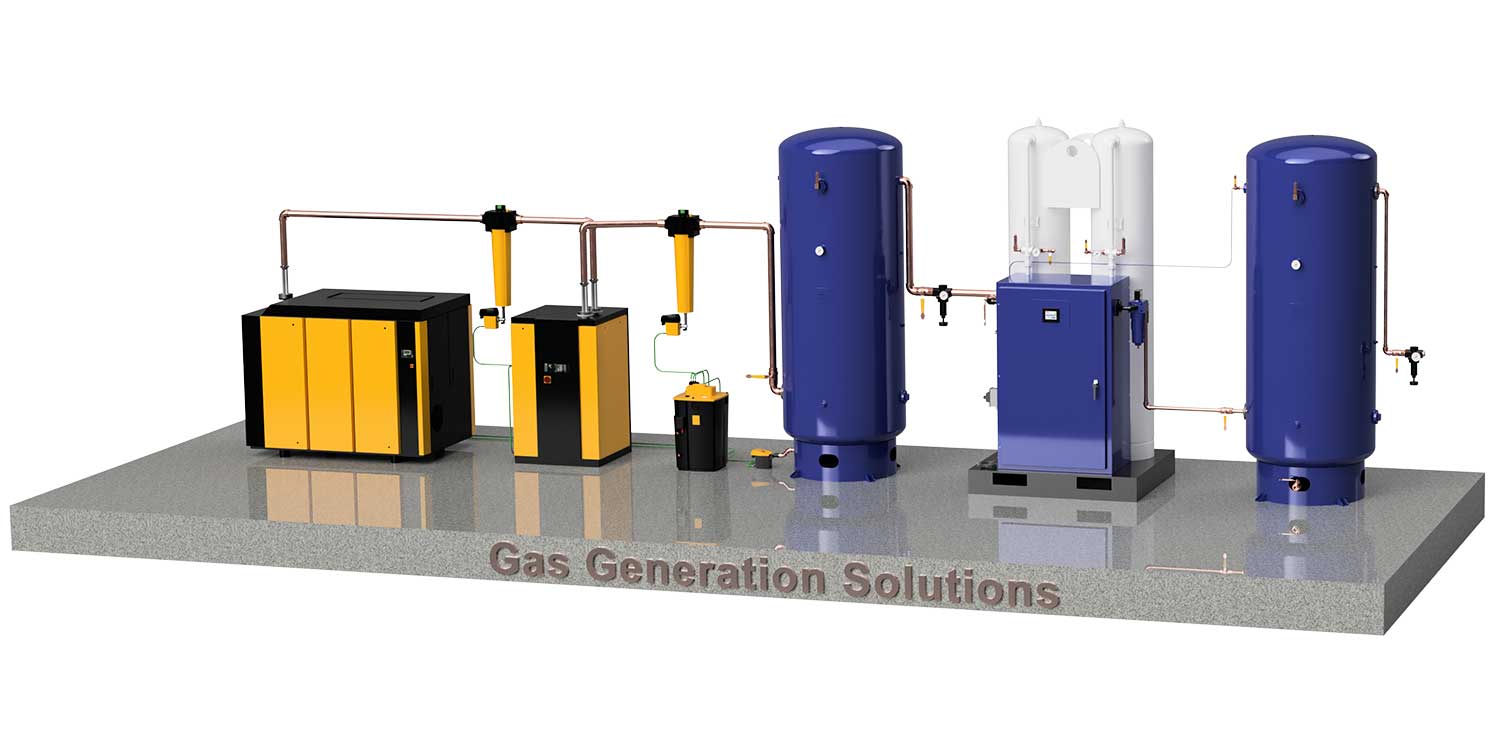
How pressure swing adsorption nitrogen generation separates nitrogen from air
Step 01
Air enters Bed A
Compressed air at 100 to 145 PSI flows into the first adsorber vessel (Bed A), which is packed with carbon molecular sieve.
Step 02
CMS traps oxygen
Carbon molecular sieve's pores adsorb oxygen and moisture molecules while allowing nitrogen to pass through to a buffer tank.
Step 03
Bed A saturates
As Bed A fills with adsorbed oxygen, it reaches saturation. The control system depressurizes it, flushing oxygen out the vent while Bed B takes over.
Step 04
Two beds alternate
The two beds swing back and forth, typically every 30 to 120 seconds, producing a steady, continuous nitrogen flow.
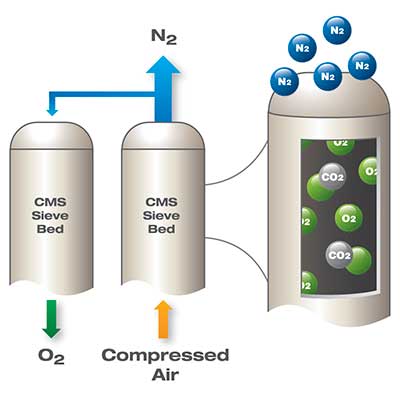
No chemicals, no waste. The swing cycle is entirely mechanical. The carbon molecular sieve regenerates itself by pressure swing alone, with no consumable cartridges or chemical regeneration needed.
What carbon molecular sieve actually does
CMS material
Porous carbon with pore sizes calibrated to admit oxygen molecules but largely block nitrogen. The selective structure is the reason PSA works at all.
Two-bed swing
Pressurization adsorbs O2 and H2O in Bed A while nitrogen exits to the buffer tank. Depressurization regenerates Bed A, flushing adsorbates to the atmosphere.
Buffer tank role
Smooths the pulsed output from the two beds into a steady nitrogen supply. Acts as a pulse damper and storage reservoir for flow consistency.
Regeneration
No chemicals, no consumables. The bed regenerates by pressure swing alone. Once depressurized, the adsorbed oxygen and moisture leave the pores naturally.
Service life
CMS itself runs 15 to 20+ years if compressed air is properly dried and filtered. Contaminated air shortens CMS life; proper pre-treatment is essential.
PSA vs membrane: how to choose
| Factor | PSA | Membrane |
|---|---|---|
| Purity range | 95% to 99.9995% | 95% to 99.5% |
| Service life | 20+ years | 5 to 7 years |
| Footprint | Larger | Smaller |
| Air-to-N2 ratio | Lower (more air-efficient) | Higher (needs more air per unit of N2) |
| Best fit | High purity: electronics, lasers, pharma, food | Low purity: fire suppression, tire inflation, marine inerting |
| Cost model | Higher upfront, lower per-CCF | Lower upfront, higher per-CCF |
Full side-by-side breakdown: PSA vs membrane nitrogen generators
Or go deeper on the other technology: membrane nitrogen generators
Where PSA fits best
Food & beverage packaging
PSA nitrogen prevents oxidation, extends shelf life, and maintains product quality in cheese, snacks, wine, and dairy applications.
Electronics & soldering
High-purity nitrogen creates inert atmospheres for wave soldering, reflow ovens, and component manufacturing with zero oxidation risk.
Laser cutting
PSA generators deliver the consistent, clean nitrogen flow that laser systems require for cutting metal, acrylic, and composite materials.
Pharmaceutical & biotech
Ultrahigh purity nitrogen from PSA systems meets pharmaceutical manufacturing, testing, and storage requirements with consistent, monitored purity.
Heat treating
On-site PSA nitrogen protects metal parts during annealing, hardening, and other thermal processes, preventing surface degradation.
Lab & analytical
Gas chromatography, mass spectrometry, and analytical instruments depend on stable, high-purity nitrogen from on-site PSA generation.
Sizing
How to size a PSA nitrogen generator
Three numbers size a PSA system: how much nitrogen you use per hour, how pure it has to be, and what pressure it has to arrive at. Send those three and we can usually return a full quotation the same day.
Number 01
Flow
We supply PSA systems from 40 SCFH to 100,000 SCFH per unit, and units chain together for higher flow. In metric that is roughly 1 to 2,600 Nm³/h.
Most sites do not know their real draw. That is normal, and it is the number worth measuring rather than estimating.
Number 02
Purity
PSA reaches 95% up to 99.9995%. Purity is the number that drives cost, because higher purity rejects more air per unit of nitrogen.
Specify the purity your process actually needs, not the highest one available. The difference shows up in the compressor.
Number 03
Pressure
Standard PSA systems accept up to 145 PSIG inlet. A high-pressure adder takes that to 185 PSIG inlet.
Applications needing more at the use point, like laser cutting or cylinder filling, add a booster stage downstream of the generator.
Working in metric?
Most nitrogen specs outside North America are written in normal cubic meters per hour. We quote in both. At 70°F ambient, 1 Nm³/h is about 38 SCFH.
What purity costs you in compressed air
A PSA generator separates nitrogen from compressed air and vents the oxygen-rich remainder, so the compressor always supplies more air than the nitrogen you draw. The ratio climbs steeply with purity, and the compressor is a large part of the capital cost. Two common metric requirements, worked through:
| Requirement | Nitrogen flow | Air per unit of nitrogen | Compressed air needed |
|---|---|---|---|
| 100 Nm³/h at 95% | 3,800 SCFH (63 SCFM) | about 2 to 1 | about 127 SCFM |
| 100 Nm³/h at 99.9% | 3,800 SCFH (63 SCFM) | about 4 to 1 | about 266 SCFM |
| 300 Nm³/h at 95% | 11,400 SCFH (190 SCFM) | about 2 to 1 | about 380 SCFM |
| 300 Nm³/h at 99.9% | 11,400 SCFH (190 SCFM) | about 4 to 1 | about 800 SCFM |
Read the last column as the cost driver. The same 100 Nm³/h costs roughly twice the compressed air at 99.9% as it does at 95%, and that is a bigger compressor, a bigger dryer, and more filtration. At 99.9995% the ratio reaches about 6 to 1. This is why two quotes at the same flow rate can be far apart: purity, not flow, is usually what moves the number.
Not sure what you actually use? We ship a free flow meter sized to your expected demand. It carries a cellular data logger, so your flow rate streams to a live dashboard with no WiFi needed at your facility. Return shipping is on you; the meter and the data are not.
Send your flow, purity, and pressureFrequently asked questions
What does PSA stand for in nitrogen generation?
PSA stands for Pressure Swing Adsorption. It is a mechanical separation technology that uses carbon molecular sieve (CMS) to selectively adsorb oxygen and moisture from compressed air, allowing nitrogen to pass through. The two-bed swing cycle regenerates the adsorbent by depressurization, with no chemical consumables needed.
How does a PSA nitrogen generator work?
Compressed air enters Bed A, where carbon molecular sieve traps oxygen and moisture, allowing nitrogen to exit to a buffer tank. When Bed A saturates, the system depressurizes it, flushing adsorbates to the atmosphere while Bed B takes over. The two beds alternate every 30 to 120 seconds, producing continuous nitrogen flow. No chemicals are involved in the process.
What is a carbon molecular sieve and why do PSA generators use it?
Carbon molecular sieve is porous carbon with pores calibrated to absorb oxygen molecules while mostly blocking nitrogen. This selective affinity is what makes PSA separation work. CMS regenerates by pressure swing alone, with no consumable cartridges or chemical treatment needed, making it ideal for continuous, low-cost on-site nitrogen generation.
How long does a PSA nitrogen generator last?
A well-maintained PSA generator runs 20 years or more. The carbon molecular sieve itself lasts 15 to 20+ years if the compressed air supply is properly dried and filtered. The key to longevity is preventing moisture and particulate contamination of the CMS beds through upstream air treatment.
What purity can a PSA nitrogen generator produce?
PSA generators deliver nitrogen from 95% up to 99.9995% purity, depending on the system configuration. Lower purity levels require less adsorbent material and compress quickly. Ultra-high purity (99.9995%) systems are used in electronics, laser cutting, pharmaceutical manufacturing, and other precision applications requiring near-absolute gas cleanliness.
How much compressed air does a PSA nitrogen generator need?
PSA generators typically operate at 100 to 145 PSI inlet pressure and consume compressed air in proportion to their nitrogen output and target purity. As a rule of thumb, producing nitrogen at 95% purity takes roughly 2 SCFM of compressed air per SCFM of nitrogen, while 99.9995% purity takes about 6 SCFM of air per SCFM of nitrogen, because higher purity requires more air. Your air compressor and dryer must be sized for both the peak demand and the drying duty. We recommend sending us your application details for a proper sizing calculation.
PSA versus membrane, which is better for my application?
Choose PSA if you need high purity (above 99% nitrogen), long service life (20+ years), or are generating nitrogen frequently at high flow. PSA is ideal for food packaging, electronics, laser cutting, pharma, and heat treating. Choose membrane if you need low purity nitrogen (95% to 99.5%), want a compact system, or only generate nitrogen occasionally. Membrane systems are smaller and lower upfront cost but have a 5 to 7 year lifespan and higher operating cost per unit of gas.
How much does a PSA nitrogen generator cost?
PSA nitrogen generators range from about $15,000 for small laboratory systems to over $500,000 for high-flow industrial systems. Most small and mid-market applications fall between $15,000 and $100,000, with high-flow industrial systems reaching $500,000 or more. The actual cost depends on flow rate, purity requirement, and system configuration. The payback period is typically 12 to 14 months when replacing bulk, cylinder, or dewar nitrogen deliveries.