
On-Site Oxygen for Aquaculture, Ozone, Wastewater, and Industrial Process
On-Site Oxygen Generator
PSA oxygen generators that pull continuous 90 to 99 percent oxygen from compressed air. One on-site source replaces cylinder swaps, dewar deliveries, and bulk liquid contracts at fish farms, ozone plants, wastewater facilities, glassblowing studios, brazing lines, dairy biogas digesters, and clinical sites.
Standard and HP purity
Continuous purity verification
Typical payback
Service life
PSA Oxygen at Industrial Scale
High-volume oxygen users have a delivery problem
A fish farm running diffused aeration on a salmon raceway, an ozone plant feeding municipal disinfection at a treatment facility, a glassblowing studio firing daily on a single-burner setup, or a dairy biogas digester scrubbing hydrogen sulfide before the engine package all consume oxygen continuously. Cylinder bottles run out and have to be swapped on a schedule. Bulk liquid oxygen has delivery surcharges, evaporation loss, and rental costs on the storage tank. The oxygen molecule is the same; the supply chain is what costs money. On-site PSA generation removes the supply chain.
PSA oxygen is the same nitrogen-from-air technology run in reverse. Compressed air enters a vessel of zeolite molecular sieve, which adsorbs nitrogen and lets oxygen pass through to a buffer tank. The buffer feeds the application continuously at the purity dialed in for the use case. Standard line runs at 95 percent plus or minus 1 percent and serves the great majority of industrial oxygen demand. A separate HP line runs at 99 percent plus or minus 1 percent for applications that need the higher purity, including research support gases, certain veterinary oxygen, and semiconductor-adjacent uses.
Switching from delivered oxygen to on-site replaces a per-cubic-foot variable cost with a fixed equipment investment that amortizes in 12 to 14 months at typical industrial duty cycles. The systems are engineered to run for 20 years or more. Every system we supply includes a built-in oxygen analyzer that reads continuous purity off the buffer tank, so you can verify output without adding instrumentation.
Oxygen for Veterinary and Animal Care
For oxygen on the clinical side: surgical and recovery oxygen for small-animal practices, equine clinics, and aquatic veterinary facilities. The complementary clinical page covers veterinary oxygen at 95 percent plus or minus 1 percent.
Open the veterinary page →Oxygen for Dairy Farm Biogas Digesters
For oxygen on the agricultural side: micro-aeration of biogas headspace to scrub hydrogen sulfide before the genset or boiler. The complementary agricultural page covers H2S removal and dairy digester biogas treatment.
Open the dairy digesters page →Sample Oxygen Generator
PSA oxygen generator system
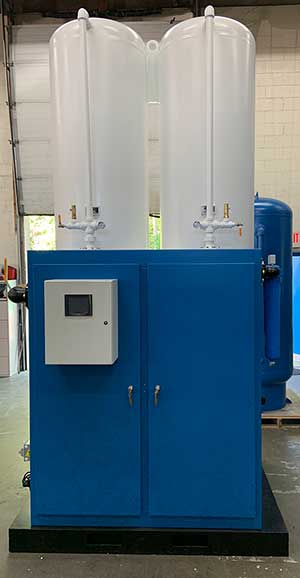
PSA oxygen generator system in our standard configuration. The integrated package combines compressor connections, sieve beds, controls, and buffer tank capacity sized to the application duty.
Where On-Site Oxygen Replaces Delivered Supply
Six application bands the standard PSA line covers
Aquaculture and Fish Farming
93 to 95% O2 / continuous
Diffused aeration on raceways, RAS tanks, hatcheries, and live-haul transport. Higher dissolved oxygen lets you stock at higher density without lowering survival, which raises pond throughput on the same footprint.
Ozone Generation
90 to 95% O2 / continuous
Feed gas to corona-discharge ozone generators for municipal water disinfection, pulp and paper bleaching, food processing sanitation, and aquaculture water treatment. Higher feed purity yields more ozone per kWh.
Wastewater Aeration
90 to 93% O2 / continuous
High-purity oxygen aeration in activated sludge basins, MBR systems, and side-stream treatment. Pure oxygen aeration cuts blower energy compared to atmospheric air and shrinks the basin footprint required to hit BOD targets.
Glassblowing and Brazing
93 to 95% O2 / per-burner sized
Oxy-fuel torches in glassblowing studios, lampwork shops, scientific glassblowing labs, and brazing benches. Replaces high-pressure cylinder swap cycles with continuous flow at consistent pressure.
Dairy Biogas and H2S Scrubbing
90 to 93% O2 / micro-aeration
Micro-aeration of digester headspace converts hydrogen sulfide to elemental sulfur biologically, cutting H2S concentrations before the engine, boiler, or upgrading skid. Extends genset life and reduces scrubber media consumption.
Dairy digesters page →Veterinary and Animal Health
95% +/- 1% O2 / wall-manifold supply
Surgical and recovery oxygen for small-animal practices, equine and large-animal clinics, and aquatic veterinary care. Continuous supply at the wall manifold replaces the cylinder cabinet and the swap-day gap.
Veterinary page →Pick the Purity, Pay for the Air
Four oxygen purity tiers and what each one costs in compressed air
Higher oxygen purity needs more compressed air per cubic foot of product. The air-to-oxygen ratio (A/O) sets the compressor sizing and the long-term electricity bill. Specifying purity higher than the application requires inflates both equipment cost and operating cost. Walking down to the right tier is usually the right move.
Aeration Floor
Wastewater aeration, ozone feed where the corona-discharge generator tolerates the lower purity, low-end aquaculture.
Industry Minimum
Industry minimum for medical oxygen, dairy biogas H2S scrubbing, mid-tier aquaculture and ozone feed.
Standard Line
Standard PSA nameplate at 95 percent plus or minus 1 percent. Fish farming, glassblowing and brazing, veterinary surgical and recovery oxygen.
HP Line
Dedicated high-purity product line for research support gases, semiconductor-adjacent uses, advanced industrial process oxygen.
PSA pulls oxygen from compressed air
A two-bed PSA system uses zeolite molecular sieve to adsorb nitrogen out of compressed air. One bed is producing oxygen while the other is regenerating at low pressure. The beds swing every few seconds. The result is a continuous oxygen-rich product stream that fills the buffer tank for the application. No on-site air separation, no cryogenic infrastructure, no liquid handling.
A/O ratio is the cost-of-purity dial
Going from 90 percent to 99 percent oxygen takes the A/O ratio from about 11 to about 19, almost a doubling. The compressor either gets bigger or runs longer to deliver that air. The right rule for sizing is to specify the lowest purity the application actually needs. Wastewater treatment does not need 99 percent, glassblowing does not need 99 percent, and most veterinary clinics size at 95 percent.
What Delivered Oxygen Actually Costs
Four failure modes on-site generation removes
Cylinder swap gaps interrupt the application
A cylinder cabinet running aquaculture diffusers, an ozone feed line, or a glassblowing torch hits empty on a schedule. The swap window is a flow interruption. Continuous on-site supply at the manifold removes the swap from the operating plan.
Bulk delivery surcharges and rentals add up
Bulk liquid oxygen carries delivery fees, fuel surcharges, hazmat fees, and a recurring tank rental on top of the per-cubic-foot rate. Cylinder and dewar accounts add per-unit handling, swap labor, and demurrage. The all-in cost of every delivered format sits well above the on-site cost of producing the same oxygen from compressed air.
Dewar boil-off is paid for and not recovered
Liquid oxygen dewars boil off in storage. The supplier returns to collect the dewar with residual liquid still in it, and that residual is not credited back. Continuous on-site generation produces only what the application is consuming, so there is no boil-off loss.
Spec'd above the actual purity need
A site that asks for 99 percent oxygen when the application runs cleanly at 93 percent is paying the air-to-oxygen ratio penalty in compressor sizing and electricity. Walking the spec down the purity column to the actual need typically meaningfully reduces compressor sizing and electricity use over the system life.
Sizing and Payback
Three numbers size the system, three numbers run the payback
What you need to tell us to size correctly
Input 1
Flow rate (SCFH)
Continuous oxygen demand at the application, in standard cubic feet per hour. If you only have a delivery record, divide cubic feet per month by hours per month of operation, or send us the records and we will work it out.
Input 2
Purity required
The minimum purity the application actually needs, not the highest purity that has ever been quoted to you. 90 percent for aeration, 93 percent for medical industry minimum, 95 percent for most clinical and industrial uses, 99 percent for HP-line builds.
Input 3
Existing compressed air supply
If you already have a shop air compressor, send us the model and SCFM rating. The PSA generator runs at 80 PSI maximum inlet, lower than nitrogen systems. We will tell you whether your existing compressor covers the duty or whether the quote needs to include compressed air.
What drives the 12 to 14 month payback
Driver 1
Per-CCF cost gap
Cylinder oxygen runs $6 to $10 per CCF all-in, dewars run $4 to $6 per CCF, bulk liquid oxygen runs $0.50 to $1.50 per CCF. On-site PSA oxygen runs $0.05 to $0.15 per CCF in compressed air and electricity. The per-CCF gap is the money on the table.
Driver 2
Duty cycle
The higher the operating duty, the faster the payback. A 24 by 7 ozone plant or a continuous wastewater aeration loop pays back faster than a glassblowing studio firing 6 hours a day, 5 days a week. Both still pay back.
Driver 3
Avoided fees and rentals
Tank rental on bulk liquid, hazmat fees, fuel surcharges, dewar handling, and cylinder swap labor are all line items that go to zero on an on-site system. They show up in the avoided-cost column of the payback calculation.
Worked Example
200 SCFH at 95 percent for a mid-size aquaculture site
Site uses 200 SCFH continuous for 16 hours a day, 22 days a month. That works out to about 70,400 cubic feet of oxygen per month, or 704 CCF.
Delivered cost at $5.00 per CCF (mid-range dewar): about $3,520 per month. On-site cost at $0.10 per CCF (compressed air plus electricity): about $70 per month. Monthly delta: about $3,450. Annual savings: about $41,400.
Equipment investment for a system sized to this duty falls in the small-industrial tier described in our catalog. With annual savings on the order of $40,000 against a small-class equipment investment, payback typically lands inside the standard 12 to 14 month window. After payback, the system runs for the rest of its 20 plus year service life on the same per-CCF cost basis.
Not sure of your oxygen demand?
Give us a call and we can go over your deliveries and usage to help determine a baseline before we size the system.
On-Site Oxygen Generator FAQ
Common questions about on-site PSA oxygen generators
What purity can a PSA oxygen generator produce?
The standard PSA oxygen line produces 95 percent plus or minus 1 percent oxygen continuously, and a separate HP product line reaches 99 percent plus or minus 1 percent. Lower purity bands of 90 percent and 93 percent are also achievable on the standard line and are commonly used for wastewater aeration, ozone feed, and dairy biogas H2S scrubbing where the application does not need the higher purity. For specialized low-purity applications, the standard line can be configured down to 60 percent.
How does an on-site oxygen generator compare in cost to delivered oxygen?
On-site PSA oxygen typically runs $0.05 to $0.15 per cubic foot in compressed air and electricity. Cylinder oxygen runs $6 to $10 per cubic foot all-in. Dewar oxygen runs $4 to $6 per cubic foot. Bulk liquid oxygen runs $0.50 to $1.50 per cubic foot. The all-in operating cost gap is what funds the 12 to 14 month payback typical for industrial duty cycles.
What is the typical payback period?
12 to 14 months at typical industrial duty cycles. Higher-duty applications such as 24 by 7 ozone plants or continuous wastewater aeration can pay back faster. Lower-duty applications like a glassblowing studio firing 6 hours a day still pay back, just over a longer window. The flow rate, the purity, and the per-cubic-foot delivered cost being replaced are the three numbers that set the timeline.
How long do on-site oxygen generators last?
20 years or more in normal continuous service. The PSA process has no rotating parts in the generator itself, since the compressor is the only component with moving parts at scale, and it is treated as a separate maintenance item. Sieve beds are sealed and do not require periodic top-off. Routine maintenance is mainly filter changes on the air-treatment side.
Which industries use on-site PSA oxygen?
Aquaculture and fish farming, ozone generation for water treatment and pulp and paper, wastewater aeration in activated sludge and MBR systems, glassblowing and brazing, dairy biogas H2S scrubbing, veterinary and animal health, research labs that use oxygen as a process gas, and certain semiconductor support gas applications. The standard 95 percent line covers most non-medical industrial duty.
Do I need a special air compressor?
A PSA oxygen generator runs at 80 PSI maximum inlet pressure, which is lower than nitrogen systems run at. If you already have a shop air compressor, send us the model and SCFM rating and we will tell you whether your existing supply covers the duty. If the existing compressor is too small or the wrong pressure profile, the quote will include a properly sized compressor and air-treatment package.
Can I check my oxygen purity continuously?
Yes. Every system we supply includes a built-in oxygen analyzer that reads continuous purity off the buffer tank. The analyzer output is available at the generator panel and can be wired to a remote indicator or building management system for plants that want continuous logging without buying separate instrumentation.
What is the difference between the standard line and the HP line?
The standard line runs at 95 percent plus or minus 1 percent and covers the great majority of industrial oxygen demand. The HP line is a separate product engineered specifically for 99 percent plus or minus 1 percent purity. The HP line uses more sieve material, more compressor headroom, and an integrated oxygen tank package, so it carries roughly a three to four times price premium at comparable nominal sizes. Specify HP only when the application actually needs 99 percent.
Get an On-Site Oxygen Quote
Tell us your flow, purity, and existing compressed air
A quote takes three numbers and a description of the application. If any of the three are unknown, give us a call and we can go over your deliveries and usage to help determine a baseline before sizing.
- Flow rate in SCFH (or your existing monthly delivery in cubic feet)
- Purity required (90, 93, 95, or 99 percent)
- Existing compressed air supply (compressor model and SCFM rating, if any)
- Application (aquaculture, ozone, wastewater, glassblowing, biogas, veterinary, other)
We supply on-site oxygen across these industries
Aquaculture and fish farming, ozone generation, wastewater treatment, glassblowing and brazing, dairy biogas, veterinary and animal health, research labs, and industrial process oxygen. Service area covers the United States, Mexico, and Canada.