Reflow Soldering
Nitrogen Generator for Reflow Soldering
Inert reflow atmosphere helps prevent tombstoning, reduces BGA voids, and improves wetting on fine-pitch SMT assemblies.
Purity range
Single oven to full assembly line
Typical payback
Service life

Nitrogen is essential in reflow soldering because it displaces oxygen during the paste-melting phase, helping minimize oxidation of solder and flux while the joint forms. Without inert atmosphere, oxygen oxidizes the solder surface, blocking wetting action and causing defects like tombstoning on small passives and voids in BGA packages.
Gas Generation Solutions supplies on-site nitrogen generators sized for reflow belt ovens, from compact 15-foot lines to high-volume 60-foot tunnels. Our PSA systems deliver the consistent high-purity nitrogen that modern SMT assembly demands. Most customers cut nitrogen costs by up to 90% compared to bulk supply while improving solder quality and reducing defect rework.
Below, we explain the reflow profile and nitrogen's role in each stage, show the defects nitrogen helps prevent, and walk you through sizing, flow requirements, and installation fundamentals.
How nitrogen works in the reflow profile
Preheat (150–200°C)
Nitrogen begins displacing oxygen in the oven chamber. The inert gas blanket reduces oxygen exposure as board temperature climbs and solder paste thermally cycles.
Soak (200–240°C)
Flux activates and reduces existing oxides on component leads and pads. Nitrogen atmosphere helps minimize new oxide formation while flux chemistry works, supporting clean surfaces.
Reflow (peak ~250°C)
Solder melts at peak temperature. Nitrogen keeps the molten pool oxide-free, lowers surface tension for better wetting, and reduces dross formation. Components stay in place without bridging.
Cooling (<100°C)
Joints solidify within a nitrogen-rich environment, producing shiny, oxide-free connections. Nitrogen supply continues until board exits the oven to minimize oxidation during cool-down.
Defects nitrogen helps prevent in reflow soldering
Tombstoning on chip resistors and capacitors
When oxygen oxidizes solder on one pad before the other, uneven surface tension causes 0402 and 0603 passives to stand on end during reflow. Nitrogen minimizes the oxide imbalance, helping keep small passives flat through reflow.
BGA voids and head-on-pillow on fine-pitch
Oxide trapped in BGA solder balls during reflow creates internal voids. Nitrogen minimizes oxide formation, reducing internal void rate and helping prevent head-on-pillow movement on 0.4mm pitch packages.
Bridging and solder balling on dense pitch
Oxidized paste has higher viscosity and is prone to bridge (shorts between adjacent pads) and form solder balls on underfill. Oxide-free solder flows freely, wets cleanly, and avoids bridging on fine-pitch BGA and QFN patterns.
Dewetting and dull joint appearance
Oxygen-induced oxide layer blocks solder wetting action, leaving dull, grainy joints with poor contact and reduced electrical and mechanical strength. Nitrogen produces shiny, fully-wetted connections with high reliability.
Customer installations
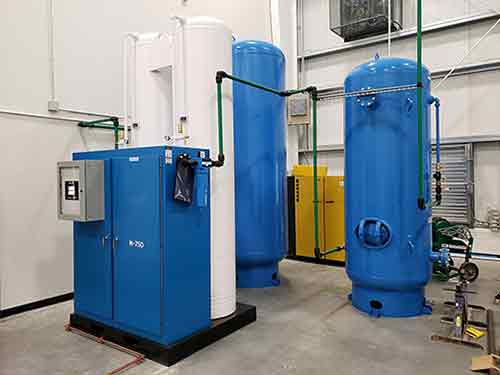
N750 reflow generator delivering over 3,000 SCFH to medium-volume belt oven, maintaining inert atmosphere during paste reflow.
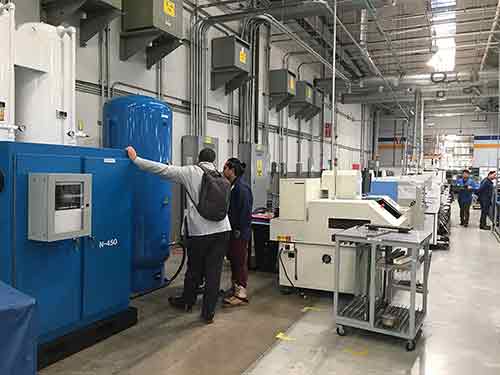
N450 compact system for smaller reflow lines, ideal for rapid prototyping and lower-volume production runs.
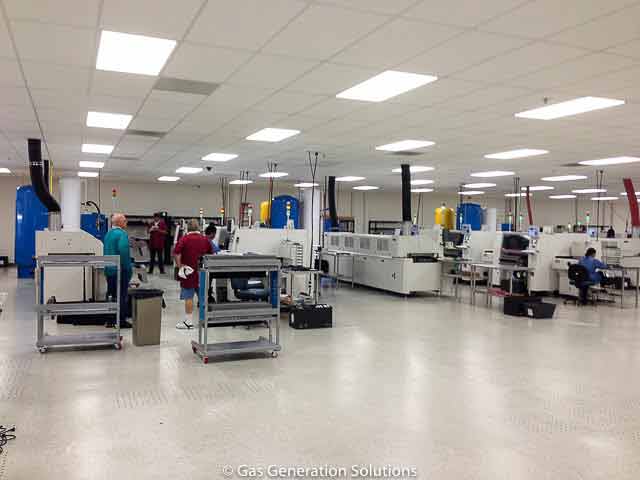
Three N300 units in parallel supply high-volume reflow line requiring 5,000+ SCFH continuous nitrogen.
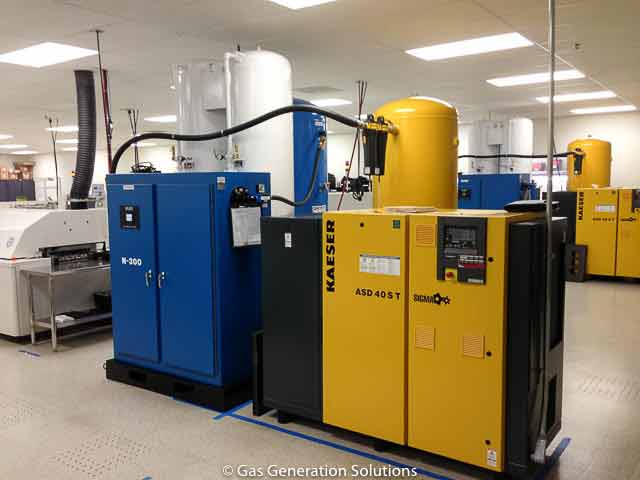
Reflow oven with integrated nitrogen supply, demonstrating seamless oven-to-generator integration for consistent purity and flow.
Reflow soldering applications across electronics
SMT PCB assembly
Automated placement and reflow of surface-mount components (0402-BGA) on double-sided boards. Nitrogen essential for high-speed lines, fine-pitch placement, and first-pass yield.
Automotive ECU and sensor boards
Engine control units, power management, and sensor interface boards. Automotive electronics must meet AEC-Q qualification and demand defect-free BGA and QFN assembly; nitrogen helps prevent tombstoning and minimizes BGA voids.
Telecom and data center boards
Optical transceivers, switch fabric, and router backplanes. High-frequency and RF boards require pristine solder joints; nitrogen helps prevent bridging on dense-pitch assemblies.
Military and aerospace avionics
Class 3 IPC standards, space qualification, and combat systems. Mil/aero reflow lines typically run at the top of the reflow range (99.99%) with continuous process monitoring.
Medical device electronics
Implants, diagnostic instruments, patient monitors. Medical reliability standards require zero-defect assembly; nitrogen-assisted reflow helps deliver repeatable, high-yield production.
Consumer and IoT electronics
Smartphones, wearables, smart home, and connected devices. High-volume consumer production benefits from reduced defects, lower rework costs, and improved supply-chain economics.
Frequently asked questions
What purity does reflow soldering need?
Reflow soldering typically requires 99.9% to 99.99% nitrogen. The higher the purity within that range, the fewer oxide defects form during the reflow profile. Standard commercial reflow lines run 99.9%; fine-pitch assembly (0.4mm BGA and smaller) and automotive or aerospace boards typically run at the top of the range, 99.99%. Our PSA systems can deliver up to 99.9995% for specialty applications requiring purity above the typical reflow range. Contact us with your oven specifications, line speed, and target oxygen level so we can recommend the right tier.
How does nitrogen help prevent tombstoning?
Tombstoning occurs when one pad oxidizes before the other, creating uneven surface tension on the molten solder. The component stands on end at one corner. Nitrogen displaces oxygen during reflow, helping minimize oxidation of the solder surface, keeping surface tension more balanced across both pads, and holding small passives flat throughout the process.
Does fine-pitch BGA assembly need higher purity nitrogen?
Yes. Fine-pitch BGA packages (0.4mm pitch and smaller) trap oxide inside solder balls during reflow if purity is too low. Running at the top of the reflow range, 99.99%, keeps oxide formation to near-zero levels, minimizing internal voids and preventing head-on-pillow movement. We recommend 99.99% for all BGA assembly below 0.5mm pitch.
How much flow does my reflow oven need?
Flow demand depends on the oven model, chamber volume, belt speed, and target oxygen level inside the oven. Most production reflow ovens consume 500 to 2,500 SCFH per oven, with multi-line facilities paralleling generators to 40,000 SCFH or more. We maintain a published flow-rate table covering major OEM reflow ovens (Kurtz Ersa, BTU, Vitronics, JUKI, Electrovert, Heller, SEHO, and others) at our reflow soldering equipment nitrogen flow rates page. Contact us with your oven model and we will size a system to match your demand.
Can I add a nitrogen generator to my existing reflow oven?
Nitrogen-ready reflow ovens accept generator-supplied nitrogen without modification to the oven. Most modern reflow ovens are nitrogen-ready out of the box. Integration involves running a supply line from the generator and connecting to the oven's nitrogen inlet. Our nitrogen systems are compatible with all major reflow OEMs, including Kurtz Ersa, BTU, Vitronics, JUKI, Electrovert, Heller, SEHO, Alpha 1, and DDM Novastar. Contact us with the oven model and current atmospheric setup, and we will advise on integration and sizing.
How does on-site nitrogen compare to dewars and bulk LIN for reflow?
Cylinders cost 6 to 10 dollars per hundred cubic feet, dewars cost 4 to 6 dollars per CCF, and bulk LIN costs 0.50 to 1.50 dollars per CCF. On-site generation costs just 0.05 to 0.15 dollars per CCF, delivering up to 90 percent savings. Most customers recover their investment within 12 to 14 months. Ongoing savings continue for the 20+ year life of the system, plus you eliminate logistics overhead and downtime from supply interruption.
What is dew point and why does it matter for reflow?
Dew point is the temperature at which moisture condenses. High dew point nitrogen introduces water into the solder joint, causing oxidation and joint degradation. Reflow soldering requires dry nitrogen at minus 40 dew point or better. PSA generators produce dry nitrogen if the upstream compressed air supply is properly dried and filtered. Inadequate air treatment is a common issue; we design air drying into every system to prevent moisture contamination.
Who installs and maintains the system?
Gas Generation Solutions designs and supplies the on-site nitrogen system, sized for your reflow oven and line speed. Installation is handled by the customer's qualified mechanical and electrical contractors at the customer's site, since site conditions and reflow line layouts vary. We support the project with sizing, system drawings, startup procedures, and operator training. Routine maintenance, mainly filter changes, is performed by the customer; we supply replacement parts and technical guidance throughout the system's 20-year service life. If you want installation included in the quote, we can scope it as a separate line item. Contact us with your oven model, chamber volume, and belt speed for sizing.