
Food & Beverage
Food Grade Nitrogen Gas Generators
On-site nitrogen for food packaging, dairy, cheese, wine, coffee, snack food, and pet food. 99.5% to 99.9% purity for every food and beverage application, with food grade filtration that meets FDA, USDA, and GFSI requirements. Up to 90% lower gas cost than delivered nitrogen. Most plants pay back in 12 to 14 months.
What we do
A food grade nitrogen generator produces inert nitrogen gas on-site for food and beverage manufacturing, packaging, and storage. Gas Generation Solutions designs and installs food grade nitrogen systems for food packagers, dairy plants, wineries, breweries, coffee roasters, snack food processors, cannabis packagers, pet food manufacturers, and fresh produce packers across the United States, Mexico, and Canada. Incorporated in 1979, we have over 40 years of industry experience. Our systems cut gas costs by up to 90% versus delivered nitrogen and most pay back in 12 to 14 months.
Deployed Systems
Food grade nitrogen generators running in production at customer sites across dairy, coffee, and wine.
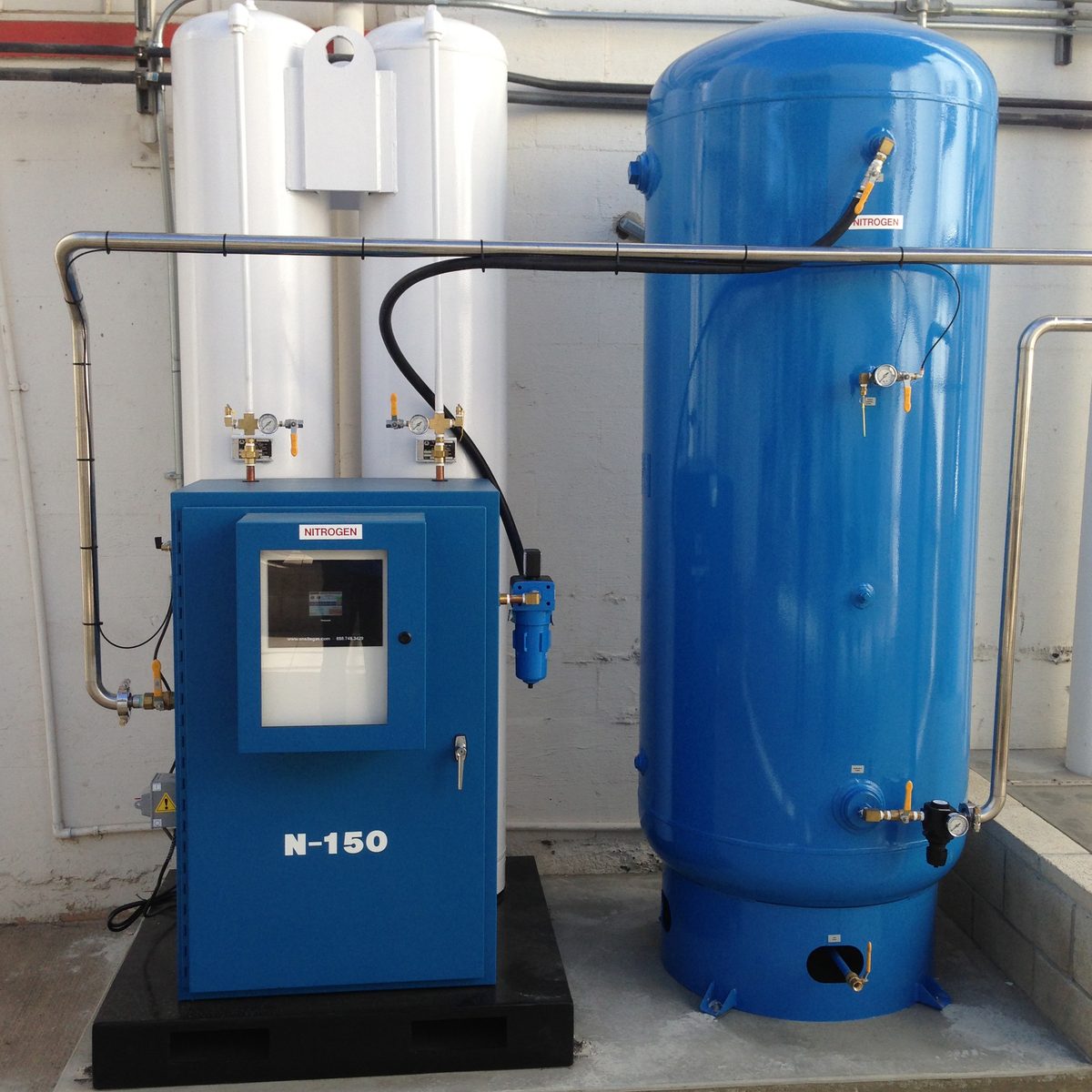
N-150 · Dairy & cheese packaging
Modified atmosphere packaging (MAP)
On-site nitrogen up to 99.9% purity for shelf-life extension and oxygen exclusion.
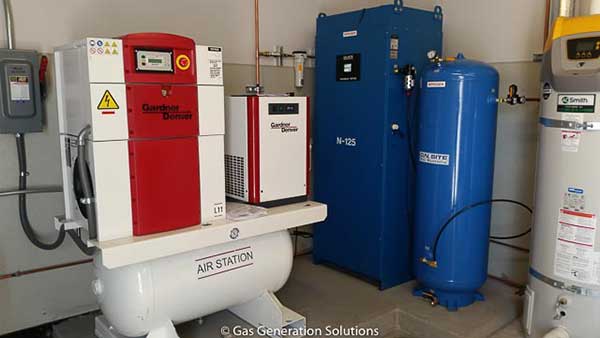
N-125 · Coffee packaging
Whole bean, ground, and pod inerting
On-site nitrogen at 99.5% purity for oxidation and rancidity control on roasted coffee.
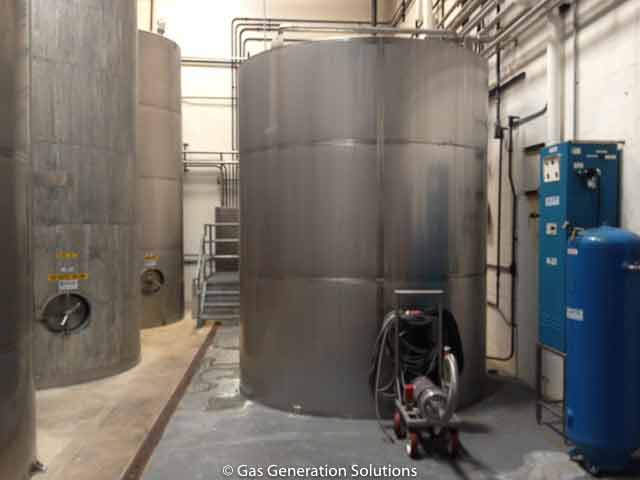
Winery install · Wine
Tank blanketing, sparging, bottling
On-site nitrogen up to 99.9% purity for dissolved oxygen control and bottle headspace inerting.
Food grade standards
What qualifies a nitrogen generator as food grade
Qualification
99% or higher purity plus food grade filtration
A nitrogen generator is considered food grade when it produces at least 99% pure nitrogen (1% or less residual oxygen) and uses inlet filtration that meets food industry air quality standards at the point of use. Food grade systems include coalescing, carbon, and particulate filters that remove oil, water, hydrocarbons, and particulates from the compressed air stream before the PSA module.
- FDA 21 CFR 184.1540:nitrogen as a Generally Recognized As Safe food additive
- USDA FSIS Directive 7120.1:ingredients allowed in meat and poultry production
- ISO 8573-1:compressed air purity specifications
- GFSI schemes:SQF, BRC, FSSC 22000 documentation expectations
F&B purity tiers
Two purity tiers cover every food and beverage application
5,000 ppm O₂
Most food packaging: shredded cheese, snack food, salad, condiments, coffee, pet food, chips, popcorn, seasoning packets, nuts, and most MAP under standard distribution.
1,000 ppm O₂
Premium tier: dairy with extended shelf life, wine bottling, high-end cheese, specialty snacks with high polyunsaturated fat, and any product needing maximum oxidation resistance.
Applications
Nitrogen across the food and beverage plant
A correctly sized on-site generator supplies every nitrogen demand in the plant from a single source.
Modified Atmosphere Packaging
100% N₂ or N₂/CO₂ blends (60/40, 70/30) for bags, trays, pouches, and cans.
Gas Flushing
Headspace purge on VFFS, HFFS, tray sealers, and thermoformer lines before seal.
Tank Blanketing
Inert layer over wine, beer, juice, oils, flavor concentrates in tanks and silos.
Sparging & DO Reduction
Strip dissolved oxygen from wine, beer, and bottled beverages during transfer.
Pipeline Purging
Clear oxygen and residual product during changeovers and startup.
Dry Ingredient Handling
Hopper, silo, pneumatic transport blanketing for powders, grains, nuts, spices.
Bulk Storage & Transport
Inert bag-in-box, totes, drums, and rail cars for cheese, coffee, oils, nuts.
Conveyor & Open-Line Inerting
Nitrogen curtains reduce O₂ exposure on cheese, meat, and bakery lines.
One generator, plant-wide supply. A single correctly sized system feeds every packaging line, every storage tank, every bulk handling station, and every process gas point of use. Adding new lines later requires only a capacity expansion, not new delivered-gas infrastructure.
Industries served
Food & beverage segments we serve
Each segment has its own page covering purity requirements, MAP blend ratios, packaging equipment, sizing ranges, and shelf life data.
Food Packaging & MAP
99.5%Modified atmosphere packaging for every food format, blend ratios, blender integration.
View pageCheese Packaging
99.5–99.9%Shredded, sliced, block, grated, bulk cheese. 60/40 and 70/30 N₂/CO₂ MAP blends.
View pageDairy & Milk Packaging
Up to 99.9%Fluid milk, cream, cultured dairy, beverages, and milk powders. Deaeration, MAP, and LN2 dosing.
View pageSnack Food Packaging
99.5%Chips, pretzels, crackers, popcorn, extruded snacks. Rancidity prevention and crush protection.
View pageWineries & Wine Bottling
99.5–99.9%Tank blanketing, sparging, bottling line inerting, dissolved oxygen control.
View pageCoffee Packaging
99.5%Whole bean, ground, and pod packaging. Oxidation and rancidity control for roasted coffee.
View pageCannabis Packaging
99.5%THC and terpene preservation in flower, pre-roll, and edible packaging.
View pageSalad & Lettuce Packaging
99.5%Respiration-rate-balanced MAP for fresh-cut produce.
View pageCondiment & Seasoning Packets
99.5%Mixed-content pouches with seeds, nuts, croutons, bacon bits, dried fruit.
View pagePet Food Packaging
99.5%Dry dog and cat food, treats, birdseed, and specialty pet products.
View pageEquipment compatibility
Built for every major food packaging OEM
Our food grade nitrogen generators supply packaging equipment from every major food industry OEM. Each machine has its own inlet pressure, flow, and purity spec; we review the spec sheet, match the generator output, and confirm compatibility before quoting.
Sizing & ROI
Sized to your real demand, paid back in 12 to 14 months
Plant size tiers
Typical nitrogen consumption ranges
Artisanal & craft
Small winery, specialty cheese, craft coffee roaster.
Mid-size regional
One to three packaging lines.
Commercial multi-line
Multiple formats or SKUs across several lines.
Large commercial plant
Whole-facility MAP, bulk tanks, process gas, redundancy.
Our free flow meter rental with cellular data logger measures actual plant consumption over days or weeks of normal production. Measured data drives sizing instead of nameplate estimates that overstate demand.
Cost & payback
Up to 90% lower gas cost vs delivered nitrogen
12–14 mo
Typical payback
20+ yr
Service life
$10,000 to $500,000+ system price range. Most mid-size F&B plants invest between $25,000 and $150,000.
Delivered nitrogen carries gas charges, cylinder rental or dewar demurrage, delivery surcharges, hazmat fees, low-pressure minimums, and 2–8% per day boil-off losses on idle liquid tanks. On-site generation eliminates every one of those line items. Recurring operating cost is electricity for compressed air plus routine filter changes.
Food safety & compliance
Audit-ready documentation for every food safety scheme
Nitrogen used in food packaging is a food-grade inert gas, listed as Generally Recognized As Safe (GRAS) under FDA 21 CFR 184.1540 and approved for meat and poultry processing under USDA FSIS Directive 7120.1. Our systems include the filtration, purity verification, and documentation required to meet GFSI schemes, HACCP programs, FSMA requirements, and export certifications.
- Inlet filter trains capture oil, water, hydrocarbons, and particulates
- Inline oxygen analyzers at point of use verify purity continuously
- Documentation pack includes commissioning records, purity verification reports, and maintenance logs
- GFSI scheme support for SQF, BRC, and FSSC 22000 audits
Maintenance
Three filter changes a year, no service contract required
Food grade nitrogen generators require minimal routine maintenance. Plant maintenance teams perform filter changes themselves. Annual filter cost is typically a few hundred dollars depending on system size.
- Every 3 months:water and dirt filter
- Every 6 months:oil filter, plus valve and safety device inspection
- Every 12 months:charcoal final filter
- Sealed sieve beds:no top-off required under normal operation
Frequently asked
Questions about food grade nitrogen generators
What makes a nitrogen generator food grade?
A nitrogen generator is considered food grade when it produces at least 99% purity (1% or less residual oxygen) and includes coalescing, carbon, and particulate filtration that meets ISO 8573-1 air-quality specifications. Food grade systems meet the requirements referenced in FDA 21 CFR 184.1540, USDA FSIS Directive 7120.1, and GFSI schemes (SQF, BRC, FSSC 22000). Purity is verified at point of use with an inline oxygen analyzer.
What purity of nitrogen is used in food and beverage applications?
Most food and beverage applications run at 99.5% nitrogen purity (5,000 ppm residual oxygen). Dairy with extended shelf life, wine bottling, and premium cheese and snack food push to 99.9% (1,000 ppm residual oxygen). Food and beverage does not require purity higher than 99.9%. Higher purity tiers are used in electronics, laser cutting, and semiconductor manufacturing, not in food.
Which food industries use on-site nitrogen generators?
Every segment of food and beverage uses on-site nitrogen generation, including food packaging, dairy and cheese, snack food, coffee, wine and beer, cannabis and CBD, salad and fresh produce, condiment and seasoning packets, pet food, bakery, confectionery, nuts and seeds, edible oils, supplements, meat and poultry, seafood, and beverage bottling.
Can one nitrogen generator supply multiple food production lines?
Yes. A single generator sized to total plant demand supplies multiple packaging lines, MAP blenders, tank blanketing stations, sparging loops, bulk storage inerting, and process gas points of use from one source. This is the standard approach for multi-line food plants and is more cost-effective than separate supplies at each line. Adding new lines later requires only a capacity expansion rather than new delivered-gas infrastructure.
How much does a food grade nitrogen generator cost?
Food grade nitrogen generators typically range from about $10,000 for a small craft or artisanal system to over $500,000 for a whole-facility plant with high flow and redundancy. Most mid-size food plants invest between $25,000 and $150,000. Price depends on flow rate, required purity, delivery pressure, and redundancy. Regardless of system size, the average payback remains 12 to 14 months, and the service life is 20 years or more.
Is on-site nitrogen gas safe for direct food contact?
Yes. Nitrogen gas is chemically inert and is listed as Generally Recognized As Safe (GRAS) under FDA 21 CFR 184.1540. It does not react with food, does not affect flavor or nutrition, and is the same gas present in ambient air at 78% concentration. On-site generation produces nitrogen at food grade purity with the same filtration and verification used for delivered food grade nitrogen. Purity is confirmed at the point of use with an inline oxygen analyzer.
Does on-site nitrogen meet FDA, USDA, and GFSI requirements?
Yes. Our food grade nitrogen generators produce gas that meets or exceeds FDA 21 CFR 184.1540 (nitrogen as a GRAS food additive), USDA FSIS Directive 7120.1 (ingredients allowed in meat and poultry production), and the purity and documentation expectations of GFSI-recognized schemes (SQF, BRC, FSSC 22000). Documentation includes commissioning records, purity verification reports, filter change logs, and inline oxygen analyzer readings suitable for food safety audits.
How long does a food grade nitrogen generator last?
Our food grade systems are designed for 20 years or more of continuous service. Sealed sieve beds do not require top-off or replacement under normal operating conditions. Competing systems using flanged sieve beds may require sieve top-off every eight to ten years, which is a significant hidden cost over the life of the equipment.
Related
Still buying cylinders or dewars for packaging? Here is the on-site alternative to delivered nitrogen and what it costs per CCF. →
Size Your Food Grade System
Borrow a flow meter. Measure your real plant demand before sizing.
We rent a flow meter at no charge, sized for food and beverage service. The meter installs inline between your current nitrogen supply and your packaging lines, with a cellular data logger so you can view flow rate and pressure in real time on our dedicated server. No WiFi required at your facility. Once we have a few weeks of data, we size the generator and storage to your real demand schedule, not a nameplate guess. Most food plants recover their full system investment inside 14 months.
Already know your flow, purity, and pressure? Send them over with your packaging equipment list and we will return a complete quotation the same day.