
What is membrane?
What Is a Membrane Nitrogen Generator?
Hollow-fiber membrane technology for low-to-mid purity nitrogen generation in a compact, lightweight footprint.
How it works95% to 99.5%
Purity range
5-7 years
Typical membrane life
Compact
Smaller footprint
Bulk-gas apps
Best fit
A membrane nitrogen generation system uses hollow-fiber polymer membranes to separate nitrogen from compressed air. The technology is based on permeation: oxygen, water vapor, and carbon dioxide diffuse through the thin polymer fiber walls at a faster rate than nitrogen. The nitrogen passes through the fiber bores into the product gas outlet, while unwanted gases vent off as waste.
Membrane systems fit best where purity requirements are modest, footprint matters, or weight is a constraint. Common applications include bulk nitrogen inerting for marine vessels, fire suppression systems, off-shore platforms, mobile nitrogen carts, tire inflation, and industrial blanketing of lower-purity gases.
If you are deciding between a membrane nitrogen generation system and PSA, or want to understand how a nitrogen generator works at a conceptual level, the sections below and the linked pages provide the technical foundation you need.
How a membrane separates nitrogen from air
Step 01
Intake and prefiltration
Compressed air enters the prefiltration train: oil coalescer, dryer, and dust filter remove contaminants and moisture.
Step 02
Membrane inlet
Clean, dry air is pressurized and forced through the bundle of hollow-fiber polymer membranes at 100-150 PSI.
Step 03
Selective permeation
Oxygen, water vapor, and CO2 permeate through the fiber walls faster than nitrogen. They vent off as waste gas.
Step 04
Product gas collection
Nitrogen flows through the fiber bores into the product outlet and buffer tank, ready for use at the specified purity.
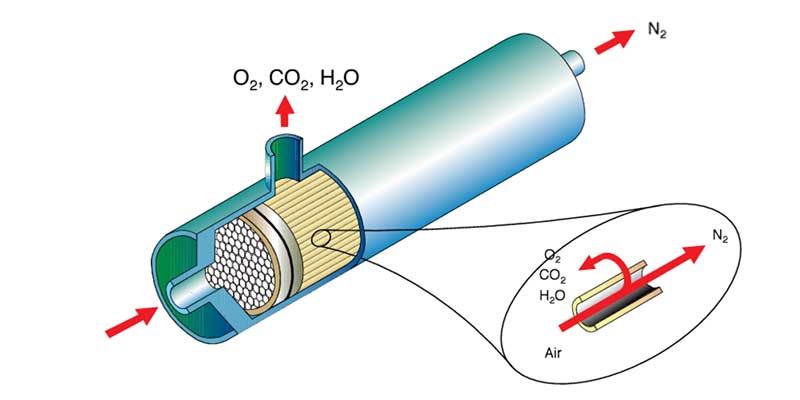
Inside the hollow-fiber membrane bundle
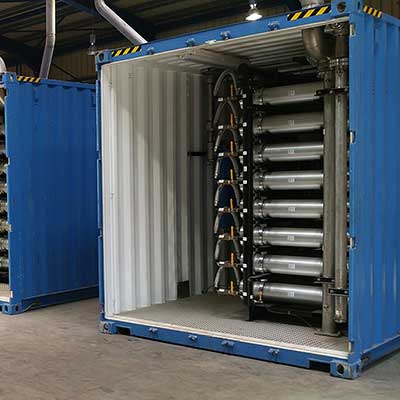
Construction
Hollow-fiber structure
Thousands of micro-thin polymer fibers are bundled together inside a pressure vessel. Each fiber is a hollow tube with walls thin enough to allow gas permeation.
Physics
Permeation rate
Oxygen permeates through the fiber walls roughly 5 times faster than nitrogen. This permeability difference is what drives the separation and creates the purity range.
Inlet condition
Operating pressure
Membrane systems typically operate at inlet pressures between 100 and 150 PSI. Higher pressure increases throughput and purity.
Performance
Temperature sensitivity
Performance is temperature-dependent. Optimal range is 40 to 150 degrees F (4 to 65 degrees C). Heated inlet air increases throughput and purity output.
Maintenance
Lifespan and replacement
Typical membrane bundle life is 5 to 7 years. Bundles are replaceable modules: you swap the bundle without replacing the entire system.
Membrane vs PSA: when membrane is the better choice
| Factor | Membrane | PSA |
|---|---|---|
| Purity ceiling | 95% to 99.5% practical maximum | 95% to 99.9995% |
| Lifespan | 5 to 7 years (membrane) | 20+ years (adsorbent sieve) |
| Footprint | Compact and lightweight | Larger, heavier |
| Air-to-gas ratio at high purity | Higher waste air (less efficient) | Lower waste air (more efficient) |
| Best fit applications | Bulk inerting, marine, fire suppression, tire inflation, off-shore, mobile rigs | High-purity manufacturing, lab, electronics, lasers, food production |
| Cost model | Lower upfront, simpler controls | Higher upfront, lower cost-per-unit at high volume |
Still deciding which technology fits your application? The full side-by-side comparison walks through both mechanisms and every spec that separates them.
Compare PSA vs membraneOr go deeper on the other technology: PSA nitrogen generators
Where membrane fits best
Marine inerting
Compact size and light weight are ideal for ship fuel tanks and storage vessel inerting in confined spaces. See nitrogen generators for marine and chemical tankers.
Fire suppression
On-site nitrogen generation supports fixed and portable fire suppression systems where purity of 95 to 99% is sufficient.
Off-shore platforms
Membrane generators eliminate the logistics challenge of delivering nitrogen to remote oil and gas installations.
Mobile nitrogen carts
Lightweight portable systems for maintenance crews, equipment rental, and on-site service work where mobility is essential.
Tire inflation
Aircraft, heavy equipment, and specialty tire inflation applications where on-site nitrogen beats bulk or cylinder supply.
Bulk industrial blanketing
Protecting stored material, preventing oxidation, and general inerting where ultra-high purity is not required.
Sizing
How to size a membrane nitrogen generator
Three numbers size a membrane system: how much nitrogen you use per hour, how pure it has to be, and what pressure it has to arrive at. Send those three and we can usually return a full quotation the same day.
Number 01
Flow
Tell us your nitrogen draw per hour and we size to it. Membrane fits steady, continuous draw particularly well, because there is no cycle to swing and no bed to regenerate.
Most sites do not know their real draw. That is normal, and it is the number worth measuring rather than estimating.
Number 02
Purity
Membrane reaches 95% up to about 99.5%. That ceiling is the decision, not a preference: above 99.5% the answer is PSA.
Membrane also uses more compressed air per unit of nitrogen than PSA, and the gap widens as purity climbs toward that ceiling.
Number 03
Pressure
Tell us the pressure your process needs at the use point, and the air pressure available to feed the system.
Applications needing high delivery pressure, like cylinder filling, add a booster stage downstream of the generator rather than pushing the generator harder.
Working in metric?
Most nitrogen specs outside North America are written in normal cubic meters per hour. We quote in both. At 70°F ambient, 1 Nm³/h is about 38 SCFH.
Purity is what decides the technology, and it decides it early. If your process runs at 99% or below and your draw is steady, membrane is usually the cheaper system to buy and the simpler one to run. If you need 99.9% or better, no membrane will get you there and the sizing conversation moves to PSA, where purity drives the compressor and the compressor drives the capital cost. The full side-by-side comparison walks through where that line falls, and the PSA sizing numbers show what the higher purities cost in compressed air.
Not sure what you actually use? We ship a free flow meter sized to your expected demand. It carries a cellular data logger, so your flow rate streams to a live dashboard with no WiFi needed at your facility. Return shipping is on you; the meter and the data are not.
Send your flow, purity, and pressureFrequently asked questions
How does a membrane nitrogen generator work?
A membrane nitrogen generator uses hollow-fiber polymer membranes to separate nitrogen from compressed air based on the principle of permeation. Compressed air enters a prefiltration train that removes oil, water, and contaminants. The clean, dry air is then forced through a bundle of hollow-fiber membranes at 100 to 150 PSI. Oxygen, water vapor, and CO2 permeate through the thin fiber walls faster than nitrogen, allowing them to vent off as waste gas. Nitrogen passes through the fiber bores into the product outlet and buffer tank.
What is a hollow fiber membrane?
A hollow fiber membrane is a micro-thin polymer tube, typically less than 1 millimeter in diameter. Thousands of these fibers are bundled together inside a pressure vessel. The fiber walls are permeable, meaning different gases pass through them at different rates. Nitrogen passes through the bore (the hollow center) while oxygen and water vapor permeate through the walls. This selective permeability is the basis for membrane-based gas separation.
How long does a membrane nitrogen generator last?
The hollow-fiber membrane bundle typically lasts 5 to 7 years under normal operating conditions. When the bundle reaches the end of its life, it can be replaced without replacing the entire system, making maintenance relatively simple and cost-effective. The lifespan can be extended with proper prefiltration and regular maintenance of the compressor inlet and air handling components.
What purity can a membrane nitrogen generator produce?
Membrane systems produce nitrogen in the range of 95% to 99.5% purity under practical operating conditions. The exact purity achievable depends on inlet pressure, temperature, the specific membrane material, and the desired flow rate. For applications requiring purity higher than 99.5%, a PSA (pressure swing adsorption) system is a better choice.
When should I choose membrane over PSA?
Choose membrane when your application requires low to moderate purity (95 to 99.5%), has space or weight constraints, or prioritizes simplicity and lower upfront cost. Membrane systems are ideal for marine inerting, fire suppression, off-shore platforms, tire inflation, and portable nitrogen carts. Choose PSA if you need higher purity (above 99.5%), have a high-volume continuous-duty application, or expect long equipment life (20+ years) to justify the higher initial investment.
How much compressed air does a membrane nitrogen generator need?
Membrane systems require a clean, dry compressed air supply at 100 to 150 PSI inlet pressure. The specific air volume depends on the desired nitrogen output. As a rule of thumb, a membrane system typically consumes roughly 3 to 4 standard cubic feet (SCF) of compressed air per 1 SCF of nitrogen produced, depending on the target purity. Your compressed air source must include adequate prefiltration (oil coalescer, dryer, dust filter) to protect the membrane.
What temperature do membranes operate at?
Hollow-fiber membranes have an optimal operating temperature range of 40 to 150 degrees F (4 to 65 degrees C). Performance is temperature-sensitive: cooler inlet air slightly reduces throughput, while warmer air increases both throughput and purity output. Membranes can be damaged by temperatures above 150 degrees F, so proper air dryer and cooling are important for long equipment life and consistent purity.
How much does a membrane nitrogen generator cost?
Membrane system pricing depends on the desired nitrogen flow rate, purity specification, and any ancillary components (dryer, buffer tank, controls). A small portable membrane system might cost a few thousand dollars, while a larger industrial system can cost tens of thousands. Generally, membrane systems have a lower upfront cost than PSA systems of equivalent size, but higher long-term cost-per-unit for high-purity, high-volume applications. Contact us with your flow and purity requirements for a specific quote.
Tell us your application and we will tell you whether membrane or PSA fits better.
Request a quoteGet a quote today