Nitrogen for Foundries and Casting Plants
Nitrogen Generator for Aluminum Degassing
On-site nitrogen for sparging hydrogen out of molten aluminum. Built to deliver continuous flow at the purity and pressure your degassing rotor or lance requires.
Purity range available
Built for rotor + lance flow
Typical payback
Service life
Aluminum degassing uses nitrogen as a sparging gas to remove dissolved hydrogen from molten aluminum before casting. Nitrogen bubbles introduced through a rotor, lance, or porous plug rise through the melt, pull hydrogen out of solution, and carry it to the surface where it is released. Hydrogen left in the casting causes porosity, gas defects, mechanical weakness, and surface blemishes that scrap parts and shorten die life.
Gas Generation Solutions designs on-site nitrogen systems for foundries and casting plants. Most aluminum degassing operations run on industrial-grade nitrogen at 98% to 99.5%, but our PSA and membrane systems cover the full 95% up to 99.9995% range when the same generator also feeds heat treating, downstream packaging, or laser cutting in the same plant. In business since 1979, we serve foundries, die casters, extrusion houses, and metal alloy producers across the United States, Mexico, and Canada.
Below, we cover how sparging works, the defects nitrogen prevents, purity tiers and technology choice, system sizing, and payback economics.
Customer installations
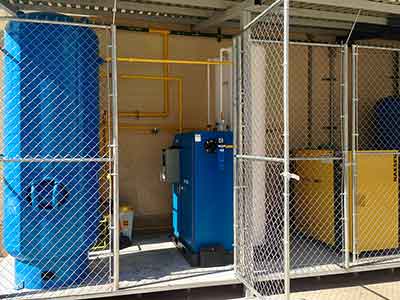
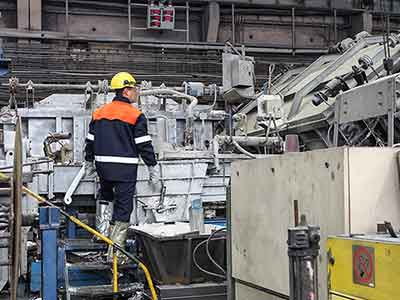
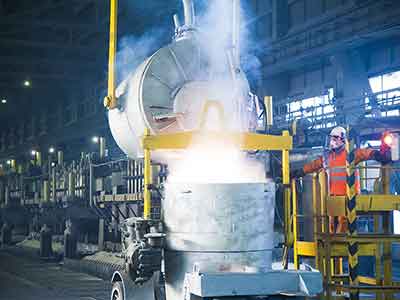
GGS nitrogen systems at aluminum casting plants
Each system is sized to the customer's degassing rotor, lance, or porous-plug flow demand and feeds adjacent processes when nitrogen is needed elsewhere in the plant.
How sparging works
Nitrogen pulls hydrogen out of molten aluminum
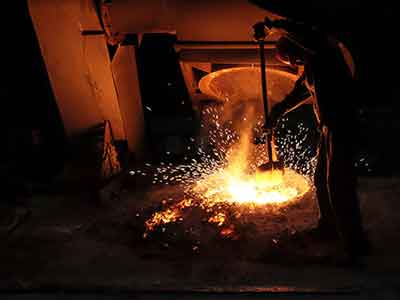
Hydrogen dissolves into liquid aluminum from moisture in scrap, charge material, refractories, and atmosphere. Nitrogen sparging is the standard method used by foundries and casting plants to drive it back out before pouring.
STEP 1
Introduce nitrogen below the melt surface
Nitrogen enters the molten aluminum through a graphite rotor, lance, or porous plug installed at the bottom of the holding furnace, ladle, or transfer crucible.
STEP 2
Bubbles rise and contact the dissolved hydrogen
The rotor or lance breaks nitrogen flow into fine bubbles. As bubbles travel upward, dissolved hydrogen migrates from the aluminum into the bubbles by partial-pressure diffusion.
STEP 3
Hydrogen carries to the surface and releases
Bubbles reach the top of the melt and release nitrogen and hydrogen into the foundry atmosphere. Inclusions and dross float with the bubbles and are skimmed off.
STEP 4
Cast the cleaned melt before reabsorption
The treated aluminum is poured into ingots, billet, sand molds, or die cavities. Holding times are kept short to prevent fresh hydrogen pickup from the foundry atmosphere.
Why nitrogen and not argon for most foundries: Nitrogen is generally produced on-site for far less per cubic foot than delivered argon and is effective for the alloys most foundries cast. Argon is used when an alloy is sensitive to nitride formation, when the operation casts titanium-bearing or magnesium-rich alloys, or when a downstream metallurgical specification calls for it. The two gases are often used in combination across the same plant.
Why degas at all
What hydrogen leaves behind in the casting
Aluminum will absorb hydrogen from any moisture it touches. If that hydrogen is not removed before solidification, it nucleates into voids and defects that scrap parts and shorten die life.
Porosity and pinholes
Dissolved hydrogen comes out of solution as the aluminum cools and gets trapped as gas voids. Porosity weakens the part, fails pressure tests, and creates leak paths in cast components.
Mechanical weakness
Tensile strength, fatigue life, and ductility all drop when hydrogen voids are present. Structural castings, automotive parts, and aerospace components fail to meet their mechanical specifications.
Surface blemishes and blisters
Subsurface gas can erupt during heat treatment or anodizing, leaving blisters, pits, and visible defects on finished parts that fail visual inspection.
Reduced die life and machining yield
Castings with porosity tear up cutting tools, increase rework and scrap, and create unpredictable wear patterns on dies. Clean melt extends die life and stabilizes downstream yields.
Purity and technology
Match purity to the alloy and the rest of the plant
Aluminum degassing itself does not need ultra-high purity. Most foundries run at 98% to 99.5%. We size the system for what your degassing rotor needs and what other processes in the same plant pull from the same generator.
Most foundries
98% to 99.5%
Industrial-grade nitrogen for sparging
- Standard rotary degassing of A356, A380, ADC12, and similar casting alloys
- Lance and porous-plug sparging in holding furnaces and ladles
- Lowest cost per cubic foot of generated nitrogen
- Membrane or low-purity PSA
Higher purity tier
99.9% to 99.99%
When the same generator feeds adjacent processes
- Heat treating, aging, or solution annealing of cast parts in the same plant
- Laser cutting on coil or sheet stock fed from the same nitrogen header
- Powder coating or finishing lines that share supply
- PSA system sized to highest-purity demand
Specialty tier
99.999% to 99.9995%
Sensitive alloys or downstream high-purity feed
- Reactive or aerospace alloys with strict gas-pickup specifications
- Plant also runs vacuum heat treating or metal 3D printing on the same supply
- Customer specifies a tighter ppm-level oxygen or moisture limit
- PSA with carbon polishing or specialty filtration
PSA versus membrane for aluminum degassing
Choose membrane when
- Purity needed is 95% to 99.5%
- Continuous, steady-state flow at the rotor or lance
- Lowest capital cost is the priority
- The plant has limited footprint or simpler maintenance is preferred
Choose PSA when
- Purity needed is 99.5% or higher
- Other processes in the plant pull from the same nitrogen header
- Customer wants room to grow into 99.9% or 99.99% later
- Specifications call for tighter oxygen or moisture limits
Sizing and economics
Right-size the generator before you buy
A degassing nitrogen system is sized to the rotor or lance flow rate, the purity required, and any other points in the plant that share the same nitrogen header. Oversize and you pay for capacity you do not use. Undersize and you starve the rotor.
Three things we ask for sizing
Rotor or lance flow demand
Manufacturer-rated SCFH per rotor or lance, the number of degassing stations running concurrently, and the duty cycle (continuous casting or batch). For most rotary degassers this lands between 100 and 1,500 SCFH per unit.
Purity required
Most aluminum degassing operations run at 98% to 99.5%. If the same nitrogen feeds heat treating, laser cutting, or downstream high-purity processes in the same plant, we size the generator to the highest-purity demand.
Pressure at the point of use
Rotor and lance applications usually run between 30 and 90 PSIG. Tell us the pressure at the rotor and the distance from the generator and we will size the receiver and piping to hold pressure during peak draw.
Payback economics
Cost reduction vs. delivered cylinders, dewars, and bulk liquid nitrogen
Typical payback for a foundry running multi-shift degassing
Service life with sealed sieve beds and routine maintenance
Not sure what your rotor actually pulls? Rent a flow meter free
We rent cellular data-logging flow meters at no cost. Install on your existing nitrogen line for a week and get an exact SCFH-by-shift profile before sizing.
Frequently asked questions
What purity of nitrogen is needed for aluminum degassing?
Most aluminum degassing operations run on industrial-grade nitrogen at 98% to 99.5% purity. Nitrogen acts as a carrier gas to pull dissolved hydrogen out of the melt, so high purity is generally not required for the sparging step itself. Higher purity (99.9% or above) is used when the same generator also feeds heat treating, laser cutting, or other downstream processes in the same plant. Our PSA and membrane systems cover the full 95% up to 99.9995% range and are sized to the highest-purity demand on the same nitrogen header.
Can on-site nitrogen replace delivered cylinders, dewars, or bulk liquid nitrogen for degassing?
Yes. Foundries running multi-shift degassing typically save up to 90% on nitrogen cost by switching from delivered gas to on-site generation. Cylinders run roughly $6 to $10 per CCF, dewars run $4 to $6 per CCF, and bulk liquid nitrogen runs $0.50 to $1.50 per CCF before boil-off losses. On-site generation lands at $0.05 to $0.15 per CCF depending on local power cost. Payback is typically 12 to 14 months.
How much nitrogen does a degassing rotor or lance use?
Most rotary degassing units consume 100 to 1,500 SCFH per rotor depending on rotor size, melt volume, target hydrogen level, and treatment time. Lance and porous-plug sparging falls in a similar range but with different bubble dynamics. We rent a free cellular flow meter so you can measure actual consumption over a representative shift before sizing the generator. The data logger transmits readings in real time to our server with no WiFi required at your facility.
How much does a nitrogen generator for aluminum degassing cost?
Pricing scales with flow, purity, pressure, and any custom requirements. Single-rotor foundries with one shift typically start near $15,000. Multi-rotor cast houses with continuous degassing usually run $40,000 to $150,000. Large facilities feeding degassing plus heat treating, laser cutting, or other downstream processes from the same generator reach $200,000 to $500,000. Payback is typically 12 to 14 months across system sizes.
Should I use PSA or membrane for aluminum degassing?
Membrane is a strong fit when purity needed is 95% to 99.5% and flow is steady, because capital cost is lower and there are no sieve beds to maintain. PSA is the right choice when purity needed is 99.5% or higher, when other processes in the plant share the same nitrogen header, or when the customer wants room to grow into 99.9% or 99.99% later. We quote both technologies on most foundry projects and recommend the one that fits the rotor and the rest of the plant.
Does nitrogen sparging completely remove hydrogen from the melt?
Sparging reduces dissolved hydrogen to acceptable casting levels, not to zero. Achievable hydrogen content depends on rotor type and speed, gas flow rate, treatment time, melt temperature, and atmospheric humidity. The treated aluminum should be cast quickly to avoid reabsorbing hydrogen from the foundry atmosphere during holding. We size generator flow and pressure to your target hydrogen level so the rotor can do its job.
How long does a nitrogen generator last in a foundry environment?
Our systems are designed for 20 years or more of service. PSA systems use sealed sieve beds that do not require top-off or replacement under normal operating conditions. Competing systems with flanged sieve beds may require sieve replacement every 8 to 10 years, which is a significant hidden cost over the life of the equipment. Foundries are dusty environments, so we specify pre-filtration and locate the generator in clean compressed-air space when possible.
How do I find out what size generator my foundry needs?
Start with the rotor or lance manufacturer SCFH spec, the number of stations running concurrently, and the duty cycle. If you also feed heat treating, laser cutting, or downstream processes from the same nitrogen header, list those flow rates and target purities. We provide free cellular flow meter rental to measure actual consumption over a representative period. Email your equipment specs and any measured flow data for a same-day quotation. Call 760-505-1300.