How it works
How a Nitrogen Generator Works
In plain language, a nitrogen generator pulls nitrogen out of regular compressed air and delivers a continuous on-site supply.
78%
Nitrogen in air
PSA and Membrane
Technologies
12-14 mo
Typical payback
20+ yr
Service life
Regular air is already 78% nitrogen. A nitrogen generator simply separates nitrogen from the other gases and water vapor in compressed air, delivering high-purity nitrogen on demand. Here are the main uses of nitrogen in industry.
Two proven technologies do this work: pressure swing adsorption, or PSA, and membrane separation. Each has trade-offs in purity, speed, and service life. This page walks you through both.
On-site generation replaces dewar delivery, cylinder banks, or bulk liquid nitrogen. No more tank rentals, no delivery schedules, no demurrage fees.
What's actually in the air you breathe
Composition
Air is mostly nitrogen
78%
Nitrogen makes up the bulk of our atmosphere. The remaining 22% is mostly oxygen (21%) and trace gases (argon, CO2, water vapor, and others).
Separation
Generators remove what isn't nitrogen
100%
The generator extracts oxygen, water vapor, carbon dioxide, and other trace gases. What remains is high-purity nitrogen, ready to deliver to your application.
Output
What comes out the other end
95-99.9995%
Purity depends on the technology and application. PSA systems deliver higher purity. Membrane systems are faster but deliver slightly lower purity.
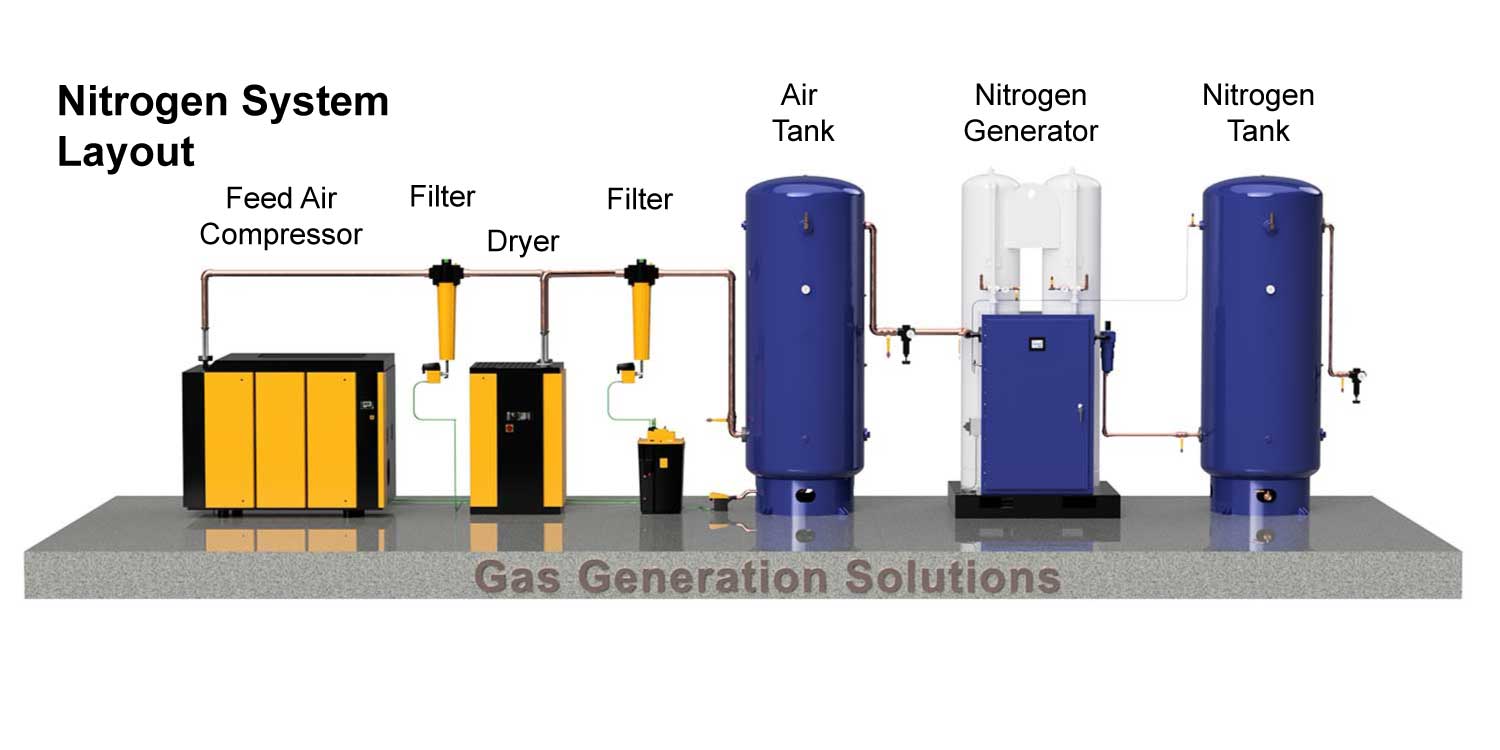
The 5-step path from air to nitrogen
01
Air intake
Atmospheric air is pulled into the system, ready to be compressed and processed.
02
Compression
An air compressor pressurizes the air, typically to 100 to 150 PSI, ready for separation.
03
Prefiltration
Oil coalescers, dryers, and dust filters clean the compressed air before it enters the separation stage.
04
Separation
Either a PSA bed or a membrane bundle separates oxygen and other gases from nitrogen.
05
Buffer and delivery
Clean nitrogen flows to a buffer tank and is delivered on demand to your application.
Two ways to separate nitrogen from air
PSA nitrogen generators
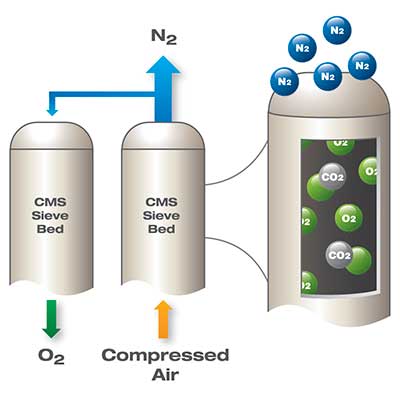
Pressure swing adsorption uses a carbon molecular sieve to absorb oxygen and other gases while nitrogen passes through. Two beds swing back and forth, one absorbing while the other regenerates.
Higher purity. Delivers 95% to 99.9995% nitrogen.
Long service life. 20+ years with proper maintenance.
Most common. Widely used across industries.
Membrane nitrogen generators
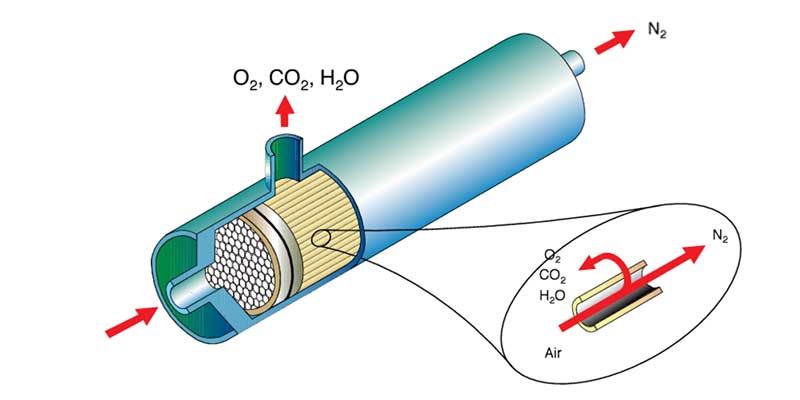
Membrane separation uses hollow polymer fibers. Compressed air flows through the fibers, and oxygen and water vapor escape through the fiber walls while nitrogen passes through.
Smaller and simpler. Fewer moving parts, easy to maintain.
Shorter service life. Typical membranes last 5 to 7 years.
Best for bulk flow. Ideal for high-volume, lower-purity applications.
Why companies switch to on-site generation
Lower cost
Typical payback is 12 to 14 months. After that, on-site generation costs up to 90% less than delivered gas. Over the lifetime of your equipment, the savings compound.
No deliveries
Nitrogen is always on tap. No scheduling with suppliers, no missed deliveries, no contract minimums. Your supply is in your hands.
No rental fees
No monthly dewar rental charges. No cylinder leasing. No demurrage or equipment minimums. You own the generator, and the nitrogen is free after the initial investment.
Long service life
PSA systems run 20 years or more with proper air conditioning. That means decades of predictable, low-cost nitrogen supply. Day-to-day maintenance is mainly filter changes.
Frequently asked questions
How does a nitrogen generator work in simple terms?
A nitrogen generator takes compressed air and separates nitrogen from the other gases (mostly oxygen). Two main technologies do this: pressure swing adsorption (PSA) and membrane separation. What comes out is high-purity nitrogen, ready to use.
Where does the nitrogen actually come from?
The nitrogen comes from the air around you. Our atmosphere is 78% nitrogen. Your compressed air already contains all that nitrogen. The generator just separates it from oxygen and water vapor.
What is the difference between PSA and membrane nitrogen generators?
PSA systems use a carbon molecular sieve and produce higher purity nitrogen (95% to 99.9995%), but are larger and more complex. Membrane systems use hollow polymer fibers, are smaller and simpler, but produce slightly lower purity and last 5 to 7 years instead of 20+.
Do I need a special air compressor for a nitrogen generator?
You need a properly sized and well-maintained compressor that delivers clean, dry compressed air at 100 to 150 PSI. Most facilities already have one. If your existing compressor is undersized or cannot deliver clean air, you may need to upgrade or add a dryer and filter.
How pure is the nitrogen that a generator produces?
Purity ranges from 95% up to 99.9995%, depending on the system type and settings. PSA systems can reach higher purities. Membrane systems typically deliver 95% to 99.5%. Your application determines the purity level you need.
How much electricity does a nitrogen generator use?
Electricity consumption depends mostly on the size of the compressor and how often it runs. Most industrial generators run on 208-480V three-phase power. The operating cost is typically much lower than the cost of delivered gas, which is why payback happens in 12 to 14 months.
How long does a nitrogen generator last?
PSA systems typically run 20 years or more with proper maintenance and clean, dry compressed air. Membrane systems last 5 to 7 years before the membranes need replacement. Regular filter changes and air conditioning keep equipment running longer.
Why generate nitrogen on-site instead of buying delivered gas?
On-site generation costs up to 90% less than delivered gas over time, with payback in 12 to 14 months. You avoid delivery fees, rental charges, and contract minimums. You have nitrogen on tap, 24/7, with no scheduling and no demurrage.
Send us your last 12 months of nitrogen invoices and we will run an exact projection against an appropriately sized system.
Get a custom projectionReady to talk?