
Vacuum Heat Treating
Nitrogen Generator for Vacuum Heat Treating Furnaces
On-site nitrogen supplies backfill gas for controlled atmosphere hardening, annealing, and quench cycles with consistent pressure and purity.
Jump to how it worksPurity range
Single system cycle
Typical payback
Service life
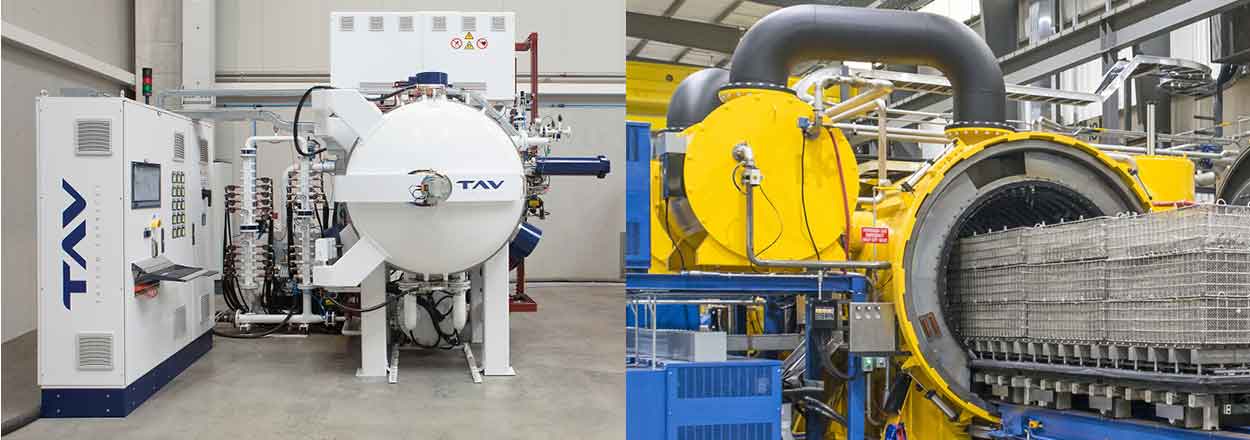
Vacuum heat treating relies on precise gas control during backfill and quench phases. After the furnace chamber is evacuated and the workpiece reaches soaking temperature, nitrogen is introduced at a controlled partial pressure to create a protective atmosphere. As the cycle progresses, high-pressure nitrogen quenches the heated parts, controlling cooling rates and preventing oxidation or warping.
On-site nitrogen generation solves two critical problems: it eliminates the logistics of managing liquid nitrogen dewars or bulk deliveries, and it supplies both backfill and quench gas at consistent pressure and purity. Nitrogen is preferred over argon because it costs significantly less while delivering the same protection for most ferrous and non-ferrous alloys.
Below, we walk you through the vacuum heat treating cycle, explain how backfill and quench pressures work, and show how on-site PSA nitrogen paired with a high-pressure booster handles both demands simultaneously.
The vacuum heat treating cycle with nitrogen
Step 01
Pump down
The furnace chamber is evacuated to a target vacuum, typically 0.1 to 1 mbar, removing air and moisture. This creates a clean, inert starting environment for the workpiece.
Step 02
Soak under vacuum
Parts are heated to the required temperature (typically 900 to 1200 C for tool steel) while maintained under vacuum. Soaking time depends on section size and desired metallurgical properties.
Step 03
Backfill with nitrogen
Nitrogen is introduced slowly to reach a partial pressure of 100 mbar to 2 bar, creating a protective atmosphere. Backfill pressure is kept low to avoid rapid cooling and support even heat distribution.
Step 04
Quench with high-pressure nitrogen
High-pressure nitrogen (6 to 20 bar) is rapidly admitted to quench the hot parts, controlling cooling rate and metallurgical structure. Pressure is carefully modulated to help minimize part distortion.
Single system, dual duty. An on-site PSA generator can supply both backfill and quench gas. The primary generator handles backfill; a booster compressor delivers quench pressure on demand.
Compatible furnace platforms
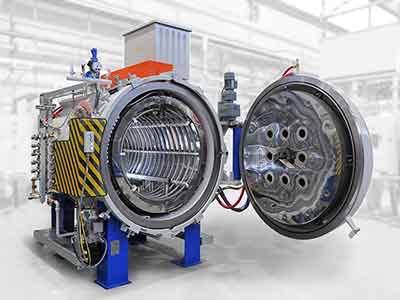
SECO-WARWICK
Vacuum heat treating furnaces commonly supplied with on-site nitrogen generation.
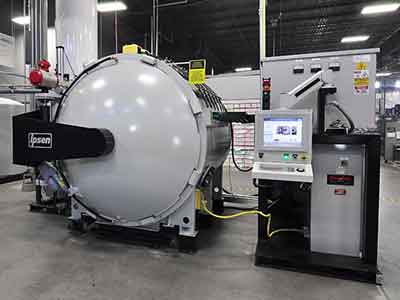
IPSEN
Vacuum heat treating furnaces commonly supplied with on-site nitrogen generation.
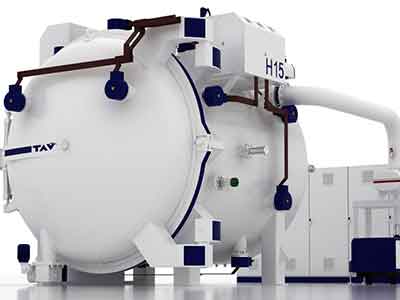
TAV
Vacuum heat treating furnaces commonly supplied with on-site nitrogen generation.

Solar Manufacturing
Vacuum heat treating furnaces commonly supplied with on-site nitrogen generation.
Backfill and quench pressure dynamics
Backfill pressure is low and sustained. After pump-down, nitrogen is bled into the chamber at partial pressure. Typical backfill pressures range from 100 mbar (0.1 bar) for delicate parts to 2 bar for robust components. The backfill phase lasts several minutes and flows relatively small volumes, typically 50 to 200 SCFH depending on chamber size.
Quench pressure is high and demand-intensive. When the soak is complete, high-pressure nitrogen floods the chamber rapidly, quenching the parts. Quench pressures range from 6 to 20 bar, with flow rates often exceeding 500 SCFH for a few minutes. This is where on-site generation shines: instead of swapping multiple liquid nitrogen dewars or relying on bulk deliveries, your system generates all the nitrogen needed on demand.
Single PSA generator plus booster compressor
An on-site PSA nitrogen generator (operating at 80 to 145 PSI) supplies both backfill and quench gas. The system is sized so that:
- The primary PSA output meets your average flow demand and typical backfill requirements.
- A secondary high-pressure air compressor or nitrogen booster (often a separate unit running at 200 to 300 PSI) supplies the burst of high-pressure nitrogen needed for quench.
- Both systems feed a common storage tank, maintaining consistent pressure throughout the cycle.
- Control logic modulates gas release to match the furnace control system's pressure ramp during backfill and quench.
The result: you eliminate the logistics headache of managing dewars or bulk LIN tanks while maintaining precise pressure control. Nitrogen costs drop by 60 to 90% compared to delivered gas, and most operations see payback in 12 to 14 months.
Purity for partial pressure control
Vacuum heat treating demands high purity nitrogen, typically 99.99% to 99.9995%, because even trace oxygen can cause surface oxidation or carburization issues at high temperature. PSA systems configured for vacuum applications are engineered to deliver the purity your process requires, and the gas remains chemically pure from generation through storage to quench.
Vacuum heat treating applications
Tool steel hardening
Vacuum hardening of precision cutting tools, dies, and punches. High-pressure quench with on-site nitrogen helps minimize oxidation and warping while supporting target hardness.
Bright annealing stainless
Controlled-atmosphere annealing of stainless steel tubes, wire, and strip. On-site nitrogen maintains a protective atmosphere at low backfill pressure, helping prevent discoloration.
Titanium aerospace hardening
Vacuum heat treating of aerospace titanium components. Ultra-high purity nitrogen backfill helps prevent alpha-case formation while rapid quench supports strength targets.
Brazing aerospace alloys
Vacuum brazing of aluminum and nickel-based aerospace assemblies. Clean nitrogen atmosphere enables robust braze joints without flux residue or oxide contamination.
Sintering MIM and powder metallurgy
Vacuum sintering of metal injection molded (MIM) parts and powder metallurgy components. High purity nitrogen at controlled partial pressure densifies parts without oxidation.
Diffusion bonding
Solid-state diffusion bonding of aerospace and medical components. Ultra-clean nitrogen atmosphere enables atomic-scale bonding without contamination or gap-filling.
Frequently asked questions
What is the typical backfill pressure in a vacuum heat treating cycle?
Backfill pressure typically ranges from 100 mbar (0.1 bar) for delicate or thin-walled parts to 2 bar for robust components. The exact pressure depends on the workpiece geometry, material, and the heat treater's control strategy. Lower backfill pressure minimizes thermal shock and reduces distortion. Higher backfill pressure accelerates the cycle by increasing gas convection around the parts.
Why nitrogen instead of argon for vacuum heat treating?
Nitrogen and argon both provide an inert atmosphere for vacuum heat treating. Nitrogen is strongly preferred because it costs 40 to 60% less than argon. For most ferrous and non-ferrous alloys, the metallurgical performance is equivalent. Argon is chosen only when specific application requirements (e.g., certain aerospace alloys or specialized quench protocols) demand it.
Can an on-site PSA generator supply both backfill and quench gas?
Yes. A single PSA nitrogen generator sized for your average flow demand can supply both phases. The primary PSA unit operates at 80 to 145 PSI and handles the sustained backfill phase. For the high-pressure quench phase (6 to 20 bar), a secondary air compressor or nitrogen booster is paired with the PSA generator. Both systems feed a common storage tank, allowing the furnace control system to modulate pressure throughout the cycle.
What purity of nitrogen is required for vacuum heat treating?
Vacuum heat treating demands high purity nitrogen, typically 99.99% to 99.9995%, to help minimize oxygen contamination at high temperature. Even trace oxygen can cause surface oxidation, carburization, or unwanted metallurgical effects during the extended soak phase. PSA systems configured for vacuum applications are engineered to deliver the purity your process requires.
How much nitrogen flow is consumed during a typical vacuum quench?
Quench flow depends on chamber volume, desired pressure ramp rate, and quench time. A typical mid-sized vacuum chamber (e.g., 30 cubic feet) might consume 300 to 800 SCFH of nitrogen over a 2 to 5 minute quench cycle. The booster compressor must be sized to deliver peak flow at the target pressure. Your specific demand should be calculated based on your furnace chamber volume and desired cooling rate.
Can on-site nitrogen supply be used for other furnace operations like carburizing or nitriding?
PSA nitrogen is well-suited for vacuum heat treating backfill and quench, which are purely inert-atmosphere applications. Carburizing and nitriding require specialized gas mixtures (e.g., endothermic atmospheres or ammonia) and are typically supplied by external sources. Some shops do use on-site nitrogen to supplement or blend with carburizing gases, which should be discussed with your process engineer and gas supplier.
What is the payback period for a vacuum heat treating nitrogen system?
Most heat treating operations see payback in 12 to 14 months when replacing delivered nitrogen (dewars or bulk LIN). The savings are driven by nitrogen cost reduction: from $4 to $6 per CCF for dewars or $0.50 to $1.50 per CCF for bulk LIN down to $0.05 to $0.15 per CCF for on-site PSA. The exact payback depends on your current gas cost, usage volume, and system size.
How long does it take to install an on-site nitrogen generation system at a vacuum heat treating operation?
Installation timeline depends on system size, site infrastructure, and furnace control integration complexity. Small to mid-sized PSA systems (200 to 1,000 SCFH) typically take 2 to 6 weeks from order to commissioning, including delivery, installation, air compressor inspection, pressure vessel testing, and furnace control interface setup. Large systems or custom installations may require 8 to 12 weeks. Contact us with your specifications for a detailed timeline.