
Nitrogen for Tire Curing, Compound Inerting, and Rubber Molding
Nitrogen Generator for Rubber Manufacturing
On-site nitrogen for tire curing bladders, compound mixing and storage blanketing, and rubber extrusion and molding lines. Dry, inert nitrogen replaces or supplements steam in the curing press and shields rubber compounds from oxygen at every stage of production.
Purity range available
Tire curing bladder pressure delivered
Typical payback
Service life
Rubber manufacturing uses nitrogen in three roles. In tire curing and retreading, high-pressure nitrogen pressurizes the curing bladder inside the press to force the green tire against the mold while it cures under heat. In compound mixing and storage, dry nitrogen blankets internal mixers, intermediate slabs, and bulk compound storage to keep oxygen off uncured rubber that would otherwise scorch or pre-crosslink during open exposure. In rubber extrusion and molding, nitrogen inerts the die exit and the mold cavity so seals, gaskets, hoses, weatherstrip, and molded parts cure without surface oxidation or porosity.
Gas Generation Solutions designs on-site nitrogen systems for tire plants, retread shops, hose and seal extruders, molded rubber parts manufacturers, and conveyor belt and industrial rubber products plants. Most rubber operations run nitrogen at 98% to 99% industrial-grade because the process value is dry, inert pressurization rather than tight ppm-level oxygen control. Our PSA and membrane systems cover the full 95% up to 99.9995% range when sensitive specialty compounds, medical-grade silicone, or aerospace elastomers require higher purity. In business since 1979, we serve rubber manufacturers across the United States, Mexico, and Canada.
Below, we cover where nitrogen acts in the tire curing cycle, the defects it prevents, purity tiers and technology choice, system sizing at up to 400 PSI tire curing pressure, and payback economics.
Rubber industry installation and equipment
GGS nitrogen for rubber manufacturing plants
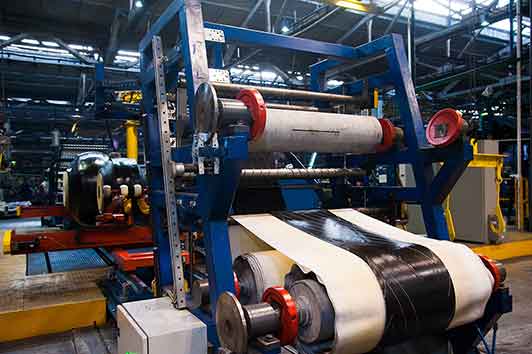
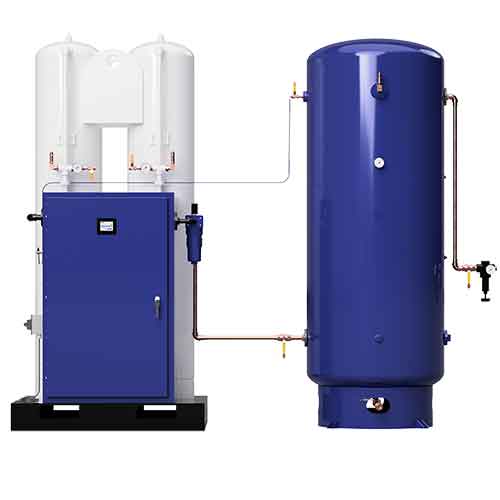
A view of nitrogen generation supporting a rubber manufacturing operation, plus the on-site nitrogen generator equipment that produces dry, inert nitrogen for tire curing, compound blanketing, and rubber molding.
How nitrogen acts in tire curing
Where nitrogen acts in the tire curing cycle
Tire curing is the headline use of nitrogen in rubber manufacturing. The same on-site generator also feeds compound mixing and storage blanketing, rubber extrusion lines, and molded rubber products on a shared nitrogen header.
STEP 1
Green tire loads and the press closes
A green (uncured) tire is loaded onto the curing press. The press closes around the tire and the bladder positions inside the casing. The bladder is the rubber diaphragm that pressurizes the inside of the tire and forces the rubber outward against the heated mold while the cure proceeds.
STEP 2
Initial heat-up with steam or hot water
The bladder inflates with steam or hot water to drive the casing against the mold and bring the tire up to cure temperature quickly. Steam transfers latent heat efficiently during this phase, but it also leaves condensate inside the bladder and exposes the bladder to oxygen as the cycle progresses.
STEP 3
Nitrogen takes over for the long hold phase
For the long steady-state cure phase, dry nitrogen at up to 400 PSI replaces or supplements the steam in the bladder. Nitrogen carries no condensate, holds pressure cleanly, and shields the bladder elastomer from oxidation at cure temperature. Pressure stays uniform across the bladder surface for the duration of the hold.
STEP 4
Pressure releases and the tire ejects
Bladder pressure vents at the end of the cure cycle and the press opens. The cured tire ejects to the post-cure inflator and the bladder is ready for the next cycle. Without condensate buildup or oxidation exposure during the hold phase, the bladder stays in service for more cycles between replacements.
Other places nitrogen shows up in a rubber plant: In compound mixing and storage, dry nitrogen blankets internal mixers, mill rolls, intermediate slabs, and bulk compound storage so uncured rubber does not scorch or pre-crosslink during open exposure. In rubber extrusion, nitrogen inerts the die exit on seals, gaskets, hoses, and weatherstrip so the cure surface forms without oxidation. In rubber molding (compression, transfer, and injection), nitrogen blankets the mold cavity for sensitive elastomers and supports gas-assist molding on hollow rubber parts. The same on-site generator can feed all of these uses through a shared nitrogen header.
Why nitrogen at the curing press and the mixer
What dry, inert nitrogen prevents in rubber manufacturing
Nitrogen earns its place in the rubber plant by addressing four distinct quality and cost problems that come up across tire curing, compound handling, and rubber extrusion and molding.
Bladder oxidation and shortened bladder life
Tire curing bladders run hot under pressure for the full cure cycle. When steam is the bladder medium for the entire hold phase, oxygen exposure at cure temperature drives elastomer degradation and shortens bladder life. Dry, inert nitrogen during the hold phase keeps oxygen off the bladder elastomer and extends usable cycles between bladder changes.
Steam condensate and uneven cure pressure
Steam in a curing bladder loses heat as it works and condenses into water inside the bladder. Condensate slugs in the bladder produce uneven contact pressure against the casing, localized cool spots in the cure, and inconsistent cycle times. Nitrogen in the bladder carries no condensate and holds uniform pressure across the full surface for the full hold.
Compound scorch and pre-crosslink during open exposure
Mixed rubber compound is reactive at room temperature once accelerators and curatives are blended in. Open exposure to air during mill discharge, slab cooling, intermediate storage, and transport causes scorch (premature crosslinking) and surface skin formation. A dry nitrogen blanket on intermediate storage and bulk compound holding prevents oxygen ingress and extends usable shelf life of mixed batches.
Surface oxidation on extruded and molded parts
Rubber extrusion of seals, gaskets, hoses, and weatherstrip cures the surface as the profile leaves the die. Oxygen contact at cure temperature produces a thin oxidized skin, surface tackiness, and weaker bond at cured-rubber-to-metal joints. Inert nitrogen at the die exit and inside the curing oven holds the cure environment oxygen-free and produces a clean cured surface.
Purity and technology
Match purity to the role nitrogen plays in the rubber plant
Most rubber operations run nitrogen at 98% to 99% industrial-grade. The process value in tire curing and compound blanketing is dry, inert pressurization rather than tight ppm-level oxygen control. Lower-purity nitrogen works for basic blanketing on routine compounds; higher-purity nitrogen serves a narrower set of specialty rubber applications.
Most rubber operations
98% to 99%
Tire curing, compound mixing and storage, standard rubber cure
- Tire curing bladder pressurization (passenger, truck, agricultural, off-the-road)
- Tire retreading bladder pressurization
- Compound mixing and intermediate storage blanketing
- Rubber extrusion (seals, gaskets, hoses, weatherstrip)
- Conveyor belt and industrial rubber product cure
- PSA or membrane sized to plant demand
Lower-cost tier
95% to 99%
Basic blanketing on routine compounds and bulk storage
- Bulk compound storage blanketing where short hold times limit oxygen exposure risk
- Open-mold cure on routine industrial rubber products
- Basic die-exit inerting on commodity extrusion profiles
- Lowest cost per cubic foot of generated nitrogen
- Membrane or low-purity PSA
Specialty tier
99% to 99.9%
Sensitive specialty compounds and medical-grade silicone
- Medical-grade silicone elastomer molding with tighter ppm-level oxygen limits
- Aerospace and high-performance specialty elastomers
- EPDM precision compounds for sealing and weatherstrip
- Plant also runs adjacent processes that require higher purity on the same supply
- PSA at this purity range
PSA versus membrane for rubber manufacturing
Choose membrane when
- Purity needed is 95% to 99%
- Steady-state demand for compound blanketing or basic die-exit inerting
- Lowest capital cost is the priority
- The plant has limited footprint or simpler maintenance is preferred
Choose PSA when
- Purity needed is 99% or higher
- Tire curing on multi-press lines with continuous high-pressure demand
- Specialty silicone, aerospace, or medical-grade rubber compounds
- Multiple tire presses or multiple plant processes share the same nitrogen header
Sizing and economics
Right-size the generator before you buy
A rubber-plant nitrogen system is sized to the gas demand at the curing press, the purity required by the application, and any other points in the plant that share the same nitrogen header. We measure actual flow before we recommend a size.
Three things we ask for sizing
Per-press flow demand and press count
Flow at a tire curing press depends on bladder volume, hold pressure, cycle time, the share of the cycle that runs on nitrogen versus steam, and how many presses run concurrently. We use measured flow data from a free cellular flow meter rental on your existing gas line to size the generator to your actual demand instead of nameplate estimates.
Purity required by application
Most tire curing, compound blanketing, and standard rubber cure runs at 98% to 99% industrial-grade. Sensitive specialty compounds, medical-grade silicone, and aerospace elastomers move into the 99% to 99.9% range. If the plant shares the nitrogen header with adjacent processes that require higher purity, we size the generator to the highest-purity demand on the header.
Delivery pressure to the curing press
Tire curing bladders run at up to 400 PSI depending on tire type and cure recipe. Compound blanketing and extrusion die-exit inerting run at much lower pressure, typically 30 to 90 PSIG at the point of use. Tell us the pressure at the highest-pressure use point and the run length from the generator and we will size the receiver and piping to hold pressure during peak draw.
Payback economics
Cost reduction vs. delivered cylinders, dewars, and bulk liquid nitrogen
Typical payback for a multi-shift rubber plant
Service life with sealed sieve beds and routine maintenance
Not sure what your tire presses or compound lines actually pull? Rent a flow meter free
We rent cellular data-logging flow meters at no cost. Install on your existing nitrogen line for a week and get an exact SCFH-by-shift profile before sizing.
Frequently asked questions
What purity of nitrogen is needed for rubber manufacturing?
Most rubber operations run nitrogen at 98% to 99% industrial-grade. Tire curing, compound mixing and storage blanketing, conveyor belt cure, and standard rubber extrusion and molding all sit in this tier because the process value is dry, inert pressurization rather than tight ppm-level oxygen control. Sensitive specialty compounds such as medical-grade silicone elastomers, aerospace high-performance rubber, and EPDM precision compounds run at 99% to 99.9%. Basic blanketing on bulk compound storage with short hold times can run on 95% to 99% nitrogen at lower cost. Our PSA and membrane systems cover the full 95% up to 99.9995% range and are sized to the highest-purity demand on the same nitrogen header.
Why is nitrogen used in tire curing instead of steam alone?
Steam delivers latent heat efficiently during the initial bladder inflation and heat-up phase of tire cure, but it has two costs over the long hold phase. Steam condenses inside the bladder as it works, leaving water that produces uneven pressure and localized cool spots in the cure. Steam also exposes the bladder elastomer to oxygen at cure temperature, which degrades the bladder and shortens the cycle count between bladder changes. Replacing or supplementing steam with dry nitrogen during the hold phase eliminates condensate, holds uniform pressure across the bladder for the full cycle, and shields the bladder from oxidation. The result is more consistent cure quality and longer bladder service life.
What pressure does the nitrogen feed need for tire curing?
Tire curing bladder pressure runs up to 400 PSI depending on tire type and cure recipe. Passenger car tires sit at the lower end of that range, truck tires and off-the-road tires sit at the higher end. We size the generator and the receiver tank to deliver and hold the required pressure during peak draw across the press count on shift. Generator output pressure ranges from 75 PSI up to 6,000 PSI across the product line, so other rubber-plant pressure requirements (compound blanketing at 30 to 90 PSIG, extrusion die-exit inerting at lower pressure) are also supported on the same supply.
Why does dewpoint matter for rubber manufacturing?
Dry nitrogen carries no water into the bladder or onto the cure surface. Water in a tire curing bladder produces uneven pressure, localized cool spots, and inconsistent cure cycle to cycle. Water in a compound blanket or extrusion inerting line introduces moisture that interferes with cure chemistry on moisture-sensitive rubber compounds and corrodes carbon-steel piping over time. Our nitrogen generators deliver dry nitrogen with a dewpoint of negative 40 degrees Fahrenheit, which is well below the dewpoint required for any standard rubber manufacturing application.
Can on-site nitrogen replace delivered cylinders, dewars, or bulk liquid nitrogen for a rubber operation?
Yes. Rubber plants running multi-shift tire presses or continuous compound and extrusion lines typically save up to 90% on nitrogen cost by switching from delivered gas to on-site generation. Cylinders run roughly $6 to $10 per CCF, dewars run $4 to $6 per CCF, and bulk liquid nitrogen runs $0.50 to $1.50 per CCF before boil-off losses. On-site generation lands at $0.05 to $0.15 per CCF depending on local power cost. Payback is typically 12 to 14 months.
How much does a nitrogen generator for rubber manufacturing cost?
Pricing scales with flow, purity, pressure, and any custom requirements. Single-press retread shops or small molded-rubber operations with one shift typically start near $15,000. Mid-size tire plants or multi-line compound and extrusion operations usually run $40,000 to $150,000. Large tire manufacturers feeding multiple curing presses, compound storage, and extrusion lines from the same generator at up to 400 PSI reach $200,000 to $500,000. Payback is typically 12 to 14 months across system sizes.
Should I use PSA or membrane for rubber manufacturing?
Membrane is a strong fit when purity needed is 95% to 99% and demand is steady, because capital cost is lower and there are no sieve beds to maintain. PSA is the right choice when purity needed is 99% or higher, when the plant runs tire curing on multi-press lines with continuous high-pressure demand, when specialty silicone or aerospace or medical-grade rubber is in production, or when multiple plant processes share the same nitrogen header. We quote both technologies on most rubber projects and recommend the one that fits the application, the pressure, and the rest of the plant.
How do I find out what size generator my rubber plant needs?
Start with the bladder volume and hold pressure of each curing press, the share of the cure cycle that runs on nitrogen versus steam, the number of presses running concurrently, and the duty cycle. If the same nitrogen also feeds compound mixing and storage blanketing, extrusion die-exit inerting, or rubber molding lines, list those flow rates and target purities. We provide free cellular flow meter rental to measure actual consumption over a representative period. Email your equipment specs and any measured flow data for a same-day quotation. Call 760-505-1300.