
On-Site Liquid Nitrogen for Labs, Clinics, and Industrial Cryogenics
On-Site Liquid Nitrogen Generator
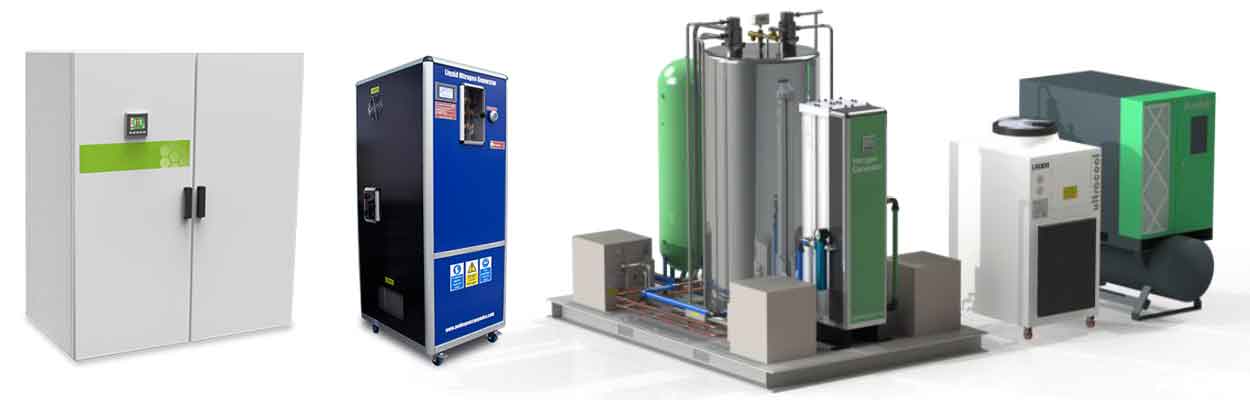
Liquid nitrogen generated on demand from compressed air and electricity. One on-site source replaces weekly dewar deliveries, bulk LN2 contracts, and the boil-off loss that comes with both. Sized from 12 liters per day for a small lab to over 1,100 liters per day for industrial cryogenic processing.
LN2 purity within operating envelope
Production range across the lineup
Typical payback vs delivered LN2
Generator replaces dewar thermal losses
Liquid Nitrogen Without the Delivery Truck
Weekly LN2 deliveries are a recurring cost and a single point of failure
A fertility clinic running cryopreservation tanks, a research lab cooling NMR magnets and freezing samples, a semiconductor pilot line purging wafer chambers, or a food processor cryo-freezing a continuous extrusion line all share the same supply problem. Liquid nitrogen has to be delivered. The dewar arrives full and is returned with residual liquid that gets billed but not refunded. Boil-off in storage burns through the contents between deliveries. A delivery delay during a procedure or a production run is not recoverable. The on-site generator removes the delivery truck from the equation.
An on-site liquid nitrogen generator pulls compressed air through a PSA stage that produces high-purity gaseous nitrogen, then feeds that gas to an integrated liquefier that cools it through cryogenic heat exchange to minus 196 degrees Celsius. The liquid drops into an insulated dewar built into the unit and is drawn off as the application calls for it. Production runs continuously and matches consumption, so there is no boil-off paid for and no residual returned uncredited.
Switching to on-site replaces the per-liter delivered cost with electricity and routine maintenance. The systems quote at greater than 99 percent purity within their normal operating envelope of 5 to 35 degrees Celsius and up to 80 percent relative humidity. Boost mode adds about 10 percent above the rated output continuously with no extra power or cooling water. Most clinical and lab installations recover their investment in 12 to 14 months at typical duty.
Lab and Laboratory Nitrogen
Gaseous nitrogen for analytical instruments, LC/MS curtain and source gas, sample evaporation, and stability chamber inerting. The complementary lab page covers gaseous nitrogen for LC/MS, GC, QTOF, and analytical workflows.
Open the labs page →Master Nitrogen Generator Hub
Gaseous nitrogen across all industries and applications. The umbrella nitrogen page covers PSA and membrane systems sized from analytical lab cabinets to industrial-scale plants.
Open the nitrogen umbrella →Where On-Site LN2 Replaces Delivered Dewars
Six application bands across labs, clinics, and industrial cryo
Fertility Clinics and Cryopreservation
12 to 144 L/day / clinic scale
Sperm, egg, and embryo cryopreservation tanks. Continuous on-site supply removes the delivery-day window where tank top-off is delayed and removes the supplier-prioritization risk that affects clinical accounts during regional shortages.
Research and Analytical Labs
12 to 240 L/day / lab scale
NMR magnet cooling, mass spectrometer cold traps, sample cryo-storage, freeze drying, and routine cryo-handling in biology and chemistry labs. Sized to match the actual draw measured from the existing dewar delivery records.
Semiconductor Manufacturing
240 to 1,100+ L/day / pilot to production
Cryogenic cooling, wafer-fab inerting, and process-tool LN2 supply. Larger units paired with optional 2,000-liter storage tanks provide the buffer required for bursty pilot line consumption.
Food Cryo-Freezing and Biotech Cold Chain
240 to 1,100+ L/day / continuous
Cryogenic freezing tunnels, IQF lines, biopharma cold chain, vaccine cold storage, and continuous cryo-extrusion. Continuous on-site production matches the always-on duty cycle these processes need.
Metal Treatment and Shrink-Fit Assembly
Mid class / batch operation
Cryogenic metal processing, shrink-fit assembly of bearings and bushings, and selected hardening cycles. On-site supply removes the stocked-dewar inventory and the boil-off paid between batches.
Pharmaceutical and Vaccine Storage
Mid class / continuous operation
Long-term sample storage, vaccine cold chain (including ultra-cold biologics), and biorepository tanks. Continuous on-site production removes the supplier-schedule dependency for cold-chain-critical inventory.
Purity Envelope and Process
Why we quote greater than 99 percent and how the system gets there
Liquid nitrogen purity cannot be tested directly because the analyzer would freeze at minus 196 degrees Celsius. The standard field check is the boiling point. At minus 196 degrees Celsius atmospheric, the liquid is sufficiently pure. The same check applies to delivered LN2.
Quoted purity
The feed gas to the liquefier is tested at 99.9 percent under lab conditions, but greater than 99 percent is what we guarantee across the operating envelope. The closed-system architecture means no ambient contamination after liquefaction.
Operating envelope
Ambient temperature range across which the purity guarantee holds. Up to 80 percent relative humidity. Water-cooled variants extend the upper temperature limit to 52 degrees Celsius for hot-climate or thermally constrained installations.
Field purity check
The boiling point of pure nitrogen at atmospheric pressure. Boiling at this temperature confirms the liquid is sufficiently pure. This is the same field check that delivered LN2 suppliers rely on.
Four steps from compressed air to liquid nitrogen
Compressed air feed
Compressed air enters the system at the required SCFM and is dried to a minus 40 degrees Celsius dew point with a desiccant dryer to protect the downstream cold head from moisture freezing.
PSA produces gaseous N2
The PSA stage adsorbs oxygen and water on a molecular sieve and lets nitrogen pass through at 99 percent or higher purity. The recommended feed for the liquefier is 99.999 percent for best results.
Cryogenic liquefaction
The high-purity nitrogen gas enters the liquefier where a cryogenic refrigeration cycle cools it to minus 196 degrees Celsius and condenses it to liquid. Heat is rejected to ambient air or a chilled water loop on water-cooled units.
Integrated dewar fills
Liquid nitrogen drops into the integrated insulated dewar built into the unit and is drawn off as the application calls for it. Dewar sizes range from 20 liters on small lab units to 500 liters on industrial units, with 2,000-liter external storage available.
What Delivered Dewars Actually Cost
Four failure modes on-site generation removes
Delivered-dewar boil-off is paid for and not recovered
Liquid nitrogen dewars boil off continuously in storage. The supplier returns to collect the dewar with residual liquid still in it, and that residual is not credited back. The integrated dewar on an on-site generator also experiences thermal losses, but those losses are continuously replaced by ongoing production rather than billed as a delivery loss.
Force majeure delivery delays affect industrial accounts
Air separation plant outages, regional shortages, and emergency medical demand can delay industrial LN2 deliveries. Suppliers prioritize hospital and medical accounts during a shortage, leaving research labs and clinics waiting. On-site production is independent of the delivery schedule.
Recurring delivery, fuel, hazmat, and rental fees stack up
A delivered LN2 contract carries a per-liter rate plus delivery fees, fuel surcharges, hazmat fees, demurrage on dewar return, and dewar rental. Those line items go to zero on an on-site system. Only the per-liter cost of compressed air and electricity remains.
Single-vendor dependency limits operational flexibility
Switching suppliers, scaling capacity for a project, or accommodating a one-off bursty demand requires a contract negotiation when LN2 is delivered. On-site generation puts capacity decisions on the operator. Two smaller units can be paired for redundancy or phased growth.
Sizing and Payback
Three numbers size the system, three numbers run the payback
What you need to tell us to size correctly
Input 1
Daily or weekly LN2 consumption
Liters per day, gallons per day, or gallons per week. If you have delivery records the math is direct: divide cubic feet of LN2 per month by hours per month, or count dewar refills per week. A delivery invoice is the best starting point.
Input 2
Operating profile
24 by 7 continuous, single shift, multi-shift, or batch. The operating profile determines whether boost mode is needed for headroom, whether redundancy via two paired smaller units is appropriate, and how the integrated dewar size matches the demand pattern.
Input 3
Existing power and air infrastructure
Available 208 to 240 V three-phase capacity, room ventilation, and any existing compressed air supply. Larger units require an external compressor that meets ISO 8573-1 Class 1.2.1 with a minus 40 degrees Celsius dew point.
What drives the 12 to 14 month payback
Driver 1
Per-liter cost gap
Delivered LN2 in dewars typically runs in the range of $2 to $5 per liter all-in. On-site LN2 production runs in the range of $0.05 to $0.30 per liter in electricity, depending on the unit and the local power rate. The gap is the money on the table.
Driver 2
No paid boil-off
Delivered dewars lose product to boil-off continuously in storage. Across a week between deliveries that compounds into a meaningful percentage of product the customer paid for and never used. On-site production matches consumption, so the delivered-dewar boil-off loss goes to zero.
Driver 3
Avoided fees and labor
Delivery fees, fuel surcharges, hazmat fees, dewar rental, demurrage, and the on-site labor that handles each delivery and dewar swap are all line items that go to zero on an on-site system. They show up in the avoided-cost column of the payback calculation.
Worked Example
500 gallons per week for a research lab or fertility clinic
Site uses 500 gallons per week (about 1,893 liters per week, or 270 liters per day) of LN2 across cryopreservation tanks and lab cryo-storage. A 240-liter-per-day class generator at 60 hertz produces about 444 gallons per week in standard mode and about 488 gallons per week with boost mode active.
Delivered cost at $3.00 per liter (mid-range dewar contract): about $5,680 per week, or about $295,000 per year. On-site cost at $0.20 per liter in electricity: about $380 per week, or about $19,700 per year. Annual savings: about $275,000.
Equipment investment for a 240-liter-per-day class system with 500-liter integrated dewar lands in the upper end of the mid-class catalog tier described above and varies with cooling type, compressor scope, and accessories. Even at the higher end of that tier, annual savings on the order of $275,000 against delivered LN2 at this consumption level typically delivers payback inside the first year. After payback the system runs on the same per-liter cost basis for its service life. Two paired 120-liter-per-day units are an alternative for redundancy.
On-Site Liquid Nitrogen Generator FAQ
Common questions about on-site LN2 generators
What purity does an on-site liquid nitrogen generator produce?
We quote greater than 99 percent LN2 within the operating envelope of 5 to 35 degrees Celsius and up to 80 percent relative humidity. The feed gas to the liquefier is tested at 99.9 percent under lab conditions, and because the system is closed there is no ambient contamination after liquefaction. The standard field check for purity is the boiling point. At minus 196 degrees Celsius atmospheric, the liquid is sufficiently pure. The same check applies to delivered LN2.
How does an on-site LN2 generator work?
Compressed air is dried to a minus 40 degrees Celsius dew point and fed to a PSA stage that produces high-purity gaseous nitrogen at 99 percent or higher. The gas enters a cryogenic liquefier where a refrigeration cycle cools it to minus 196 degrees Celsius and condenses it to liquid. The liquid drops into an integrated insulated dewar built into the unit and is drawn off as the application calls for it. The whole process is continuous and matches consumption.
How does the cost compare to delivered liquid nitrogen?
Delivered LN2 in dewars typically runs in the range of $2 to $5 per liter all-in including delivery fees, fuel surcharges, hazmat fees, dewar rental, and demurrage. On-site LN2 production runs in the range of $0.05 to $0.30 per liter in electricity, depending on the unit class and the local power rate. The per-liter cost gap typically pays back the equipment investment in 12 to 14 months at clinical and lab duty cycles.
What is boost mode and when do I use it?
Boost mode is a built-in pressure boost that increases LN2 production by about 10 percent above the rated output, with no additional power, cooling water, or feed air required. Boost can run continuously with no time limit. Use it as a 10 percent safety margin when a customer's stated requirement is just above the rated output of the next-smaller unit, or as headroom for sizing-tight installations.
Do I need an external air compressor?
Small lab units with internal compressors are plug and play. Mid and large units require an external compressor sized to the unit. The compressed air must meet ISO 8573-1 Class 1.2.1 quality with a minus 40 degrees Celsius dew point, and a desiccant dryer is required upstream rather than a refrigerated dryer. The desiccant purge consumes about 15 percent of the air volume, which has to be included in the compressor sizing.
Can the system run continuously, 24 hours a day?
Yes. The generators are designed for continuous 24 by 7 operation. Daily and weekly production figures are calculated assuming continuous operation. Service intervals on larger units run at 4,000, 8,000, 12,000, and 32,000 hours, which works out to roughly every 5.5, 11, 16.5, and 44 months at continuous duty.
How quiet are these systems?
The smaller units operate below 60 dBA. Mid and large units operate below 65 dBA. That is comparable to normal conversation and well below typical mechanical room background levels. Noise is rarely a constraint on installation location, even for clinical or office-adjacent placements.
What ambient temperature range do these systems handle?
Air-cooled units operate within 5 to 35 degrees Celsius ambient and up to 80 percent relative humidity. Water-cooled variants extend the upper limit to 52 degrees Celsius for hot-climate installations or thermally constrained mechanical rooms. The water-cooled option requires a chilled water loop on site.
Get an On-Site LN2 Quote
Send your weekly LN2 draw and we will size the system
A quote starts with one number: how much LN2 you currently use per week or per day. From there we recommend the right unit, confirm whether boost mode covers any peak demand, and lay out the air, power, and space requirements.
- Current LN2 consumption (gallons per week, liters per day, or your last delivery invoice)
- Operating profile (continuous, single shift, batch)
- Available power: 208 to 240 V three-phase capacity
- Existing compressed air supply (compressor model and SCFM rating, if any)
- Application (fertility clinic, research lab, semiconductor, food cryo, metal treatment, pharma cold chain)
We supply on-site LN2 across these customer segments
Fertility clinics, research labs, university chemistry and biology departments, semiconductor pilot lines, food processors, biopharmaceutical cold chain, vaccine storage facilities, metal treatment shops, and shrink-fit assembly. Service area covers the United States, Mexico, and Canada.