
On-Site Nitrogen for Medical Devices and Pharmaceutical Packaging
Nitrogen Generator for Medical Devices and Pharmaceutical Packaging
On-site nitrogen for sterile barrier packaging, ethylene oxide cycle purges, blister and vial headspace flushing, and lyophilization backfill. Continuous purity for validated lines, no cylinder change-outs mid-run, and one auditable gas source for batch records.
Packaging-line purity range
Continuous purity log for batch records
Typical payback
Service life
Two Sides of the Same Gas
Device packaging and drug-product packaging share one supply problem
Medical device contract manufacturers and pharmaceutical packaging operations share one supply problem. Both run validated lines that cannot tolerate a cylinder swap mid-batch, both write batch records that have to cite a continuous gas source, and both depend on residual oxygen control to protect the product after the seal closes. On-site nitrogen generation solves all three at the same source.
On the device side, nitrogen displaces oxygen and moisture inside Tyvek and foil pouches before sealing, purges ethylene oxide and humidity from sterilizer chambers after the kill cycle, and serves as assist gas for stent and hypotube laser cutting where a clean cut edge is the difference between scrap and a sellable part. On the drug-product side, nitrogen flushes the headspace of blisters, vials, ampoules, and pre-filled syringes before closure, and breaks vacuum on lyophilization cycles so freeze-dried biologics finish their cycle under inert headspace rather than ambient air. For nitrogen on the production side of drugs, biologics, and vaccines, see our nitrogen generator for medicinal manufacturing page.
Switching to on-site replaces cylinder and dewar deliveries with a continuous source rated for 20 years or more, recovers the investment in 12 to 14 months at typical packaging-line duty, and removes the batch-interruption risk that comes with running out of gas during a sterile fill.
Pharmaceutical Industry: process and reactor gas
For nitrogen as process gas in drug manufacturing: reactor blanketing, chromatography carrier, lyophilization process gas, API production, tablet coating, and cleanroom inerting at manufacturing scale.
Open the upstream page →Food Grade Nitrogen: for packaging beyond pharma
If your facility also packages nutraceutical, supplement, or food product lines, the same on-site source qualifies for food-grade modified atmosphere packaging across multiple verticals.
Open the food-grade page →Sample Installations
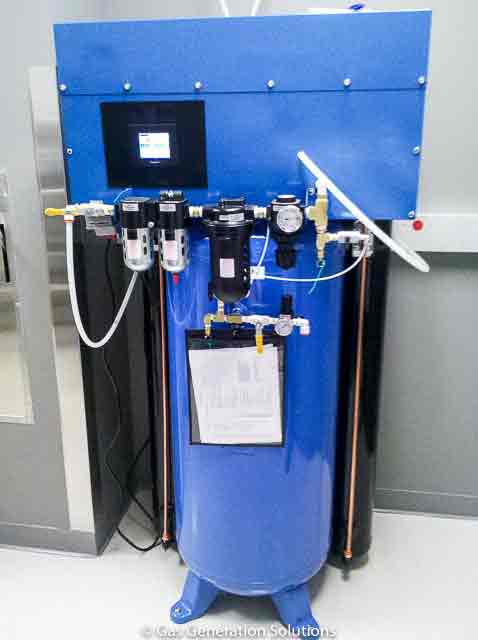
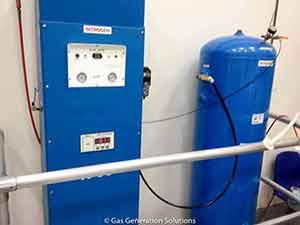
On-site nitrogen systems sized for packaging-line duty
Two on-site PSA nitrogen generator installations sized for continuous packaging-line service. Both deliver lab- and packaging-grade nitrogen at the point of use on a continuous duty cycle.
By Application
Six places nitrogen earns its keep on a regulated line
Three medical device manufacturing applications and three pharmaceutical packaging applications. The same generator can supply more than one of these from a common buffer tank if the peak flows and required purities overlap.
Medical device manufacturing
Sterile barrier packaging
Tyvek and foil pouches and trays sealed under nitrogen flush to displace residual oxygen and moisture before the lid film is heat sealed. Reduces in-pack oxidation of polymer components and protects bioresorbable implants whose hydrolysis kinetics depend on dry, inert headspace.
- Typical purity99% to 99.5%
- Pressure at fill head60 to 100 PSIG
Ethylene oxide cycle purge
After the EO sterilization kill cycle, the chamber is repeatedly evacuated and back-filled with nitrogen to strip residual EO and humidity from the load before the chamber door opens. A reliable, continuous nitrogen source keeps the degas cycle on schedule and the chamber on its qualification.
- Typical purity99% to 99.5%
- Cycle patternIntermittent peak demand
Stent and hypotube laser cutting
Nitrogen as assist gas for fiber laser cutting of stainless and nitinol tubes used in cardiovascular and neurovascular devices. The inert shroud prevents oxide scale on the cut edge so finished parts skip an electropolish step or pass first-time at inspection.
- Typical purity99.99%
- Pressure200 to 400 PSIG (booster required)
Pharmaceutical packaging
Blister pack form-fill-seal
Nitrogen flushed into the formed blister cavity before the lid foil seals the dose. Limits oxygen-driven degradation of moisture and oxygen sensitive solid dose products such as effervescent tablets, oxygen-sensitive APIs, and polymer-coated tablets that lose dissolution profile under O2 exposure.
- Typical purity99% to 99.5%
- Flow patternContinuous during line run
Vial and ampoule headspace flush
Nitrogen swept through the vial neck before stoppering or ampoule sealing to displace ambient air. Standard practice for parenterals and for any liquid product whose stability profile cites a residual oxygen specification in the closed container.
- Typical purity99.99%
- Residual O2 targetDefined by product spec
Lyophilization vacuum break
At the end of a freeze-drying cycle, the chamber vacuum is broken with nitrogen rather than ambient air so freeze-dried cake finishes under inert headspace. Common requirement for biologics, monoclonal antibodies, and oxygen-sensitive small-molecule injectables.
- Typical purity99.99% or higher
- Demand patternCycle peak at backfill
What Clean Nitrogen Protects
What goes wrong without a continuous, on-spec nitrogen source
Each of these failure modes traces back to either oxygen ingress, a gap in the gas supply during a validated cycle, or a purity drift outside the product specification.
Container closure integrity loss
A vial or pre-filled syringe that meets a residual oxygen specification at fill can drift outside that spec if the headspace flush is undersized or interrupted. Out-of-specification batches at stability pull get rejected and the production lot is at risk.
Result: continuous purity at the fill head, no cylinder bank manifold pressure dip during change-out, no mid-batch supply interruption, and a built-in oxygen analyzer reading the buffer tank for batch-record evidence.
Oxidative degradation of biologics and oxygen-sensitive APIs
Proteins, monoclonal antibodies, lipid emulsions, and certain small-molecule APIs lose potency or change impurity profile under residual oxygen exposure across the product shelf life. The damage is invisible at fill and shows up at the stability pull months later.
Result: higher achievable purity than typical bulk delivery, no supply gaps that force a fill at room air, batch records cite one continuous source.
EO degas cycle out of qualification
An ethylene oxide sterilization chamber whose nitrogen purge is undersized or runs out partway through degas leaves residual EO and humidity above the product specification. The load fails release and the chamber qualification is in question.
Result: sized to the chamber peak demand, with buffer tank capacity for repeated vacuum-and-fill cycles. No reliance on cylinder rotation timing.
Cut-edge oxidation on stent and hypotube laser cutting
Insufficient assist-gas purity or pressure during fiber laser cutting of stainless or nitinol leaves an oxide-scaled cut edge. The part either fails inspection or carries an extra electropolish step that adds cost and cycle time.
Result: 99.99% delivered at point of use, with a booster sized for the cutting head pressure. Same generator can supply other lines off the buffer when the cutter is idle.
Purity by Use
Pick the lowest purity that meets your product spec
Higher purity costs more compressed air per cubic foot of nitrogen produced. Sizing the system to the highest purity any one line actually needs (not the highest purity in the catalog) keeps both the equipment cost and the operating cost down.
A/N ~2.8
Sterile barrier and high-flow purges
Sterile barrier pouch flush, large-volume EO chamber purge, blister cavity flood at high line speed.
A/N ~3.4
General pharma packaging
General pharma packaging, sterile barrier where additional headroom against the product spec is wanted, chamber backfill on smaller lyo cycles.
A/N ~4.6
Vial fill and stent laser
Vial and ampoule headspace flush for parenterals, lyo backfill on standard injectables, stent and hypotube laser cutting assist gas.
A/N ~5.8 and up
Biologics lyo backfill
Lyophilization backfill on biologics with tight residual O2 spec, monoclonal antibody fill, oxygen-sensitive protein products.
PSA from compressed air
Pressure swing adsorption pulls nitrogen from compressed shop air. Two beds of carbon molecular sieve adsorb oxygen under pressure while the second bed regenerates at low pressure. The cycle alternates so the line sees a continuous flow of dry, oil-free nitrogen.
Output is rated at the nameplate purity continuously, not just at a peak. Every system includes a built-in oxygen analyzer continuously logging buffer-tank purity, so batch records cite a single, auditable source.
Why the air-to-nitrogen ratio matters
Producing 99% nitrogen takes about 2.8 cubic feet of compressed air per cubic foot of nitrogen. Producing 99.999% takes roughly twice that. The compressor sized for the higher purity is materially larger and burns more electricity for the life of the system.
If only one line on the floor actually needs the higher purity, it is often cheaper to undersize the generator to the lower-purity lines and supply the high-purity line from cylinders, or run a dedicated smaller cabinet.
Sizing and Payback
Three numbers to size, three numbers to justify
Packaging-line sizing is straightforward when the line list is in front of you. Sum the per-line peak flows at each purity tier, add buffer for cycle peaks, and match to a generator that holds spec at the highest tier any line needs. Three inputs drive the build, three drivers drive the payback, and a worked example below shows how a typical packaging hall lands.
Sizing inputs
- 1. Peak nitrogen flow per line SCFH or SCFM at the form-fill-seal head, vial neck, or sterilizer chamber inlet during the busiest cycle phase.
- 2. Required purity per line The product specification or chamber qualification, not the highest purity in the catalog.
- 3. Required pressure at point of use Typical packaging fill heads run 60 to 100 PSIG. Laser cutting assist gas runs 200 to 400 PSIG with a separate booster.
Payback drivers
- Cylinder and dewar avoidance Per-CCF delivered-gas cost runs roughly $6 to $10 per CCF for cylinders and $4 to $6 per CCF for dewars. On-site nitrogen runs roughly $0.05 to $0.15 per CCF, or up to a 90% reduction.
- Change-out labor and traffic No forklift moves, no hose disconnects, no manifold rotation. Validation gets one source to qualify, not a rotating supplier list.
- Batch interruption avoided A stalled sterile fill caused by a cylinder bank running out is hours of revalidation and potentially a discarded lot. On-site removes the failure mode entirely.
Worked example: vial fill, blister line, and EO chamber
Vial fill
50 SCFH @ 99.99%
Blister line
30 SCFH @ 99%
EO chamber peak
100 SCFH @ 99.5%
Sized at 99.99%
~130 SCFH
If the same generator supplies all three from a common buffer, the system has to be rated at 99.99% across the rolled-up flow. Sustained-plus-buffer demand is around 100 to 130 SCFH at 99.99%, which lands cleanly on a small-to-mid cabinet rated for roughly 130 SCFH at 99.99% on around 11 SCFM of compressed air at 100 to 119 PSIG inlet. If only the vial line truly needs 99.99%, sizing the generator to 99.5% and supplying the vial line from cylinders is often the cheaper installed-cost option.
Frequently Asked Questions
Medical devices and pharma packaging FAQ
What size nitrogen generator do I need for a vial filling line?
Sizing depends on three numbers: peak nitrogen flow at the vial neck, the residual oxygen specification of the product, and the line's run pattern. A small parenteral line typically draws between 30 and 80 SCFH at 99.99% purity continuous, which lands on a small-to-mid PSA cabinet running on 5 to 10 SCFM of compressed air. Larger multi-line operations and biologics fills can scale up by an order of magnitude. Send peak SCFH per line and we will size against your current shop air and pressure.
What purity is required for blister packaging?
Blister form-fill-seal lines typically run between 99% and 99.5% nitrogen purity into the blister cavity before the lid foil seals. Higher purities are warranted only when the product specification calls out a lower residual oxygen number, which is the case for some oxygen-sensitive APIs and effervescent dose forms. Sizing to the highest purity any one line actually needs, rather than the highest in the catalog, keeps the compressor and the operating cost down.
Can on-site nitrogen replace cylinders for sterile pharmaceutical packaging?
Yes, and it removes a recurring failure mode. A cylinder bank that runs out partway through a sterile fill stalls the line and forces a revalidation event. An on-site PSA generator delivers continuous nitrogen at the nameplate purity, with a buffer tank covering peaks. Batch records cite one auditable source rather than a rotating cylinder lot. Most packaging operations transition the validated lines onto the generator first and keep cylinders only as a documented backup.
How does on-site nitrogen support GMP and batch record requirements?
On-site PSA generates a continuous, single-source gas at nameplate purity, which is easier to document in a batch record than a cylinder bank that is rotated by a supplier. Every system we supply includes a built-in oxygen analyzer that continuously measures purity in the buffer tank, so each batch record can attach a continuous purity log without extra instrumentation. Equipment qualification covers the generator and its built-in analyzer once, rather than re-qualifying every cylinder lot or supplier change. GGS supplies the generator; documentation and validation are owned by your quality team.
What purity is needed for biologic lyophilization backfill?
Lyophilization backfill purity is set by the product specification, typically 99.99% or higher. Biologics, monoclonal antibodies, and certain oxygen-sensitive proteins call for residual headspace oxygen in the parts-per-million range, which means purity in the 99.999% band or above. The generator must be sized for the cycle's peak vacuum-break demand, which is short and sharp; a buffer tank smooths that demand so the cabinet can run at a steadier flow.
Can the same generator support an EO sterilization purge cycle and a packaging line?
Often, yes. The two demands rarely peak at the same instant: EO degas runs on a chamber cycle measured in minutes, and packaging lines run on a continuous duty pattern measured in hours. A common buffer tank between the generator and both demands covers the chamber's intermittent peak. Sizing has to be done against the higher of the two purities and the rolled-up flow. If the packaging line needs higher purity than the chamber, the generator is sized to the packaging line and the chamber consumes whatever it draws at the same purity.
How much shop floor space does a packaging-line nitrogen generator require?
The cabinet footprint scales with flow and purity. A small parenteral or blister line generator fits in a roughly 4 by 4 foot footprint plus a buffer tank. Larger packaging halls with multiple lines or a lyophilizer use cabinets in the 6 to 10 foot footprint plus tank. The system needs feed air from the existing shop compressor, electrical power, and a vent path for the regeneration exhaust. We size and lay out the equipment around your existing shop air and any available wall space.
What is the typical payback for a packaging-line nitrogen generator?
Most packaging-line installations recover the system investment in 12 to 14 months, driven by displaced cylinder and dewar deliveries, eliminated change-out labor, and avoided batch interruptions. Operating cost falls up to 90 percent versus delivered gas at typical packaging duty. After payback, the cost basis is electricity to run the compressor and routine filter changes, and the system is rated for 20 years or more of service life.
Tell us about your packaging or device line
To return a useful sizing in one round, send the following per line. We will quote against your existing shop air or include a compressor in the package.
- List of nitrogen-consuming lines (blister, vial, ampoule, pre-filled syringe, lyophilizer, EO chamber, laser cutter, sterile pouch fill).
- Peak nitrogen flow per line in SCFH or SCFM.
- Required purity per line (or the residual oxygen specification on the product).
- Required pressure at point of use, typically 60 to 100 PSIG for fill heads.
- Existing compressor make and HP, plus available header pressure at the proposed generator location.
On-site nitrogen for aerospace, pharmaceutical, food and beverage, electronics, and industrial manufacturing customers across the United States, Mexico, and Canada. Up to 90% lower nitrogen cost than delivered gas. Payback in 12 to 14 months. Service life of 20 years or more.