
The Truth About Delivered Nitrogen
What Are the Alternatives to Bulk and Liquid Nitrogen, and What Do They Really Cost?
Bulk and liquid nitrogen vent and boil off before you ever use them. A tanker loses an estimated 3% to 5% in transit, a bulk tank boils off about 2% of its volume every day, and a high-pressure laser may pull only a third of a dewar. Here is what that costs, and why making nitrogen on-site ends the waste.
Vented in transit before delivery
Bulk tank boil-off, used or not
Of a dewar a laser can actually use
Lower nitrogen cost on-site
The Truth About Delivered Nitrogen
What do you really pay for when you buy bulk nitrogen?
There are no flow meters for liquid nitrogen, and there are no tank gauges for bulk liquid gases, period. A tanker is filled at the cryogenic air separation plant and weighed, and the weight determines the gallons you are billed for. From that moment on, the nitrogen is leaving. If you are weighing the alternatives to bulk and liquid nitrogen, start with how much of it you never actually receive.
You are billed at the plant, then it vents on the way to you
Because the DOT sets strict limits on the pressure allowed in the truck, the tanker starts releasing nitrogen into the air as soon as it is filled. Estimates vary between 3% and 5% of a tanker's volume is released during the commute to the consumer. If the truck stops at another customer's location before yours, a best-guess estimate is made as to how much nitrogen goes to one customer and how much goes to the next.
What it costs you
For the gas company, the best-case scenario is that the customer gets about 90% to 95% of what they are charged for into their bulk tank. Then tank evaporation begins.
The truth about bulk liquid nitrogen tanks
Because nitrogen boils at approximately -320 degrees Fahrenheit, the nitrogen in a bulk liquid tank is always boiling. The standard bulk tank has a relief valve, not unlike a pressure cooker, which releases boiled-off liquid nitrogen as the pressure builds, which it is always doing. Left untouched long enough, all of the liquid nitrogen will boil, vaporize, and release into the atmosphere. The speed with which you use your nitrogen has very little effect on the amount of boil-off, and ambient temperature plays essentially no role: a tank in Alaska boils off at nearly the same rate as a tank in Florida.
Reality check
According to a bulk gas specialist at a major industrial gas supplier, a bulk cryogenic tank boils off at a rate of 2% of the volume of the tank per day, not the volume of liquid in it. On a 1,500-gallon tank, that is 30 gallons per day, about 3,000 SCFH, venting into the atmosphere every 24 hours, whether the tank is full or nearly empty.
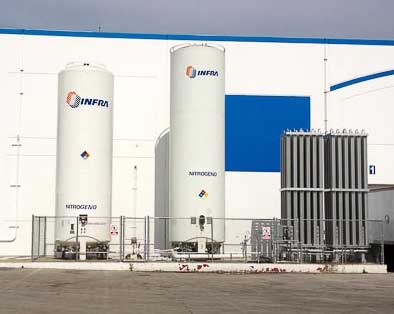
Bulk liquid nitrogen tanks vent boiled-off nitrogen around the clock, before this customer replaced them with an on-site generator.
The truth about dewars
Dewars are always venting boiled-off nitrogen, and as a result their relief valves degrade over time. A dewar that ordinarily holds 4,500 SCF of nitrogen can hold less by the time it arrives at your facility, and different dewars vent at different rates. No one gets all of the gas out of a dewar or tank. Laser cutters, which operate at an N2 pressure of up to 500 PSIG, may only draw about one third of the gas out of a dewar before the pressure is neutralized and the nitrogen will no longer flow.
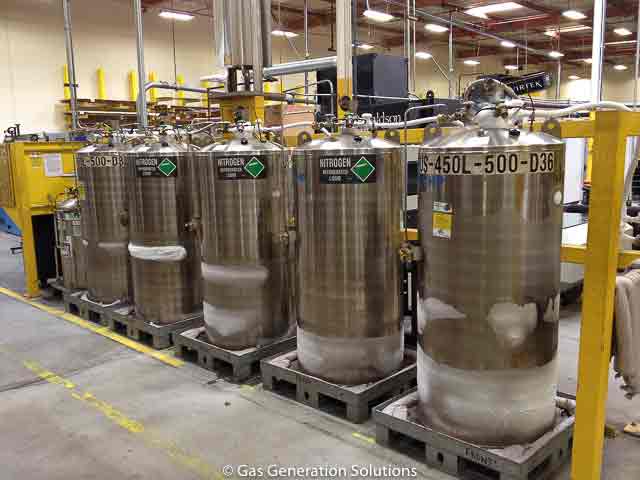
Liquid nitrogen dewars vent continuously, and a high-pressure laser may use only about a third of one before flow stops.
An on-site generator only makes what you draw
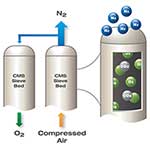
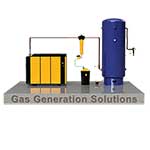
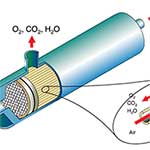
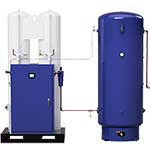
Every loss above comes from storing and shipping a liquid that will not stop boiling. An on-site nitrogen generator removes that problem entirely. It makes high-purity nitrogen from the compressed air you already have, on demand, so there is no transit venting, no daily boil-off, and no gas left stranded in a dewar. You pay for the nitrogen you actually use, and most customers cut their nitrogen cost by up to 90% compared to delivered gas.
Common Questions
Bulk and liquid nitrogen loss FAQ
How much nitrogen is lost when bulk liquid nitrogen is delivered?
An estimated 3% to 5% of a tanker's volume vents into the air during the drive to the customer, because DOT pressure limits force the truck to release nitrogen as soon as it is filled. The best case for the gas company is that you receive about 90% to 95% of what you are billed for into your tank, before tank evaporation even begins.
Why does a bulk liquid nitrogen tank lose gas even when you are not using it?
Nitrogen boils at about -320 degrees Fahrenheit, so a bulk tank is always boiling. A relief valve vents the boiled-off gas as pressure builds. According to a bulk gas specialist at a major industrial gas supplier, a bulk cryogenic tank boils off about 2% of the volume of the tank per day. On a 1,500-gallon tank that is roughly 30 gallons, or about 3,000 SCFH, vented every 24 hours, whether the tank is full or nearly empty.
Do liquid nitrogen dewars lose gas too?
Yes. Dewars are always venting boiled-off nitrogen, so their relief valves degrade over time. A dewar that ordinarily holds 4,500 SCF can arrive holding less, and different dewars vent at different rates.
Why can a laser cutter only use part of a nitrogen dewar?
Laser cutting runs at an N2 pressure of up to 500 PSIG. At that pressure, a laser may only draw about one third of the gas out of a dewar before the dewar pressure is neutralized and the nitrogen will no longer flow, leaving the rest stranded.
What is the alternative to bulk and liquid nitrogen waste?
An on-site nitrogen generator. It makes high-purity nitrogen from compressed air on demand, so there is no transit venting, no daily boil-off, and no gas stranded in a dewar. You pay only for the nitrogen you draw, and most customers cut their nitrogen cost by up to 90% compared to delivered gas.
Where On-Site Nitrogen Replaces Delivered Gas
Industries and applications we serve
Customers across food and beverage, electronics, manufacturing, and research generate their own nitrogen on-site instead of paying for bulk, dewars, and cylinders. Explore the applications below.













How On-Site Nitrogen Works
Learn more about generating your own nitrogen

Stop Paying to Nitrogenate the Air
See what your boil-off is really costing you
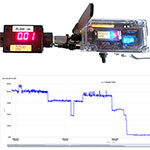
If you do not know your current nitrogen usage, we will send a flow meter at no cost to measure your real demand, then size an on-site system and show you the payback against what you pay now for bulk or liquid nitrogen. No obligation.