Chemical Processing
Nitrogen Generators for Chemical Processing
On-site nitrogen for tank and reactor blanketing, vessel inerting and purging, line purging, liquid sparging, and pressure transfer. A nitrogen generator for chemical processing holds an inert atmosphere over oxygen- and moisture-sensitive products and keeps vapor spaces out of the flammable range, at 99% to 99.99% purity from a single continuous source. Up to 90% lower gas cost than delivered cylinders and bulk liquid, with most plants paying back in 12 to 14 months.
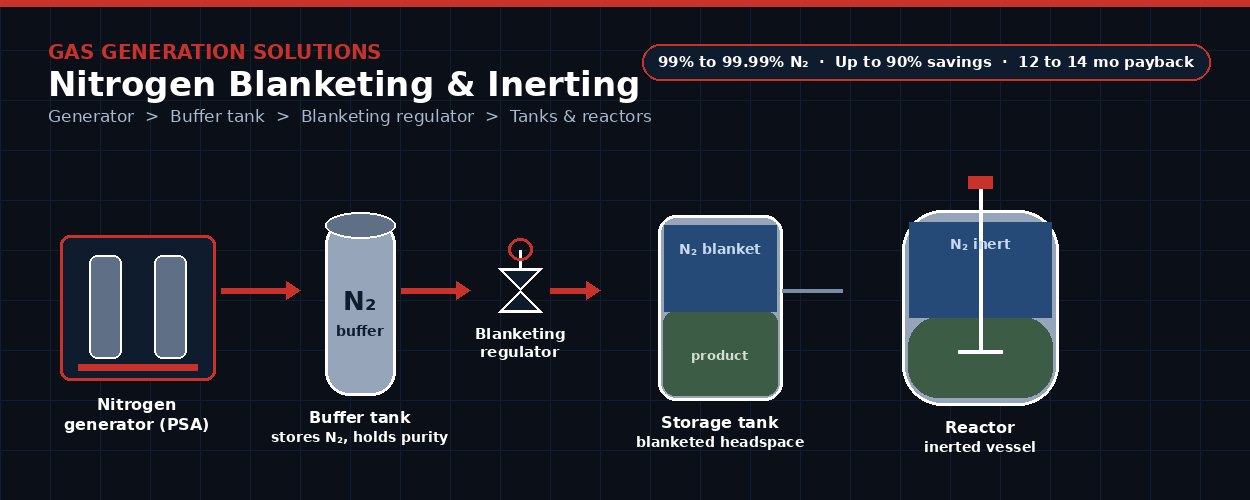
Tank and reactor blanketing, vessel inerting, line purging, sparging, pressure transfer across chemical, specialty, and process plants nationwide.
What we do
Oxygen and moisture are the enemies of stored and reacting chemicals. They drive oxidation, color and quality loss, polymerization, and hydrolysis, and an oxygen-rich vapor space over a flammable liquid is an explosion risk. Chemical plants use nitrogen to blanket, inert, and purge tanks, reactors, and lines so that air never contacts the product. A nitrogen generator for chemical processing replaces delivered cylinders and bulk liquid with a continuous on-site supply, which matters because a blanketing or inerting duty cannot tolerate a gap in supply. Gas Generation Solutions designs these systems for chemical manufacturers, specialty and fine chemical producers, coatings and adhesives plants, petrochemical operations, and process plants. Our systems produce nitrogen at purities from 95% up to 99.9995%, reducing gas costs by up to 90% compared to delivered cylinders and bulk liquid nitrogen. A single generator can run a complete nitrogen blanketing system, vessel inerting, line purging, liquid sparging, and pressure transfer from one source. Gas Generation Solutions was incorporated in 1979 and has over 40 years of industry experience. Our USA-built systems ship across the United States, Mexico, and Canada. For the full industrial picture, see the industrial nitrogen cornerstone or the closely related oil and gas nitrogen page.
Applications
How nitrogen is used in chemical processing
A correctly sized on-site generator supplies every nitrogen point of use in the plant from a single source: storage tanks, reactors, transfer lines, and the loading and packaging areas.
Tank & reactor blanketing
Hold a low-pressure nitrogen blanket in the vapor space of storage tanks and reactors so air never contacts the product. Protects against oxidation, moisture pickup, and quality loss. Nitrogen blanketing detail →
Vessel inerting & purging
Purge oxygen out of vessels before introducing flammable or reactive material, and keep the headspace below the oxygen level that supports combustion through the process.
Line & pipe purging
Clear transfer lines and piping of oxygen, moisture, and residual product between batches and before maintenance, so the next material moves through a clean, inert path.
Sparging & liquid degassing
Bubble nitrogen through a liquid to strip dissolved oxygen or unwanted volatiles, protecting oxygen-sensitive products and stabilizing batches before the next step.
Pressure transfer & pad-depad
Use nitrogen pressure to move liquids between vessels without a pump, and pad the headspace as liquid leaves so no vacuum or air ingress forms during draw-down.
Drying & moisture exclusion
Keep dry, hygroscopic, or moisture-sensitive products away from humid air during storage and transfer by maintaining a dry nitrogen atmosphere in the vessel.
One generator, whole-plant supply. A properly sized on-site system feeds every nitrogen demand from one source: the tank farm, the reactor hall, transfer lines, and the loading and packaging areas. One generator replaces the complete delivered-nitrogen supply chain.
Purity & supply
Dial in the purity the product needs, from one continuous source
Nitrogen purity
Purity is set by how oxygen- and moisture-sensitive the product is
Chemical blanketing and inerting duties span a wide purity range. The right grade is the one the product and the process require, measured as percent N₂ with the balance as residual oxygen.
General inert blanketing
Tank padding and purging where a small residual oxygen level is acceptable. Lowest air consumption and lowest cost per cubic foot.
Standard chemical storage
The common range for blanketing oxygen-sensitive products, reactor inerting, and routine line purging across most chemical plants.
Sensitive products & reactions
Highly oxygen-sensitive intermediates, sparging duties, and processes where lower in-vessel oxygen protects yield and color.
Most oxygen- and moisture-critical
Specialty and fine chemistry where trace oxygen or moisture would degrade the product or stall the reaction.
Why on-site
A blanketing or inerting duty cannot pause for a delivery
Nitrogen demand in a chemical plant is intermittent but unforgiving. A blanket has to hold whenever the tank breathes or draws down, and an inerting duty has to be ready the moment a vessel is charged. On-site generation removes the delivered-gas supply chain from that path.
No supply gaps. The generator runs continuously and replenishes a buffer tank, so the blanket and inerting supply are always available without cylinder swaps or delivery scheduling.
No boil-off losses. Bulk liquid nitrogen vents continuously from an idle tank. On-site generation produces nitrogen only as the plant uses it.
Purity you control. The same system serves a low-purity blanket and a high-purity reactor by setting the grade for each duty, instead of buying multiple delivered grades.
A built-in oxygen analyzer reads buffer-tank purity continuously, so you can confirm the nitrogen feeding a blanket or inerting duty meets spec at all times.
Sizing & ROI
Sized to measured demand, paid back in 12 to 14 months
Plant tiers
Nitrogen demand by plant scale
Single vessel, pilot & lab
One or a few storage tanks or reactors under blanket, pilot lines, and intermittent purging. Demand is low and bursty.
Multi-vessel batch plant
Multiple tanks under blanket, batch reactors that inert and purge on each cycle, sparging duties, and routine line purging between products.
Tank farm & continuous process
A full tank farm under continuous blanket, continuous-process inerting, large sparging loads, and pressure transfer across many vessels at once.
Our free flow meter rental with cellular data logger measures actual consumption across real blanketing, purging, and transfer cycles. Measured data drives sizing instead of nameplate estimates.
Cost & payback
Up to 90% lower gas cost vs delivered nitrogen
12–14 mo
Typical payback
20+ yr
Service life
$10,000 to $150,000+ system price range from a single-vessel system to a full tank-farm plant.
Delivered nitrogen for a chemical plant carries compounding costs: gas charges, cylinder or dewar rental, hazmat fees, delivery surcharges, and boil-off from idle liquid tanks. On-site generation eliminates all of them. Recurring cost is electricity for compressed air plus routine filter changes. Over a 20-year service life, cumulative savings commonly reach well into six figures for a multi-vessel plant.
Related pages
Industrial nitrogen context and related applications
The chemical processing page is one part of a broader industrial nitrogen cluster. Go up to the cornerstone and the full application list, or across to other industries where nitrogen blankets, inerts, and purges the same way.
Oil & Gas
Blanket / PurgeTank and vessel blanketing, line purging, and pipeline inerting.
Autoclaves
BlanketSealed vessel blanketing under pressure, the same inerting logic.
Plastic Injection
InertResin drying and inert atmosphere for molding operations.
Rubber
InertInert atmosphere for curing and process protection.
Aluminum Degassing
SpargeSparging molten metal to strip dissolved hydrogen.
Heat Treating
InertProtective furnace atmospheres for annealing and heat treat.
Size Your Plant System
Borrow a flow meter. Size the generator to your real blanketing and purging demand.
We rent a flow meter at no charge, sized for plant service. The meter installs inline on your current nitrogen supply, with a cellular data logger so you can view flow rate and pressure in real time on our dedicated server. No WiFi required at your facility. After a stretch of normal operation, including vessel purges and transfers, we size the generator and storage to your measured peak simultaneous demand, not a nameplate estimate. Most plants recover their full system investment inside 14 months.
Already know your flow, purity, and pressure? Send them over with your tank and reactor layout and we will return a complete quotation the same day.
Frequently asked
Questions about chemical processing nitrogen generators
What nitrogen purity does chemical processing need?
Purity is set by how oxygen- and moisture-sensitive the product is. General inert blanketing runs at 95% to 99% where a small residual oxygen level is acceptable. Standard chemical storage and reactor inerting commonly run at 99% to 99.5%. Highly sensitive products and sparging push to 99.9%, and the most oxygen- or moisture-critical chemistry uses 99.99%. Chemical processing rarely requires purity higher than 99.99%, though our generators are capable of any purity from 95% up to 99.9995%.
What is nitrogen blanketing, and why does it matter?
Nitrogen blanketing, also called tank padding, maintains a low-pressure layer of nitrogen in the vapor space above a stored or reacting liquid so that air never contacts the product. It protects against oxidation, moisture pickup, and quality loss, and it keeps the vapor space below the oxygen level that can support combustion. The blanket adds nitrogen as the tank breathes with temperature swings and as liquid is drawn down, holding the headspace inert at all times.
How is nitrogen used in chemical processing?
Nitrogen blankets storage tanks and reactors to exclude oxygen and moisture, inerts and purges vessels before flammable or reactive material is introduced, purges transfer lines and piping between batches, sparges liquids to strip dissolved oxygen or volatiles, moves liquids by pressure transfer and pads the headspace during draw-down, and keeps moisture-sensitive products dry during storage and transfer.
Why use nitrogen for inerting and purging vessels?
Nitrogen is inert, dry, and inexpensive to produce on-site, which makes it the standard gas for inerting and purging. Purging a vessel with nitrogen displaces oxygen before flammable or reactive material is charged, and holding an inert atmosphere through the process keeps the headspace below the oxygen level that supports combustion. The same nitrogen also protects the product from oxidation and moisture during the reaction.
Can one nitrogen generator feed blanketing, inerting, and sparging?
Yes. A single generator sized to total plant demand can supply tank and reactor blanketing, vessel inerting and purging, line purging, sparging, and pressure transfer from one source. A buffer tank handles short demand spikes from a purge or a transfer. This is more cost-effective than running separate supplies at each demand point and simplifies expansion when the plant grows.
How much does a nitrogen generator for chemical processing cost?
Systems for chemical processing typically range from approximately $10,000 for a single-vessel or pilot system to over $150,000 for a full tank-farm plant with continuous-process inerting. Price depends on total flow rate, required purity, delivery pressure, and any redundancy requirements. Regardless of system size, the average payback remains 12 to 14 months.
How much nitrogen does a chemical plant use?
Consumption varies widely by plant scale and process. A single-vessel, pilot, or lab operation typically uses 20 to 500 SCFH. A multi-vessel batch plant uses 500 to 3,000 SCFH. A tank farm or continuous process can use 3,000 to 20,000 SCFH or more. Blanketing makeup is small, but vessel purges and transfers spike demand for short bursts, so peak simultaneous demand drives sizing. Our free flow meter rental measures your actual consumption across real blanketing, purging, and transfer cycles.
How long does a chemical processing nitrogen generator last?
Our systems are designed for 20 years or more of continuous service. Sealed sieve beds do not require replacement or top-off under normal operating conditions. Competing systems using flanged sieve beds may require sieve replacement every 8 to 10 years, which is a significant hidden cost over the life of the equipment. Call 760-505-1300 or contact us here for a same-day quotation.