
Nitrogen for Extrusion Plants and Die Shops
Nitrogen Generator for Aluminum Extrusions
On-site nitrogen for extrusion presses. Displaces oxygen at the die face during ram extrusion, prevents oxide build-up on the die, and extends die life across 6061, 6063, 6082, and 7075 aluminum alloys.
Purity range available
Reduces oxide build-up on dies
Typical payback
Service life
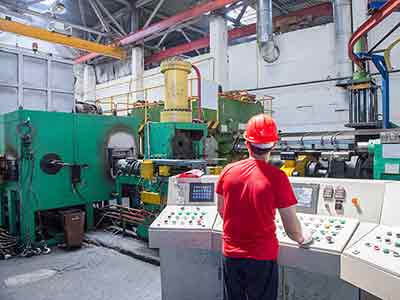
Aluminum extrusion presses force preheated billet through a steel die at temperatures near 1,000 degrees Fahrenheit. At that temperature aluminum reacts with any oxygen it touches, building oxide on the die face that transfers as streaks and surface defects to every extrusion that follows. Nitrogen introduced near the die exit displaces oxygen at the contact surface, slows oxide formation, and extends usable die life between rebuilds.
Gas Generation Solutions designs on-site nitrogen systems for extrusion plants and die shops. Most extrusion presses run on industrial-grade nitrogen at 98% to 99.5%, which is enough to displace oxygen at the die face and protect the die surface. Our PSA and membrane systems cover the full 95% up to 99.9995% range when the same generator also feeds aging ovens, solution heat treating, anodizing prep, or downstream cutting on the same nitrogen header. In business since 1979, we serve extrusion houses, automotive component plants, architectural shape producers, and aerospace alloy fabricators across the United States, Mexico, and Canada.
Below, we cover where nitrogen acts on the press, the defects it prevents, purity tiers and technology choice, system sizing, and payback economics.
Customer installations
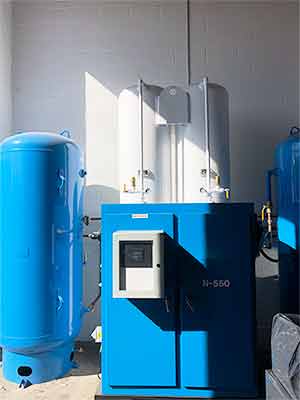
GGS nitrogen systems at aluminum extrusion plants
Each system is sized to the customer's press atmosphere demand, die-face flow rate, and any other points in the plant that share the same nitrogen header.
How nitrogen protects the die
Where nitrogen acts on the extrusion press
Aluminum at extrusion temperature reacts with any oxygen it touches. Nitrogen displaces that oxygen at the die face during the press stroke and keeps oxide off the working surfaces of the die.
STEP 1
Billet preheats and loads into the container
A 6061, 6063, 6082, or 7075 billet is heated to roughly 1,000 degrees Fahrenheit, taper-quenched, and loaded into the press container. Surface oxide on the billet is unavoidable in air; the press relies on container and ram action to break it up before extrusion.
STEP 2
Nitrogen displaces oxygen at the die face
A nitrogen feed is introduced near the die exit. The inert blanket at the die face displaces oxygen from the working surface so that fresh aluminum extruding through the die does not encounter free oxygen and form fresh oxide on the die.
STEP 3
Aluminum extrudes through the die under inert atmosphere
The ram drives the billet through the die. Without an oxygen-rich layer at the die face, the aluminum surface stays cleaner against the die, oxide build-up on the die is reduced, and the die gives a longer service interval before rebuild or replacement.
STEP 4
Extrusion runs out, quenches, and ages
The extrusion exits the die, runs onto the puller, quenches at the press exit, stretches, and cuts to length. Plants that age in T6 or solution-heat-treat 7075 in the same facility often pull additional nitrogen from the same generator to feed those ovens.
Where nitrogen is most effective: Nitrogen at the die face is most valuable on long press runs and on alloys where surface finish drives downstream yield, including 6063 architectural shapes, 6082 structural sections, and 7075 aerospace stock. The same generator can feed aging ovens, anodizing prep tanks, and downstream cutting on the same nitrogen header.
Why blanket the die at all
What oxide on the die leaves behind on the extrusion
A clean die produces clean extrusions. Once oxide accumulates on the die surface, every defect on the die transfers to every part downstream until the die is rebuilt.
Shortened die life
Oxide build-up on the working face of the die wears the bearing surfaces faster, requires earlier rebuild or replacement, and shortens the run between scheduled die maintenance. Inert atmosphere at the die face slows that wear cycle.
Surface oxide and streaking
Aluminum extruding past oxidized die surfaces picks up streaks, drag marks, and surface defects that fail visual inspection on architectural shapes and require additional finishing on structural sections.
Lower anodizing yield
Surface defects from a worn or oxidized die show up as visible flaws after anodizing. Architectural 6063 extrusions in particular are graded on anodized appearance, and surface defects scrap parts that would otherwise pass.
Higher scrap and rework rates
Defects transferred from a degraded die show up at the press, the saw, the stretcher, and the finishing line. A cleaner die pays back across every downstream station as fewer parts are scrapped, reworked, or downgraded.
Purity and technology
Match purity to the alloy and the rest of the plant
Extrusion at the die face does not need ultra-high purity. Most plants run at 98% to 99.5%. We size the system for what the press needs and what other processes in the same plant pull from the same generator.
Most extrusion plants
98% to 99.5%
Industrial-grade nitrogen at the die face
- Standard die-face blanketing on 6061, 6063, 6082, and similar wrought alloys
- Container and dummy block purging on architectural shape runs
- Lowest cost per cubic foot of generated nitrogen
- Membrane or low-purity PSA
Higher purity tier
99.9% to 99.99%
When the same generator feeds adjacent processes
- T6 aging ovens and solution heat treatment in the same plant
- Anodizing prep and finishing lines that share supply
- Downstream cutting, drilling, or fabrication on the same nitrogen header
- PSA system sized to the highest-purity demand
Specialty tier
99.999% to 99.9995%
Aerospace alloys or downstream high-purity feed
- 7075, 2024, and other aerospace alloys with strict gas-pickup specifications
- Plant also runs vacuum heat treating or metal 3D printing on the same supply
- Customer specifies a tighter ppm-level oxygen or moisture limit
- PSA with carbon polishing or specialty filtration
PSA versus membrane for aluminum extrusion
Choose membrane when
- Purity needed is 95% to 99.5%
- Continuous, steady-state flow at the press die face
- Lowest capital cost is the priority
- The plant has limited footprint or simpler maintenance is preferred
Choose PSA when
- Purity needed is 99.5% or higher
- Aging ovens, anodizing, or other plant processes pull from the same nitrogen header
- Customer wants room to grow into 99.9% or 99.99% later
- Specifications call for tighter oxygen or moisture limits
Sizing and economics
Right-size the generator before you buy
An extrusion nitrogen system is sized to the press atmosphere demand, the purity required, and any other points in the plant that share the same nitrogen header. Oversize and you pay for capacity you do not use. Undersize and you starve the press during peak draw.
Three things we ask for sizing
Per-press atmosphere flow demand
The flow rate at the die face depends on press tonnage, die size, and how nitrogen is introduced (die-face shroud, container purge, full press atmosphere). We use measured flow data from a free cellular flow meter rental on your existing line to size the generator to your actual demand.
Purity required
Most aluminum extrusion presses run at 98% to 99.5%. If the same nitrogen feeds aging ovens, anodizing prep, or downstream high-purity processes in the same plant, we size the generator to the highest-purity demand on the header.
Pressure at the point of use
Press die-face delivery typically runs between 30 and 90 PSIG depending on shroud design and distribution. Tell us the pressure at the press and the distance from the generator and we will size the receiver and piping to hold pressure during peak draw.
Payback economics
Cost reduction vs. delivered cylinders, dewars, and bulk liquid nitrogen
Typical payback for a multi-shift extrusion plant
Service life with sealed sieve beds and routine maintenance
Not sure what your press actually pulls? Rent a flow meter free
We rent cellular data-logging flow meters at no cost. Install on your existing nitrogen line for a week and get an exact SCFH-by-shift profile before sizing.
Frequently asked questions
What purity of nitrogen is needed for aluminum extrusion?
Most aluminum extrusion presses run on industrial-grade nitrogen at 98% to 99.5% purity. Nitrogen is used at the die face to displace oxygen and slow oxide build-up on the die, so high purity is generally not required for the press itself. Higher purity (99.9% or above) is used when the same generator also feeds aging ovens, anodizing prep, or other downstream processes in the same plant. Our PSA and membrane systems cover the full 95% up to 99.9995% range and are sized to the highest-purity demand on the same nitrogen header.
Where is nitrogen actually introduced on an extrusion press?
Nitrogen is most commonly delivered through a shroud or nozzle near the die exit so that the inert atmosphere reaches the die working surface during the press stroke. Some plants also purge the container or dummy block area. The exact delivery method depends on press tonnage, die design, and the plant's existing distribution piping. We size the generator for the measured flow at the press and the specific delivery method already in place.
Can on-site nitrogen replace delivered cylinders, dewars, or bulk liquid nitrogen for an extrusion plant?
Yes. Extrusion plants running multi-shift presses typically save up to 90% on nitrogen cost by switching from delivered gas to on-site generation. Cylinders run roughly $6 to $10 per CCF, dewars run $4 to $6 per CCF, and bulk liquid nitrogen runs $0.50 to $1.50 per CCF before boil-off losses. On-site generation lands at $0.05 to $0.15 per CCF depending on local power cost. Payback is typically 12 to 14 months.
How much does a nitrogen generator for aluminum extrusion cost?
Pricing scales with flow, purity, pressure, and any custom requirements. Single-press plants with one shift typically start near $15,000. Multi-press extrusion houses with continuous die-face nitrogen and shared aging-oven supply usually run $40,000 to $150,000. Large facilities feeding the press, T6 aging, anodizing prep, and downstream cutting from the same generator reach $200,000 to $500,000. Payback is typically 12 to 14 months across system sizes.
Should I use PSA or membrane for aluminum extrusion?
Membrane is a strong fit when purity needed is 95% to 99.5% and flow is steady, because capital cost is lower and there are no sieve beds to maintain. PSA is the right choice when purity needed is 99.5% or higher, when aging ovens or anodizing share the same nitrogen header, or when the customer wants room to grow into 99.9% or 99.99% later. We quote both technologies on most extrusion projects and recommend the one that fits the press and the rest of the plant.
How much does nitrogen at the die face actually extend die life?
The improvement varies by alloy, press tonnage, billet temperature, die geometry, and how cleanly the inert atmosphere is held at the die working surface. Plants that have moved from open-air extrusion to nitrogen-blanketed die-face operation generally report longer runs between die rebuilds and fewer surface defects on the extrusion. The exact improvement is best measured by tracking die replacement intervals before and after the change at your plant.
How long does a nitrogen generator last in an extrusion plant environment?
Our systems are designed for 20 years or more of service. PSA systems use sealed sieve beds that do not require top-off or replacement under normal operating conditions. Competing systems with flanged sieve beds may require sieve replacement every 8 to 10 years, which is a significant hidden cost over the life of the equipment. Extrusion plants are warm and dusty environments, so we specify pre-filtration and locate the generator in clean compressed-air space when possible.
How do I find out what size generator my extrusion plant needs?
Start with the press atmosphere flow rate at the die face, the number of presses running concurrently, and the duty cycle. If the same nitrogen also feeds T6 aging, solution heat treatment, anodizing prep, or downstream fabrication, list those flow rates and target purities. We provide free cellular flow meter rental to measure actual consumption over a representative period. Email your equipment specs and any measured flow data for a same-day quotation. Call 760-505-1300.