Selective Soldering
Nitrogen Generator for Selective Soldering
High-purity nitrogen flooding the selective solder pot helps prevent bridging and cold solder joints on through-hole and miniature point joints.
Purity range
Per station
Typical payback
Service life
Selective soldering is precision hand and robot soldering for point joints on PCBs where mass-reflow would damage adjacent components. Nitrogen atmosphere helps minimize oxidation of solder, flux, and leads during the selective heating process, supporting repeatable, oxide-free joints.
Gas Generation Solutions supplies on-site nitrogen generators sized for selective soldering stations, from single-workstation setups to multi-station lines. Our PSA systems deliver the high purity nitrogen that selective applications demand, from 99.99% up to 99.999%. Most customers reduce nitrogen costs by up to 90% compared to cylinder and bulk supply while improving joint quality and eliminating supply chain logistics.
Below, we explain how nitrogen works in selective soldering, cover purity requirements and flow sizing, and walk you through installation and retrofit fundamentals.
How selective soldering uses nitrogen
Nitrogen flooding around the selective solder joint minimizes oxidation and helps deliver repeatable, low-defect results on miniature and through-hole connections.
Solder pot heated
The selective soldering pot heats solder to 240 to 260 degrees Celsius. Without an inert atmosphere, oxygen immediately oxidizes the liquid solder surface.
Flux applied to joint
Rosin or water-soluble flux is applied to the specific target joint. Flux reduces surface tension and promotes wetting. Nitrogen helps minimize flux oxidation during heating.
Nitrogen floods the joint
As the robot or hand tool positions the PCB over the solder pot, high-purity nitrogen is pumped into the heating chamber, displacing oxygen and creating an inert solder environment.
Joint solidifies oxide-free
The joint cools rapidly under the nitrogen blanket. Result: shiny oxide-free solder, strong mechanical and electrical connection, low rate of bridging or cold joint defects.
Purity tiers for selective soldering
Selective soldering typically runs at 99.99% to 99.999% purity, with 50 to 500 SCFH nitrogen per station. The cards below show the typical selective range plus the tier above and below for context. Higher purity reduces oxide defects on point joints.
Below typical
Entry point used for low-volume hand stations or supplementary nitrogen feeds where defect tolerance is moderate. Most production selective lines run higher.
Entry tier (typical)
Entry point for typical selective soldering lines. Cuts bridging and cold joint defects. Standard for most commercial selective operations and high-volume PCB assembly.
High purity (typical top)
Top end of typical selective soldering range. Used in automotive, aerospace, and medical device assembly where joint quality is mission-critical and defect rates must approach zero.
Ultra-precision
Above typical selective specs. Available for ultra-critical specifications: military hardware, space, and advanced medical implants. Specified by customer quality requirements.
Customer installations
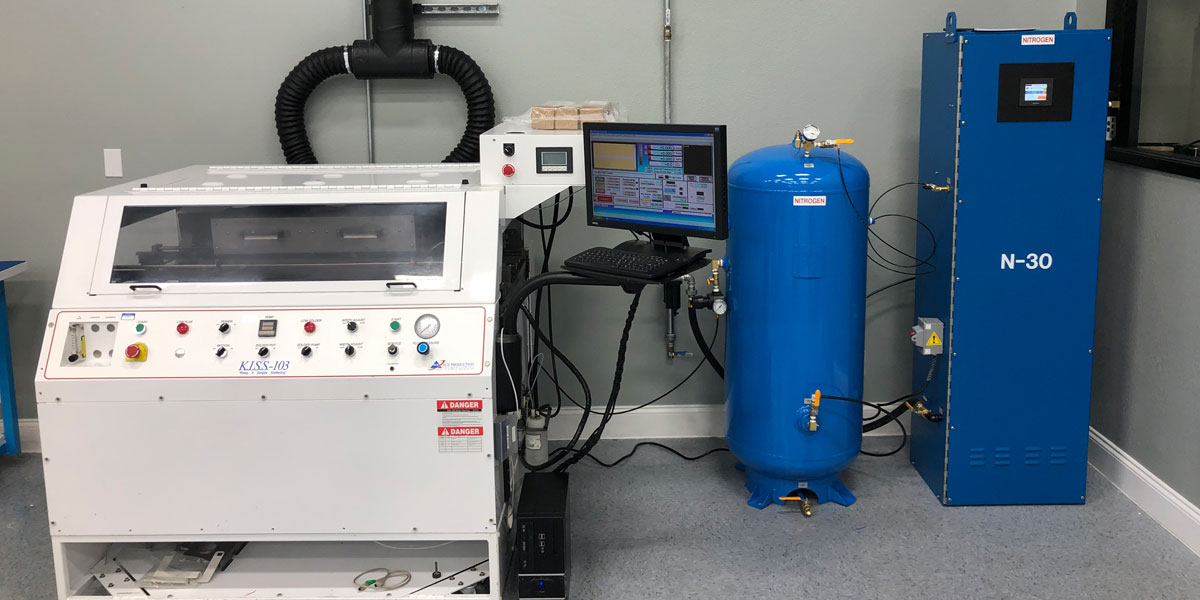
Selective soldering workstation equipped with on-site nitrogen generator ensuring oxide-free hand and robot-soldered connections on through-hole joints.
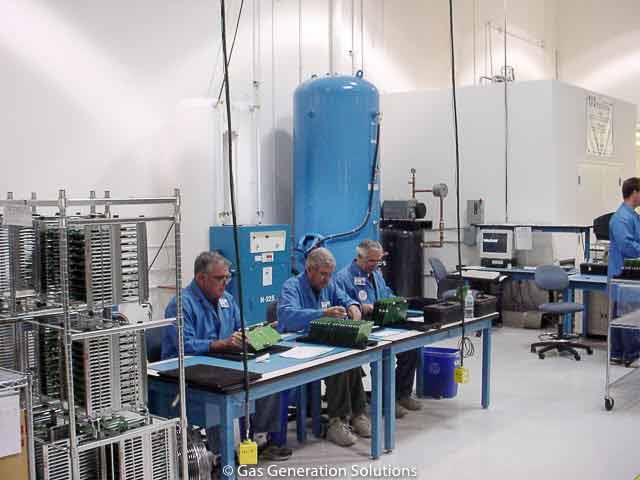
Multi-station selective soldering line supplied by a single on-site nitrogen generator, delivering consistent high-purity nitrogen stream to multiple workstations simultaneously.
Selective soldering applications
PCB through-hole assembly
High-mix low-volume PCB assembly lines use selective soldering to hand-solder or robot-solder through-hole components where reflow would damage nearby SMT parts already soldered to the board.
Automotive ECU and sensor boards
Automotive electronics require zero defects and high reliability. Selective soldering with high-purity nitrogen helps prevent bridging and cold joints on ECU power stages, sensor connectors, and safety-critical circuits.
Telecom backplanes and modules
Telecom switching equipment, optical transceiver modules, and data center backplanes rely on selective soldering to attach high-current connectors and specialized components with precision and repeatability.
Military and aerospace avionics
Avionics boards, flight control systems, and military-grade electronics are often selective-soldered with high-purity nitrogen, typically 99.999% or higher, to meet IPC Class 3 and zero-defect manufacturing requirements.
Medical device PCBs
Medical implants, patient monitors, diagnostic equipment, and life-support devices require traceability and flawless solder joints. Selective soldering with high-purity nitrogen supports repeatability and regulatory compliance.
Consumer and IoT high-mix lines
Consumer electronics, smart home devices, and IoT products benefit from selective soldering when designs mix through-hole and surface-mount assembly, reducing defects and improving first-pass yield.
Frequently asked questions
What purity does selective soldering need?
Selective soldering typically requires 99.99% to 99.999% nitrogen. The higher the purity, the fewer oxide defects form on joints. 99.99% is the sweet spot for most commercial selective lines; high-reliability applications (automotive, aerospace, medical) often run 99.999%. Our PSA systems can deliver up to 99.9995% for specialty applications above the typical selective range. Contact us with your workstation specifications and volume to confirm the right purity tier.
How is nitrogen delivered to the selective soldering pot?
On-site nitrogen is delivered via stainless-steel supply lines routed from the generator to the selective soldering workstation. A pressure regulator controls flow, and the nitrogen is piped into the heating chamber or inlet port, creating a blanket around the solder pot and joint area. The flow is typically adjustable from 50 to 500 SCFH depending on pot size, joint frequency, and cycle time. Most installations use a simple manual regulator or automated gas mixer for atmosphere control.
Can I add a nitrogen generator to my existing selective soldering machine?
Yes, if the machine is nitrogen-ready. Our nitrogen systems are compatible with major selective soldering OEMs, including ACE, Kurtz Ersa, Vitronics, JUKI, Pillarhouse, SEHO, DDM Novastar, Nordson, and RPS. Adding nitrogen supply involves running a line to the pot, installing a regulator or valve, and configuring the atmosphere setpoint. Contact us with the machine model and current atmosphere setup for a generator sizing recommendation.
How much nitrogen flow does a typical selective station need?
Flow demand depends on pot volume, joint density, cycle time, and target oxygen percentage. Most single selective stations consume 50 to 500 SCFH. A rule of thumb is 0.5 to 1.0 SCFH per cubic inch of pot volume. Multi-station lines can be served by one larger generator. For example, four 100-SCFH stations would be sized to about 400 SCFH total demand. We maintain a published flow-rate table covering major OEM selective soldering machines (Kurtz Ersa, ACE, Nordson, SEHO, JUKI, Pillarhouse, Vitronics, Soltec, and others) at our selective soldering equipment nitrogen flow rates page. Contact us with your station count, pot size, and line speed, and we will calculate the right generator size.
Does selective soldering require higher purity than reflow or wave?
Yes, generally. Selective soldering runs at 99.99% to 99.999% because nitrogen is delivered as a focused shroud over a small zone where small leakage matters. Reflow and wave both run at 99.9% to 99.99% because their atmospheres are larger and more turbulent. High-reliability selective applications (automotive, aerospace, medical) typically sit at the top of the selective range, 99.999%.
How does on-site nitrogen cost compared to cylinders, dewars, and bulk LIN?
Cylinders cost 6 to 10 dollars per hundred cubic feet, dewars cost 4 to 6 dollars per CCF, and bulk LIN costs 0.50 to 1.50 dollars per CCF. On-site generation costs just 0.05 to 0.15 dollars per CCF, delivering up to 90 percent savings. Most customers recover their system investment within 12 to 14 months. Ongoing operational savings continue for the 20+ year life of the system, and you eliminate cylinder delivery logistics and downtime.
What is dew point and why does it matter for selective soldering?
Dew point is the temperature at which nitrogen becomes saturated with water vapor and moisture condenses. High dew point nitrogen (wet nitrogen) introduces water into the solder joint, causing rapid oxidation and joint degradation. Selective soldering typically requires dry nitrogen at minus 40 dew point or better. Our PSA generators produce dry nitrogen if the upstream compressed air supply is properly dried and filtered. Inadequate air drying is a common installation mistake. We design air treatment into every system to deliver dry, high-purity nitrogen output.
Who handles installation and maintenance of the generator?
Gas Generation Solutions designs and supplies the on-site nitrogen system, sized for your selective soldering line. Installation is handled by the customer's qualified mechanical and electrical contractors at the customer's site, since site conditions and selective line layouts vary. We support the project with sizing, system drawings, startup procedures, and operator training. Routine maintenance, mainly filter changes, is performed by the customer; we supply replacement parts and technical guidance throughout the system's 20-year service life. If you want installation included in the quote, we can scope it as a separate line item. Contact us with your station count and pot specifications for sizing.