Pricing by Tier
Nitrogen Generator Price: $15K to $500K by Tier
Three tiers, five sizing factors. Small $15K to $35K, Medium $35K to $100K, Large $100K to over $500K. Price is set by flow rate, purity, output pressure, whether the system is standalone or turnkey, and whether a high-pressure booster is part of the build. This page walks you through each tier, what it includes, and where your application is likely to land.
How pricing works
Nitrogen generator pricing is set by physics, not by package tiers
A nitrogen generator's price tracks its physical capability. More flow, higher purity, and higher pressure all pull the number up. A turnkey package with its own compressor adds equipment cost. A high-pressure booster for laser cutting or cylinder filling adds again. Two systems with the same headline flow rate can be 3x apart in price if one runs at 99.5% and 60 PSI and the other runs at 99.99% and 100 PSI with a booster.
This page breaks the cost down two ways. First by tier, so you can see where small, medium, and large systems land and what each tier typically includes. Then by sizing factor, so you can see why two quotes can differ for what looks like the same job. The figures cited here come from systems Gas Generation Solutions has built and shipped. We have been in business since 1979 and ship across the United States, Mexico, and Canada.
If you already know your demand and want a catalog view of available configurations, see nitrogen gas generator for sale. If you want to walk through payback math and on-site generation cost in detail, see how much does a nitrogen generator cost. Otherwise read on for the tier breakdown.
What each tier looks like
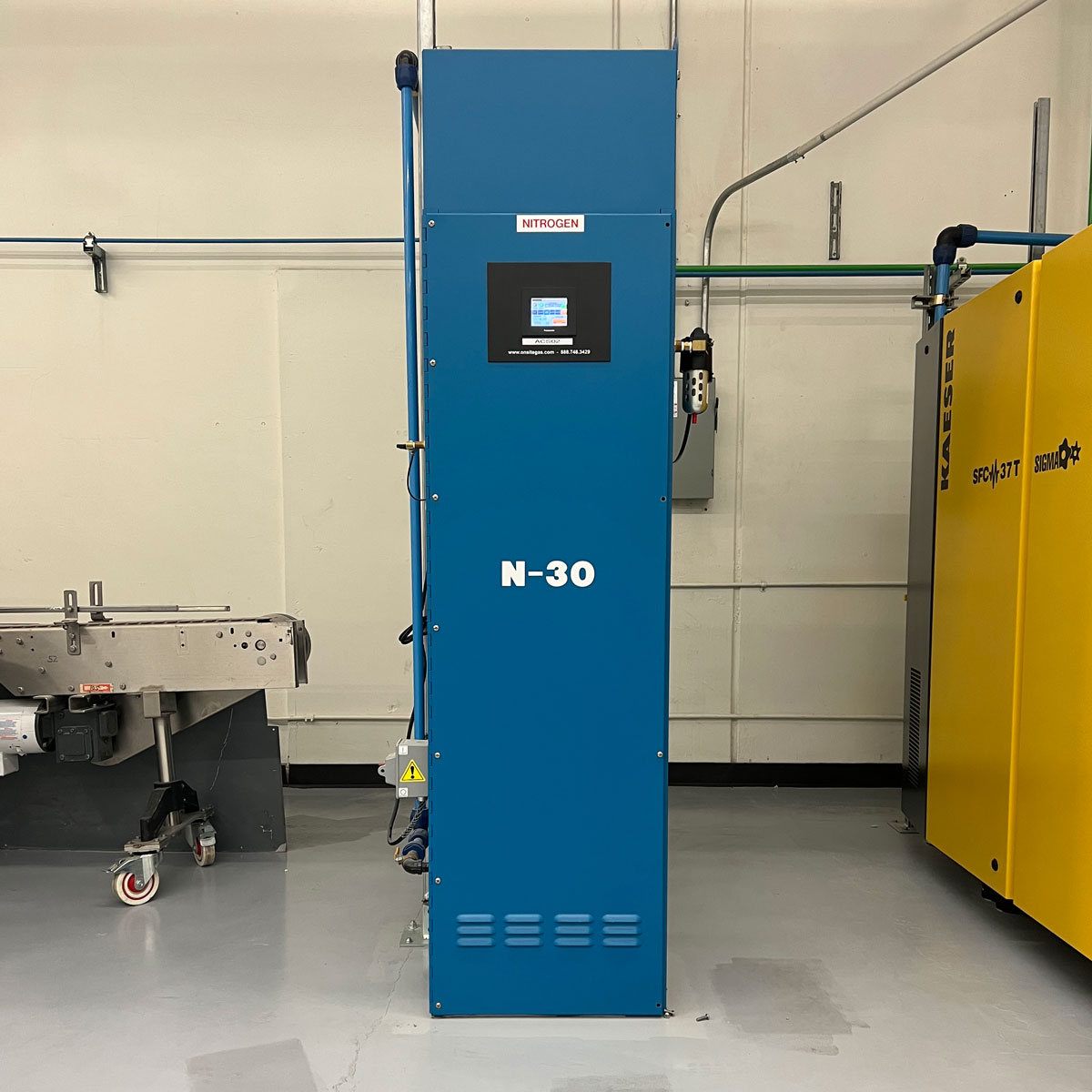
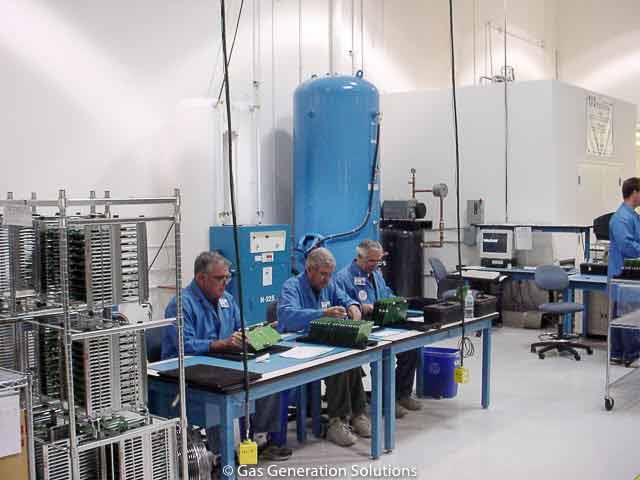
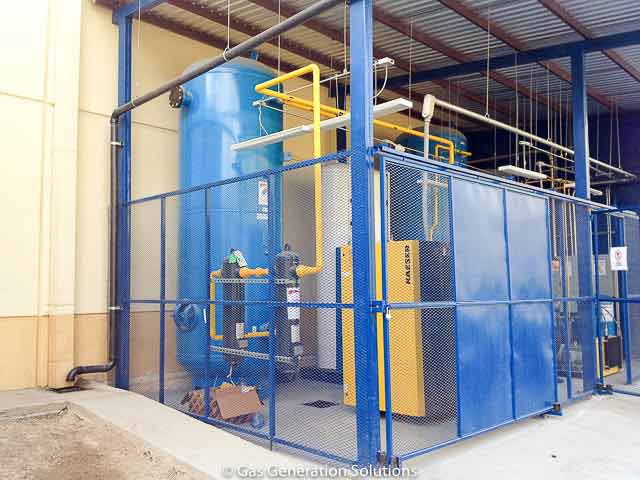
Small, medium, and large installs running today
Three real customer systems anchoring the tier ranges. Same engineering family, different scale.
What moves the price
Five factors that set what your nitrogen system costs
Every quote walks through these five variables. The first three are physical capacity. The last two are package and accessory choices. Two systems with the same headline flow rate can be 3x apart on price once these are dialed in.
Flow rate
How much nitrogen the system produces per hour, measured in SCFH (standard cubic feet per hour) or SCFM. Bigger generators have more sieve material, larger tanks, larger compressors, and more valves. Cost scales nonlinearly: doubling flow does not double price, but it always raises it.
Primary driverFlow accounts for the largest share of the price spread between Small and Large tiers.
Purity
The percent nitrogen in the output. Higher purity means more air is rejected per cubic foot of nitrogen produced, so the upstream compressor has to be larger and the sieve beds work harder. 95% to 99.5% is typical for food packaging. 99.9% to 99.999% covers electronics, soldering, and heat treating, with selective soldering and fine-pitch reflow at the top of that range. 99.999% and 99.9995% reach into laser cutting and semiconductor manufacturing.
Strong driverGoing from 99.5% to 99.99% can add 30 to 60 percent to a same-flow build because the compressor and sieve sizing both move.
Output pressure
The PSI the nitrogen leaves the generator at. Food packaging typically needs under 60 PSI. Electronics manufacturing typically needs 80 to 100 PSI. Laser cutting and cylinder filling need much higher pressure and trigger a separate booster compressor stage.
Step driverPressure adds modestly under 100 PSI. Above that, see factor 5 below.
Standalone or turnkey package
A standalone generator runs from your existing shop air supply. A turnkey package adds a dedicated air compressor sized to the generator, plus dryer, filtration, and a buffer tank. Standalone is cheaper if your shop already has clean dry air at the right flow. Turnkey is cleaner if you do not, or if dedicated supply is preferred for reliability and accountability.
Package driverAdding the dedicated compressor and dryer typically adds 30 to 50 percent to the standalone price for an equivalent generator.
High-pressure booster compressor
Required when nitrogen has to leave the generator above the PSA generator's native output pressure. Fiber laser cutting at 300 to 600 PSI is the most common trigger. Cylinder and dewar filling at 2,500 to 4,500 PSI is the heaviest. Boosters are sized to flow rate and target pressure, and they add their own footprint, electrical load, and maintenance schedule.
Bracket driverA booster can move a build from the Medium bracket into the Large bracket on its own. The booster itself plus its compressor and storage often runs $30K to $150K depending on flow and target pressure.
Tier comparison
Small, Medium, and Large nitrogen generators side by side
Tier ranges are typical street prices for build-to-order systems. The line between tiers is fuzzy. A high-purity small system can land in Medium pricing once the compressor and dryer are added; a large low-purity system can land in mid-Medium pricing if there is no booster.
Small tier
$15K to $35K
Build-to-order, US-built, ships in 6 to 10 weeks
Typical flow
40 to 500 SCFH
Typical purity
95% to 99.5%
Typical pressure
Under 60 PSI
Common applications
Coffee bag flushing, small craft food packaging, lab use, low-volume blanketing, beverage
Typical configuration
- PSA generator, sealed sieve beds
- ASME-stamped buffer tank
- Standalone (uses your shop air) or turnkey
- Floor-standing cabinet, indoor install
Medium tier
$35K to $100K
Build-to-order, US-built, ships in 8 to 14 weeks
Typical flow
500 to 5,000 SCFH
Typical purity
99.5% to 99.99%
Typical pressure
60 to 100 PSI
Common applications
Production-line food packaging, MAP, wave and reflow soldering, heat treating, wineries, multi-line plants
Typical configuration
- PSA generator with larger sieve volume
- ASME-stamped buffer plus reserve tank
- Turnkey package with dedicated compressor and dryer
- Skid-mounted, indoor or covered outdoor install
Large tier
$100K to $500K+
Build-to-order, US-built, ships in 12 to 20 weeks
Typical flow
5,000 to 100,000 SCFH
Typical purity
99.9% up to 99.9995%
Typical pressure
100 PSI native, 300 to 4,500 PSI with booster
Common applications
Fiber laser cutting, semiconductor manufacturing, vacuum heat treating, cylinder and dewar filling, plant-wide industrial
Typical configuration
- Multi-bed PSA, larger ASME tanks
- Turnkey with dedicated compressor and dryer
- High-pressure booster and storage when required
- Skid-mounted, often outdoor enclosure or dedicated mech room
Why your quote can land between tiers. Two systems sized for the same flow can land in different brackets once purity, pressure, package type, or a booster shifts. Send us your application and we will spec a build that hits your operating point without paying for capacity you do not use. Or build your own nitrogen generator to walk through the same five sizing factors first.
From application to price
Three real-world examples and the tier they land in
Same five sizing factors, three different applications, three different price brackets. The figures below are typical street prices for representative builds.
Small tier
Coffee roastery, 200 lb/hr capacity
Lands at $22K to $28K
Low flow, modest purity, low pressure, and no booster keep this in the Small tier. Standalone keeps it lower because the roastery already has clean shop air for the bag flusher.
Medium tier
Snack food packaging plant, two filler lines
Lands at $58K to $72K
Higher flow lifts it into Medium. Turnkey adds the dedicated compressor and dryer for production-line reliability. Pressure is high but stays under the booster threshold, so no booster cost.
Large tier
Fiber laser cutting shop, three machines
Lands at $250K to $300K
Higher purity raises the compressor and sieve sizing. The fiber laser pressure requirement triggers a high-pressure booster plus storage, which on its own moves the build firmly into the Large tier.
Where to go next
Catalog, ROI, or specific application
The two sister pricing pages and the most common application spokes buyers visit from this page.
Catalog · bottom of funnel
Nitrogen Gas Generator For Sale
Browse 100+ build-to-order configurations by flow rate, industry, and purity. Trust block, install gallery, and a request-quote form.
Browse the catalog →
ROI deep dive · top of funnel
How Much Does a Nitrogen Generator Cost
Walks through payback math, on-site generation cost per CCF, and the five inputs that move ROI. Pair with this page for a full picture.
See the ROI math →
Application pages buyers go to from here
Pricing FAQ
Common questions about nitrogen generator price
Answers to the questions buyers ask before requesting a formal quote.
What does a nitrogen generator cost?
On-site nitrogen generators run from about $15,000 to over $500,000. Small systems for craft food packaging, coffee bag flushing, and lab use start around $15,000 and go up to about $35,000. Medium production systems run $35,000 to $100,000. Large industrial systems for laser cutting, semiconductor, and plant-wide supply run $100,000 to over $500,000. Five factors set the final number: flow rate, purity, output pressure, whether it is standalone or turnkey, and whether a high-pressure booster is required.
Why can two quotes for the same flow rate be very different?
Because flow rate is only one of five sizing factors. A 1,000 SCFH generator at 99.5% and 60 PSI as a standalone unit lands very differently than a 1,000 SCFH generator at 99.99% and 100 PSI as a turnkey package with dedicated compressor and dryer. Higher purity raises the upstream compressor sizing because more air is rejected per cubic foot of nitrogen produced. Higher pressure raises the compressor stage sizing. Turnkey adds the dedicated air supply equipment. A booster, if required, can shift the whole quote into the next tier on its own.
What is included in a turnkey package?
A turnkey nitrogen generator package includes the PSA generator, the dedicated air compressor sized to the generator, an air dryer, particulate and oil filtration, an ASME-stamped buffer tank, and the connecting plumbing and instrumentation. The customer provides incoming power, floor space, and the connection to the point of use. A standalone generator does not include the compressor and dryer; the customer connects it to existing shop air.
What is the typical payback period?
12 to 14 months is the typical payback for a nitrogen generator that replaces delivered cylinder or bulk gas. Payback is driven by what the customer was paying before switching to on-site generation, the cost of generating nitrogen on-site (typically $0.05 to $0.15 per CCF depending on power rates and purity), and how much volume the operation actually uses. Higher-volume sites pay back faster. See the cost and ROI page for the full math.
Is financing available?
Yes. Equipment financing is available for any size system. Most customers structure payments so the monthly finance cost is less than the monthly delivered-gas cost they replace, which means cash flow improves on day one. Mention financing on the quote request and we will route the project to a partner who handles industrial gas equipment.
Do prices include installation?
Tier prices on this page cover the equipment, shipping to the United States, Mexico, or Canada, and start-up support. Site preparation (electrical, concrete pad if needed, exhaust ducting if required, plumbing to the point of use) is typically handled by the customer's mechanical contractor or facilities team. We provide the install drawings, utility requirements, and start-up checklist. For turnkey installs we can connect you with installation partners on request.
How long is the lead time?
Small systems typically ship 6 to 10 weeks from approved drawings. Medium systems run 8 to 14 weeks. Large systems with boosters or specialty configurations run 12 to 20 weeks. Lead time is set at the time of order based on current build queue and any custom configuration. We commit to dates in writing and ship direct to your site.
What information do you need to give me a quote?
Three numbers are enough to produce a real quote: target flow rate (SCFH or SCFM), required purity (percent nitrogen), and required output pressure (PSI). Add the application (what the nitrogen feeds), whether you have existing shop air, and your zip code for shipping. Most quotes go out within 24 to 72 hours of receiving these inputs. If you do not know your flow rate, we can ship a free flow meter to measure your current consumption.
Step 1: size the system
Free flow meter, on us
Not sure of your current nitrogen consumption? We ship a free flow meter that records your actual demand over a typical week. The data drives the right tier and avoids paying for capacity you do not use.
Step 2: get an exact quote
Send your flow, purity, and pressure
Three numbers and your application is enough for a real quote. Most go out within 24 to 72 hours. Phone: 760-505-1300.