On-Site Nitrogen for Pharmaceutical Process Gas
Nitrogen Gas Generators for the Pharmaceutical Industry
On-site nitrogen for reactor blanketing, lyophilization vacuum break, tablet and film coating, sparging and API drying, cleanroom inerting, and autoclave and sterilizer cycles. Continuous purity at the manifold, no cylinder swap mid-batch, and one auditable gas source for batch records.
Process-gas purity range
Continuous purity log for batch records
Typical payback
Service life
Process Gas at Manufacturing Scale
Pharmaceutical manufacturing has a continuous-nitrogen problem
Reactor batches that run for hours under inert headspace, lyophilizer cycles that have to break vacuum with dry nitrogen rather than ambient air, and tablet coaters that run continuous shifts on solvent-based or aqueous coatings all share one supply problem: cylinder and dewar gas runs out. A switch mid-reactor is a quality event that sends the batch to investigation. A delivery delay during a lyo cycle compromises a freeze-dry. On-site generation removes the supply variable entirely so the manufacturing line sees one continuous nitrogen source at the manifold.
Six places nitrogen earns its keep in pharma manufacturing: reactor blanketing for oxygen-sensitive APIs, lyophilization vacuum break for biologics and small-molecule injectables, tablet and film coating on solvent or aqueous lines, sparging and API drying after crystallization, cleanroom inerting on classified spaces and isolator chambers, and autoclave and sterilizer cycle purges. The same generator can supply more than one of these from a common buffer tank when the peak flows and required purities overlap, which is most multi-suite plants. For dedicated medicinal product manufacturing, including drugs, biologics, vaccines, and sterile compounding, see our nitrogen generator for medicinal manufacturing page.
Switching to on-site replaces cylinder and dewar deliveries with a continuous source rated for 20 years or more, recovers the investment in 12 to 14 months at typical manufacturing duty, and removes the batch-interruption risk that comes with running out of gas mid-cycle. Every system we supply includes a built-in oxygen analyzer in the buffer tank, so each batch record can attach a continuous purity log without extra instrumentation.
Medical Devices and Pharma Packaging: downstream finishing
For nitrogen on the finishing side: blister and vial headspace flush, sterile barrier packaging, lyo backfill on the closed-container side, and ethylene oxide sterilization purges. The complementary downstream page covers fill-finish operations.
Open the packaging page →Labs and Laboratory: analytical and QC
For nitrogen on the analytical side: LC-MS curtain and source gas, QTOF drying and collision cell, sample evaporation, and stability chamber inerting. Same generator family, smaller cabinet for QC and analytical labs.
Open the labs page →Sample installations
On-site nitrogen for pharmaceutical manufacturing
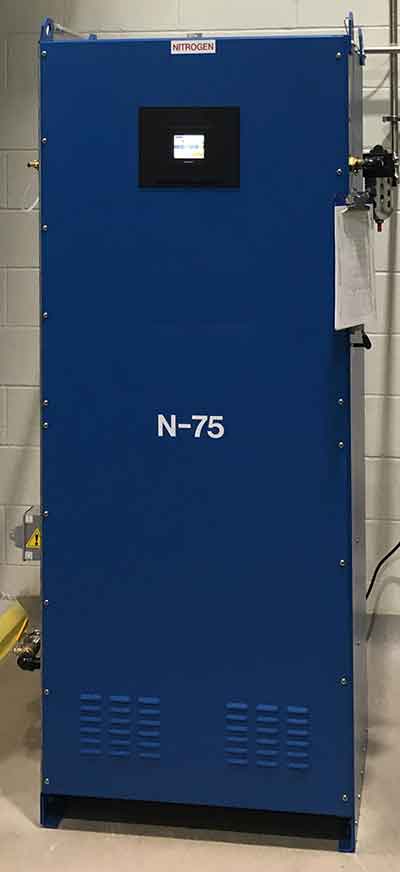
PSA nitrogen generator package serving a pharmaceutical manufacturing facility. Continuous purity at the manifold supports reactor blanketing, lyo backfill, and tablet coating from a common buffer tank.
Manufacturing-scale nitrogen package: PSA cabinet, buffer tank, and air treatment train. Sized to peak flow across multiple suites with the built-in oxygen analyzer logging buffer-tank purity for batch-record evidence.
By Application
Six places nitrogen earns its keep in pharma manufacturing
Six process-gas applications across the pharma plant. The same generator can supply more than one of these from a common buffer tank when peak flows and required purities overlap, which describes most multi-suite operations.
Reactor blanketing
Inert headspace over batch reactors, hold tanks, and crystallizers running oxygen-sensitive APIs and intermediates. Continuous low-flow nitrogen supply on the reactor manifold maintains positive pressure throughout the batch and protects product chemistry from atmospheric oxygen ingress on charging and discharging.
- Typical purity99% to 99.99%
- Flow patternContinuous low-flow on manifold
Lyophilization vacuum break
At the end of a freeze-drying cycle, the chamber vacuum is broken with nitrogen rather than ambient air so freeze-dried cake finishes under inert headspace. Standard practice for biologics, monoclonal antibodies, and oxygen-sensitive small-molecule injectables. The cycle peak at backfill drives the buffer-tank sizing.
- Typical purity99.99% or higher
- Demand patternCycle peak at backfill
Tablet and film coating
Inerting on solvent-based and aqueous tablet and film coaters protects oxygen-sensitive API cores and prevents solvent vapor from approaching the lower flammability limit inside the coating drum. Continuous nitrogen at the drum reduces the oxygen percentage in the recirculation loop below the LFL margin.
- Typical purity99% to 99.5%
- Flow patternContinuous during coater run
Sparging and API drying
Sparging through process solvents to strip dissolved oxygen before charging an oxygen-sensitive reaction, and post-crystallization drying of API powders under nitrogen sweep in a vacuum tray dryer or filter dryer. Both run during defined process steps rather than continuously.
- Typical purity99% to 99.5%
- Flow patternStep-defined high flow
Cleanroom and isolator inerting
Inert headspace in classified isolator chambers, RABS enclosures, and weighing booths handling oxygen-sensitive APIs. Lower flow than reactor or coater service, but a tight residual oxygen specification at the point of use because the chamber atmosphere is held inert during operator transfers.
- Typical purity99.99%
- Flow patternContinuous low-flow into chamber
Autoclave and sterilizer cycle purges
Nitrogen displacement on steam autoclaves running prevacuum cycles, plus chamber backfill and degas on ethylene oxide sterilizers. Sterilizer cycles draw a peak demand for a short window during evacuation and backfill steps; a buffer tank covers the peak so the generator runs at steady flow.
- Typical purity99% to 99.5%
- Demand patternCycle peak during evac and backfill
Purity by Use
Pick the lowest purity that meets your process spec
Higher purity costs more compressed air per cubic foot of nitrogen produced. Sizing the system to the highest purity any one line actually needs (not the highest in the catalog) keeps both equipment cost and operating cost down across the plant.
A/N ~2.8
Reactor blanket and process purges
Reactor blanket on standard APIs, tablet coater inerting, autoclave purge, sparging through process solvents.
A/N ~3.4
General manufacturing inerting
General process inerting where additional headroom against the product spec is wanted, EO sterilizer chamber backfill, API drying.
A/N ~4.6
Sensitive APIs and isolator chambers
Reactor blanket on oxygen-sensitive APIs, isolator chamber inerting, lyo backfill on standard injectables, cleanroom point-of-use feeds.
A/N ~5.8 and up
Biologics lyo backfill
Lyophilization backfill on biologics with tight residual O2 spec, monoclonal antibody fill, oxygen-sensitive protein products. Highest purity, highest air cost.
PSA from compressed air
Pressure swing adsorption pulls nitrogen from compressed shop air. Two beds of carbon molecular sieve adsorb oxygen under pressure while the second bed regenerates at low pressure. The cycle alternates so the manifold sees a continuous flow of dry, oil-free nitrogen.
Output is rated at the nameplate purity continuously, not just at a peak. Every system includes a built-in oxygen analyzer continuously logging buffer-tank purity, so each batch record can attach a continuous purity log without adding a third-party instrument to the line.
Why the air-to-nitrogen ratio matters
Producing 99% nitrogen takes about 2.8 cubic feet of compressed air per cubic foot of nitrogen. Producing 99.999% takes roughly twice that. The compressor sized for the higher purity is materially larger and burns more electricity for the life of the system.
If only the lyo line on the floor needs 99.999% and every other process runs at 99.99% or below, it is often cheaper to undersize the main generator to the lower-purity loads and run a small dedicated cabinet for the lyo than to push the whole plant up to the high-purity tier.
What Clean Nitrogen Protects
What goes wrong without a continuous, on-spec nitrogen source
Each of these failure modes traces back to either oxygen ingress, a gap in the gas supply during a validated cycle, or a purity drift outside the process specification. The result is rarely a small adjustment. It is a CAPA, a discarded batch, or an EH&S incident.
Reactor blanket pressure dip mid-batch
A multi-hour reactor batch running on a cylinder manifold sees the manifold pressure drop as cylinders empty and rotate. A pressure dip below positive can pull ambient air across the headspace seal and introduce oxygen exposure. The batch ends in investigation regardless of whether the API actually degraded.
Result: continuous nitrogen at the reactor manifold, no manifold pressure dip during change-out, no mid-batch supply interruption, and a built-in oxygen analyzer reading the buffer tank for batch-record evidence.
Lyophilization backfill failure
A lyo cycle that cannot break vacuum with nitrogen at the scheduled time leaves the freeze-dried cake exposed to ambient air on chamber door open. Biologic potency loss and oxygen-sensitive small-molecule impurity drift show up months later at the stability pull, not at fill. The lot is at risk.
Result: sized to the cycle peak demand at the highest purity any lyo product needs, with buffer tank capacity for the short, sharp peak. No reliance on cylinder rotation timing during a multi-day cycle.
Tablet coater lower-flammability-limit margin
Solvent-based film coating recirculates organic vapor inside the drum. If the inerting nitrogen flow drops or the drum oxygen reading climbs, the recirculation atmosphere can approach the lower flammability limit. The coater interlocks shut down the run, the batch holds, and the EH&S investigation begins.
Result: continuous on-spec nitrogen at the coater inlet at the right flow for the drum size, with the buffer tank covering recirculation peaks. Drum oxygen reading stays within validated margin.
API drying cycle impurity drift
A vacuum tray dryer or filter dryer running on a cylinder bank that runs out partway through a sweep cycle leaves the API powder exposed to residual oxygen. Subsequent stability data shows an impurity profile drift outside the product specification, and the lot is rejected.
Result: continuous nitrogen sweep at the sized flow for the entire cycle. The dryer cycle finishes under inert atmosphere as designed.
Sizing and Payback
Three numbers to size, three numbers to justify
Manufacturing-scale sizing is straightforward when the process list is in front of you. Sum the per-process peak flows at each purity tier, add buffer for cycle peaks, and match a generator that holds spec at the highest tier any process needs. Three inputs drive the build, three drivers drive the payback, and the worked example below shows how a typical multi-suite plant lands.
Sizing inputs
- 1. Peak nitrogen flow per process SCFH or SCFM at the reactor manifold, lyo chamber backfill peak, coater drum inlet, or sterilizer chamber during the busiest cycle phase.
- 2. Required purity per process The process specification or chamber qualification, not the highest purity in the catalog. Tablet coater 99%, reactor 99.99%, lyo backfill 99.999%.
- 3. Required pressure at point of use Most reactor and coater service runs 60 to 100 PSIG. Lyo and isolator service runs lower. High-pressure service requires a separate booster.
Payback drivers
- Cylinder and dewar avoidance Per-CCF delivered-gas cost runs roughly $6 to $10 per CCF for cylinders and $4 to $6 per CCF for dewars. On-site nitrogen runs roughly $0.05 to $0.15 per CCF, or up to a 90% reduction.
- Change-out labor and traffic No forklift moves, no hose disconnects, no manifold rotation. Validation gets one source to qualify, not a rotating supplier list.
- Batch interruption avoided A reactor batch held mid-cycle on a manifold dip is a CAPA and an investigation. A lyo backfill that misses its scheduled time is a discarded freeze-dry. On-site removes both failure modes entirely.
Worked example: reactor manifold, lyo line, and tablet coater
Reactor manifold
50 SCFH @ 99.99%
Lyo backfill peak
200 SCFH @ 99.999%
Tablet coater
50 SCFH @ 99%
Sized at 99.999%
~300 SCFH
If the same generator supplies all three from a common buffer, the system has to be rated at 99.999% across the rolled-up flow because the lyo line drives the spec. Sustained-plus-buffer demand is around 250 to 300 SCFH at 99.999%, which lands on a mid-cabinet running on roughly 30 SCFM of compressed air. If only the lyo line truly needs 99.999%, sizing the main generator to 99.99% across the reactor and coater and running a small dedicated cabinet for the lyo backfill is often the cheaper installed-cost option, with a smaller compressor footprint plant-wide.
Frequently Asked Questions
Pharmaceutical manufacturing nitrogen FAQ
What size nitrogen generator does a multi-line manufacturing plant need?
Sizing depends on three numbers: peak nitrogen flow at each point of use, the highest purity any one process needs, and the cycle pattern of the largest peak. A multi-suite plant running a reactor manifold at 50 SCFH, a tablet coater at 50 SCFH, and a lyo line that peaks at 200 SCFH during backfill rolls up to roughly 250 to 300 SCFH at the lyo purity tier. Send peak SCFH per process and the required purity for each, and we will size against your existing shop air and target pressure.
What purity is required for biologic lyophilization backfill?
Lyophilization backfill purity is set by the product specification, typically 99.99% or higher. Biologics, monoclonal antibodies, and certain oxygen-sensitive proteins call for residual headspace oxygen in the parts-per-million range, which means purity in the 99.999% band or above. The generator must be sized for the cycle's peak vacuum-break demand, which is short and sharp; a buffer tank smooths that demand so the cabinet can run at a steadier flow upstream of the lyo chamber.
How does on-site nitrogen support batch records and validation?
On-site PSA generates a continuous, single-source gas at nameplate purity, which is easier to document in a batch record than a cylinder bank rotated by a supplier. Every system we supply includes a built-in oxygen analyzer continuously logging buffer-tank purity, so each batch record can attach a continuous purity log without adding a third-party instrument to the line. Equipment qualification covers the generator and its built-in analyzer once, rather than re-qualifying every cylinder lot or supplier change. GGS supplies the generator; documentation, validation, and any process-gas qualification activities are owned by your quality team.
Can the same generator supply reactor blanketing and lyophilization backfill?
Often, yes, with one design constraint: the generator has to be sized to the highest purity any process needs. If reactor blanketing runs at 99.99% and lyo backfill needs 99.999%, the system has to be rated at 99.999% across the full rolled-up flow. A common buffer tank covers the lyo cycle peak so the cabinet runs at a steadier upstream flow. If the lyo line is the only process that truly needs 99.999%, sizing the main generator to 99.99% and running a small dedicated cabinet for the lyo backfill is often the cheaper installed-cost option.
What pressure does point-of-use nitrogen need at the reactor manifold?
Most reactor blanketing runs at 60 to 100 PSIG at the manifold, set just above the reactor headspace operating pressure to maintain positive nitrogen flow during charging and discharging. Tablet coaters and isolator chambers typically run lower. Sterilizer chamber backfills run at chamber-pressure setpoints. The PSA generator delivers at the cabinet outlet, with regulators at each point of use stepping the pressure to the process requirement. High-pressure service such as cylinder fill or specialty applications requires a separate booster compressor.
How does manufacturing-scale nitrogen differ from packaging-line nitrogen?
Both use the same PSA technology and many of the same purity tiers, but the demand pattern is different. Manufacturing-scale loads tend to be continuous low-flow over hours of reactor or coater run time, with intermittent cycle peaks from lyo or sterilizer chambers. Packaging-line loads tend to be steady continuous flow during a line shift with intermittent EO chamber peaks. A multi-suite plant that runs both upstream manufacturing and downstream packaging is often best served by a centralized nitrogen system sized to the rolled-up plant peak, with both demands fed from a common buffer.
How much shop floor space and utilities does a manufacturing-scale system require?
The cabinet footprint scales with flow and purity. A small reactor-only or lyo-only generator fits in a roughly 5 by 5 foot footprint plus a buffer tank. A multi-suite plant generator with a buffer sized for lyo and sterilizer peaks runs 8 to 12 feet plus the buffer tank. Utilities required are feed air from the existing plant compressor, electrical power, and a vent path for the regeneration exhaust. Larger systems can be located in a utility room with the buffer tank near the manifold, or containerized outside the building. We size and lay out the equipment around your existing shop air and any available wall or yard space.
What is the typical payback for a manufacturing-scale nitrogen system?
Most pharma manufacturing installations recover the system investment in 12 to 14 months, driven by displaced cylinder and dewar deliveries, eliminated change-out labor, and avoided batch interruptions on multi-hour reactor runs and lyo cycles. Operating cost falls up to 90 percent versus delivered gas at typical manufacturing duty. After payback, the cost basis is electricity to run the compressor and routine filter changes, and the system is rated for 20 years or more of service life.
Get a Sized Quote
Send the process list. We will size against your existing shop air.
A typical sized-quote conversation takes 10 to 15 minutes once we have the basics. The numbers we need to scope a manufacturing-scale system:
- Process list with peak nitrogen flow per point of use (SCFH or SCFM)
- Required purity per process (reactor / lyo / coater / sparge / cleanroom / sterilizer)
- Required pressure at point of use (PSIG at manifold or chamber inlet)
- Existing plant compressor capacity and dewpoint, if any
- Current monthly cylinder, dewar, or bulk delivery volume and supplier line items
If you don't have these numbers
A two-week flow-meter baseline replaces the guesswork
Plants on bulk or cylinder service often do not have a clean read on actual peak flow. We rent a flow meter with a cellular data logger that installs at the existing nitrogen header, captures peaks across two weeks of normal operations, and produces a baseline curve that sizes the generator without overshoot.
The reading replaces guesswork on cylinder swap rate, chamber-cycle math, or dewar consumption averages.
Pharma Manufacturing Coverage
Sized for the manufacturing operations that run on continuous nitrogen
From single-line API plants to multi-suite biologics manufacturing, the generators we supply are sized to the actual rolled-up plant flow at the highest purity any process needs. Continuous purity at the manifold, batch-record-ready purity logging from the built-in oxygen analyzer, no cylinder rotation during a multi-day cycle.