
Technical Reference for Compressed Air and Nitrogen Flow Measurement
Flowmeters for Compressed Air and Nitrogen Gas
A reference page on the flow meter types, pipe size range, data logger features, and installation principles that decide whether a flow measurement is useful or noise. Free rental kits ship across the United States, Mexico, and Canada for sites that want to size an on-site generator off measured data.
No fee, no purchase pressure
Meters and loggers built domestically
Pipe size range across fleet
Time-stamped trace, no WiFi needed
Why a Flow Measurement Matters
Measure first, then size, then save
The flow meter is the cheapest piece of equipment in the on-site nitrogen story. A measured number from a meter on the line for a week is a better input to a generator quote than a year of nameplate guesses, equipment manuals, or memory of last quarter's bulk gas invoice. The same is true of compressed air. A logged trace tells you what you are actually using, where your peaks land, and how long the line idles between draws.
This page is the technical reference for the rental fleet. Below you will find the two meter shapes in service across the rental kits, how the cellular data logger captures the trace, the standard pipe size range, the units of measure used in the data file, and the install positions that produce a clean reading. A nitrogen flow meter and a compressed air flow meter are both covered here, and both spellings, flowmeter and flow meter, turn up across equipment manuals and purchase orders for the same instrument. If you have a working knowledge of plant air systems, this page is intended as a quick orientation. If you are new to flow measurement, the same content reads from the top.
The rental program is free of charge. Standard term is 30 days. We ship the kit out at no cost. The customer covers return shipping on their own carrier account at the end of the rental, which typically runs a few dollars ground. Some applications need a single flow meter on a single supply line. Others need a multi-meter kit covering several pipe sizes across a plant. Both are intended to give the customer a measurement before any quote, any purchase, or any commitment to a generator size class.
Free flowmeter rental kit (standard)
The standard rental program for low-pressure nitrogen and compressed air lines. Digital cellular-logger meter or inline ball-style, 3/8 inch through 8 inch, 30-day term, free outbound shipment.
View rental program →High-pressure flowmeter rental
High-pressure flowmeter rated for up to 600 PSIG, paired with the same cellular data logger and built for fiber laser cutting and other high-pressure applications. Separate kit, same free rental terms.
View HP variant →Flowmeter Hardware
Two meter shapes and the data they produce
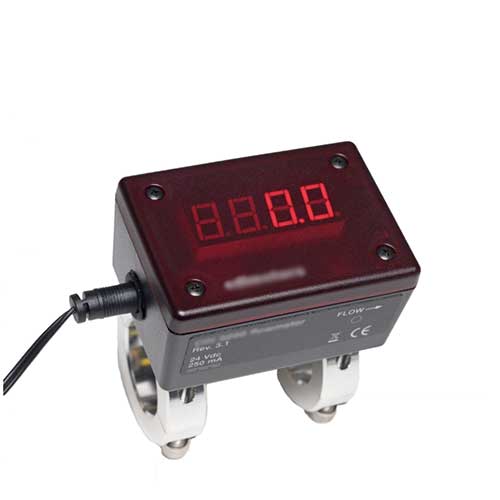
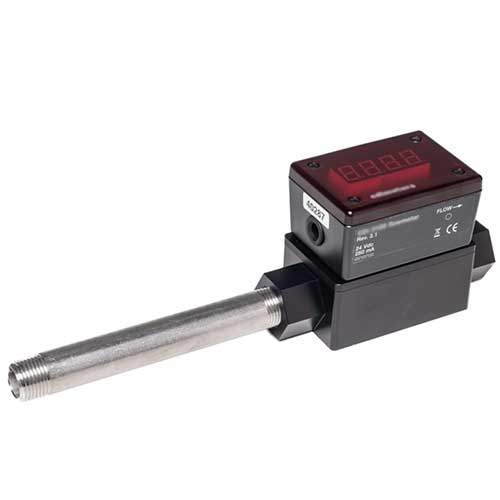
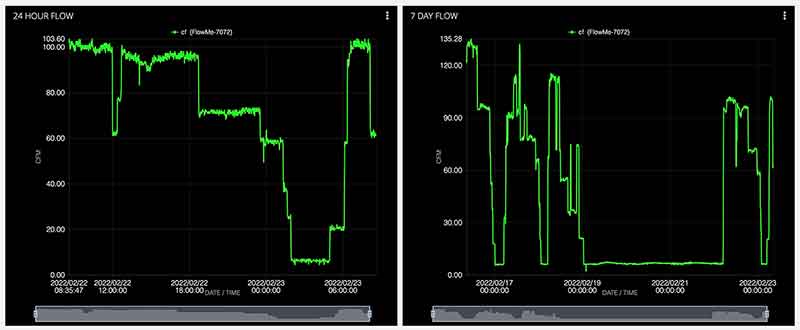
A clamp-style digital meter on an existing nitrogen line, the same meter installed at the point of use, and the live data logger trace as it appears on the web dashboard during a typical week of plant operation.
Meter Types In Detail
Two meter shapes cover the full duty range
High-flow production lines call for a digital meter with cellular data logging so the duty cycle is captured automatically across days or weeks. Low-flow points like glove boxes and small tools are easier to read off a face-display ball-style meter. Both ship in the rental program and a single kit can carry both.
Type 01
Digital flowmeter with cellular data logger
Clamp-style or inline digital meter paired with a cellular data logger. The meter reports the instantaneous flow rate to the logger on a fixed sampling interval and the logger transmits the readings over a built-in cellular link. The output is a time-stamped trace covering the full rental window.
Best for
- Production lines, multi-shift duty, plant-wide supply headers
- Any application where transient peaks matter for buffer-tank sizing
- Sites where on-site IT cannot or will not provision WiFi for a temporary device
What it cannot do
- Read instantaneous flow at a glance for an operator on the floor
- Operate without battery or power for the meter and logger
Type 02
Inline ball-style flowmeter
Mechanical variable-area flowmeter with a face display showing the current flow rate. A float inside a vertical tube rises until the gas flow around it balances the float weight, and the position of the float on a calibrated scale shows the flow rate. No power, no network, no logger.
Best for
- Glove boxes, small tools, single-station soldering pots, low-flow lab points
- Spot checks during a session or shift where an operator can read the gauge
- Rough-cut sizing on any line where logging the full trace is overkill
What it cannot do
- Capture a time-stamped trace without an operator writing readings down
- Catch short transient peaks that occur between manual readings
Data Logger Architecture
What the cellular logger captures and returns
The logger pairs with the digital flowmeter, samples the meter's flow output on a fixed interval, time-stamps each reading, and streams the readings to GGS servers over a built-in cellular link. The customer views the live trace on any phone, tablet, or computer through a web dashboard throughout the rental, and receives a summary of the values that drive generator sizing at the end.
Capture 01
Time-stamped flow trace
Every sample carries a timestamp. The trace shows when the line drew, how much it drew, and how long each draw lasted. The shape of the trace is what reveals shift patterns, idle periods, and product-changeover spikes that nameplate numbers obscure.
Capture 02
Average flow over the duty cycle
Mean flow rate across the full measurement period. This is the steady-state number a continuous-duty PSA generator needs to match to keep up with demand. Most well-instrumented plants land their average flow lower than they expected coming in.
Capture 03
Peak flow events
Short-duration spikes in demand. Typical of laser pierce events, oven warmup cycles, and batch transitions on a packaging line. Peak flow drives the buffer tank sizing more than it drives the generator. The trace tells the difference.
Capture 04
No on-site network setup
Cellular transmission means the logger does not need WiFi, ethernet, or any IT involvement at the site. Plug in the meter, plug in the logger, and walk away. Useful at sites where security policy or network architecture would block a temporary device on the wired network.
Units and Install Principles
Reading the data file and placing the meter on the line
Flow units in the data file
Unit 01
SCFM
Standard cubic feet per minute. Standard reference conditions correct for temperature and pressure so two readings taken at different shop conditions are still directly comparable. SCFM is the default unit for North American nitrogen and compressed air sizing.
Unit 02
SCFH
Standard cubic feet per hour. Same unit family as SCFM, scaled up by 60. Generator catalogs commonly publish capacity in SCFH for low-flow lab and small-shop tiers, and in SCFM for plant-scale tiers.
Unit 03
Nm³/h
Normal cubic meters per hour. Metric standard-conditions unit, common on European-built equipment specs. The data file can be converted between SCFM, SCFH, and Nm³/h without losing fidelity since all three normalize to standard reference conditions.
Install positions that produce a clean read
Tip 01
Mount close to the equipment under measurement
Putting the meter on the supply line to one specific machine gives a cleaner read than mounting it on a header where several branches merge. The closer the meter is to the duty, the easier it is to attribute the trace to the application.
Tip 02
Allow a straight run upstream of the meter
Elbows, tees, and partially closed valves immediately before the meter create swirl and turbulence that bias the reading. The kit ships with install instructions including the recommended straight pipe length for the meter type, sized to the pipe in question.
Tip 03
Stay downstream of pressure regulators
Standard-condition flow units are corrected for pressure, but a meter mounted upstream of a regulator sees a pressure profile that does not match the application. Mounting on the regulated side gives a reading that reflects what the equipment actually consumes.
Tip 04
Run for a representative window
A single shift is usually enough for a single-product line. A full week is closer to right for a multi-product line with shift-by-shift variation. The standard 30-day rental term is intended to give the customer room to log whatever window matches their duty pattern.
Where Flow Measurement Pays Off
Six application classes where measured data lands the right generator
Each of these has a published nameplate flow rate that almost never matches actual duty. A logged trace from one of these lines resolves the gap and lets the sizing engineer pick a generator off real numbers.
Laser cutting assist gas
High flow / digital + logger
Fiber and CO2 lasers swing flow with material thickness, kerf, pierce frequency, and assist pressure. The logged trace separates the steady cutting average from the high-pressure pierce peaks so the generator and any high-pressure booster get sized correctly.
Reflow and wave soldering ovens
Mid flow / digital + logger
Per-oven nitrogen draw varies with belt speed, nozzle configuration, and product mix. Logging a typical production day across one or several ovens captures the aggregate that drives generator selection across the SMT line.
Heat treating and annealing
Mid to high flow / digital + logger
Belt furnaces, box furnaces, and bell furnaces each have a different inerting demand by zone. A meter on the supply header captures total flow across a representative cycle including the warm-up purge and the cool-down step.
Food packaging and MAP lines
Mid flow / digital + logger
MAP flush rates depend on bag count per minute, headspace volume, and the gas-flush specification. A measurement run during a live shift lands the generator and the buffer tank for the actual line tempo, not the manufacturer's worst-case rated number.
Selective soldering pots
Low flow / ball-style
A single selective soldering nozzle draws a low and steady flow. A face-display ball-style meter is enough to log the duty rate and confirm the right small generator size for one or several stations operating in parallel.
Glove boxes and small tools
Low flow / ball-style
Lab glove boxes, small inerting chambers, and bench-top tools rarely justify a digital logger. The ball-style meter on the line gives a quick read that an operator or engineer can spot-check across a few sessions to bound the duty.
Frequently Asked Questions
Compressed air and nitrogen flowmeters
What meter types are in the rental fleet?
Two shapes. A digital flowmeter that pairs with a cellular data logger captures average flow, peak flow, and a time-stamped trace across the rental window. An inline ball-style flowmeter has a face display showing the current flow rate and needs no power, no logger, and no network. A single rental kit can carry both for sites with mixed flow points.
What pipe sizes does the rental fleet cover?
Pipe sizes from 3/8 inch through 8 inch across the digital and ball-style meters. Sites with a main supply header plus several branch lines or tool drops can take a multi-size kit so the same rental covers everything in one shipment. Applications outside the standard size range are checked against the fleet on request.
What units does the data file report?
The default reporting unit is SCFM, standard cubic feet per minute. The same trace can be presented in SCFH or in metric Nm³/h on request. All three normalize to standard reference conditions, so a measurement taken in one shop is directly comparable to a measurement taken in another shop without correction.
How long does the rental run?
Standard rental term is 30 days. Longer terms are available on request, and the term can be extended mid-rental by replying to the original shipment email. Some applications close after one shift of measurement. Others need a full month to capture every product changeover and shift pattern. Both work in the program.
Do you have flowmeters for high-pressure applications?
Yes. High-pressure flowmeters paired with the same cellular data logger are available, rated for up to 600 PSIG and sized for fiber laser cutting and other high-pressure applications. The high-pressure rental is a separate kit with its own page. Tell us your operating pressure and we will pick the right kit from the fleet.
Where on the line should the meter be mounted?
Close to the equipment under measurement, downstream of any pressure regulator, and with the recommended straight pipe length upstream of the meter. The kit ships with install instructions covering the meter type and the pipe size in question. The closer the meter is to the duty, the easier it is to attribute the trace to the application.
Is there really no rental charge?
Yes. The rental program is free of charge. No rental fee, no deposit, no purchase pressure. Outbound shipping is on us; the customer covers return shipping on their own carrier account at the end of the rental, which typically runs a few dollars ground. The reason the program exists is that right-sizing a generator off measured flow is much more accurate than sizing off nameplate, and the customer who measures first ends up with a better-fit system. We would rather help you measure than guess.
What happens to the data after the rental ends?
Ship the kit back when the rental window closes out. The data is already in our system because the cellular logger streams to our servers in real time, so you have had access to the trace on the web dashboard throughout the rental. We send a final summary of average flow, peak flow, and duty cycle alongside the raw trace. Most customers use those numbers to size an on-site generator. Some file the data and come back six months later when the timing is right. The data is yours, the rental is closed out, and there is no follow-on commitment.
Tell us the application, the pipe, and the operating pressure
A short conversation about the equipment under measurement, the pipe size at the proposed install point, and whether the line is low or high pressure is enough to pick the right kit from the rental fleet. We will ship the meter and the data logger free of charge for a 30-day measurement window.
Request a rental kit →The rental program runs free of charge for sites across the United States, Mexico, and Canada. Standard term is 30 days. Longer terms on request. We ship the kit out at no cost; the customer covers return shipping on their own carrier account.