
Free Flowmeter Rental Program for Nitrogen and Compressed Air
Nitrogen Gas Flowmeter Rental Kits with Data Loggers
Borrow the right flowmeter for your equipment, install it on your nitrogen or compressed air line, log a week of real usage, and use the data to size the on-site generator that pays you back. Standard term is 30 days. Free of charge across the United States, Mexico, and Canada.
No rental fee, no purchase pressure
Standard rental term, longer on request
Pipe size range across kit
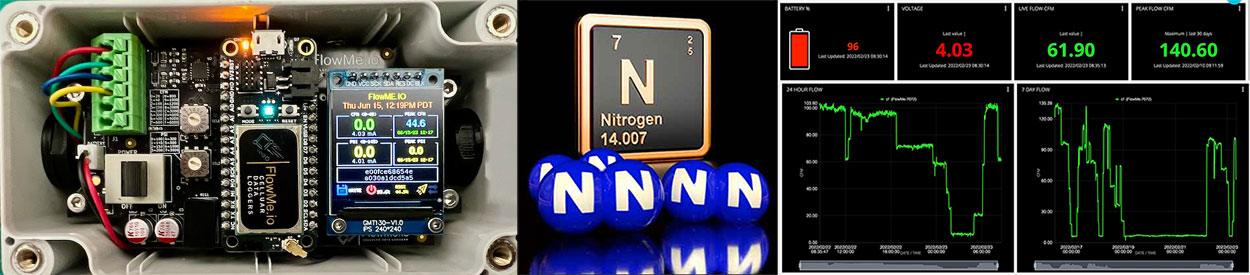
Real-time flow capture, no WiFi needed
Measure First, Then Size
A flowmeter rental is the cheapest first step toward an on-site generator
Nameplate consumption is almost never your real consumption. Equipment manufacturers publish flow specs at peak duty, but a real shop runs at variable duty across shifts, products, and seasons. Sizing an on-site nitrogen generator off a nameplate number tends to over-size the system, which raises the capital number and the operating kilowatt-hour bill without producing more gas. Sizing off a measured number lands the generator at the right flow, the right purity, and the right compressor pairing.
Borrow a meter, log a week, ship it back. The flowmeter rental program is built for this exact use case. We send the kit. You drop the meter inline on the existing nitrogen line, leave it in place for a week or two, and the cellular data logger captures average flow, peak flow, duty cycle, and any periods of high transient demand. The data file shows what your actual generator should be sized to.
No fee, no purchase pressure. The rental is free of charge. Standard term is 30 days, with longer terms available on request. We do not require a quote signature in advance and we do not bundle the rental into a sales push. Some customers measure, file the data, and come back six months later to size the system. That works for us. The cleaner the measurement, the better the eventual generator fit.
All on-site nitrogen generators
PSA and membrane nitrogen generators sized from 40 SCFH lab systems through 100,000 SCFH plant-wide installations. The flowmeter measurement step lands on the right tier in this lineup.
View nitrogen lineup →How a nitrogen generator works
Buyer-friendly walkthrough of pressure swing adsorption, the carbon and zeolite molecular sieve materials, and how compressed air becomes high-purity nitrogen on-site.
Learn how a generator works →Flowmeter Rental Hardware
What the rental kit looks like in the field
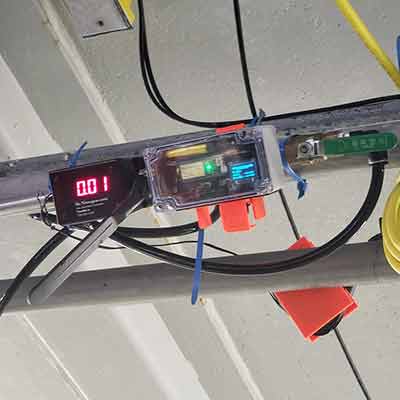
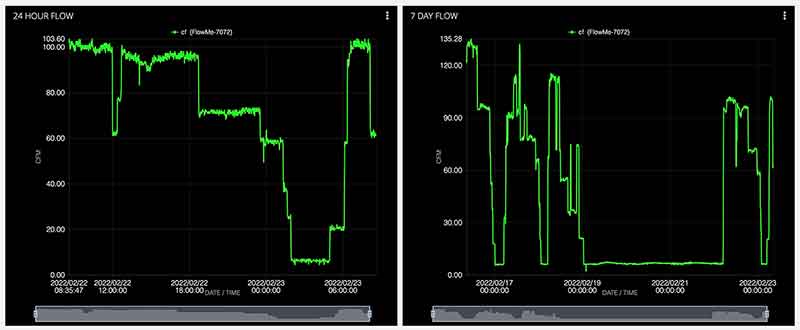
A point-of-use clamp install on an existing nitrogen line, the same meter dropped onto a food packaging line, and the data logger output on a typical week of plant duty. The rental kit ships ready to install.

Flowmeter Types
Two meter shapes cover the full duty range
High-flow production lines call for a digital meter with cellular data logging so the duty cycle is captured automatically. Low-flow points like glove boxes and small tools are easier to read off a face-display ball-style meter. Both ship in the rental program, and a kit can carry both for sites with mixed flow needs.
Type 01
Digital flowmeter with cellular data logger
Clamp-style or inline digital meter paired with a cellular data logger that captures average flow, peak flow, and time-stamped readings without WiFi or local network access. Plug it in, leave it running, and view the live trace on any phone, tablet, or computer through the web dashboard throughout the rental.
- Pipe sizes from 3/8 inch through 8 inch
- Cellular data link, no on-site network setup
- Captures average, peak, and full time-stamped trace
- Best for production lines, multi-shift duty, and any application where transient peaks matter
Type 02
Inline ball-style flowmeter
Mechanical variable-area flowmeter with a face display showing the current flow rate. No power, no network, no logger. Simple to install on small lines and easy to read at a glance.
- Sized for low-flow points
- Visual flow readout on the face of the meter
- No power or data connection needed
- Best for glove boxes, small tools, single-station soldering pots, and other low-flow points where the operator can take a few spot readings
How It Works
From request to data file in four steps
Free of charge. No rental fee, no deposit, no purchase pressure. The customer covers return shipping at the end of the rental. The rental program exists because right-sizing a generator off measured flow saves the customer money. We would rather see a meter on your line for two weeks than a guess on a sizing form.
Step 01
Tell us your application and pipe sizes
A short conversation about the equipment you are measuring (laser cutter, reflow oven, MAP packaging line, glove box, brazing station), the existing pipe sizes, and an estimate of expected flow. We pick the right meter shape and size from the rental fleet to match the duty.
Step 02
We ship the kit to your site
The kit ships to your site with the meter, the data logger if applicable, install instructions, and packaging sized for the return shipment. Standard term is 30 days. Longer terms are available on request, and you can keep the kit longer mid-rental by replying to the shipment email.
Step 03
Install on the line, log the duty cycle
Clamp-style meters install on the outside of an existing nitrogen or compressed-air line in a few minutes. Inline ball-style meters drop into a tee. The cellular data logger captures readings without WiFi or any on-site network setup. Run for at least one full duty cycle, ideally a representative week.
Step 04
Ship the kit back, the data is already yours
Pack the kit back in the original shipping box and send it back ground via any standard carrier. The full trace is already in your hands because the cellular logger streamed it live to the web dashboard throughout the rental. We summarize average flow, peak flow, and duty cycle from the dashboard data and use those numbers to size the on-site generator if you want to go to the next step. The data is yours either way.
Where the Rental Pays Off
Six application classes where measurement matters
Every one of these has a published nameplate flow that almost never matches actual duty. Putting a meter on the line for a week resolves the gap and lets us size the generator off real numbers.
Laser cutting assist gas
High flow / digital + logger
Fiber lasers and CO2 lasers swing flow with material thickness, kerf, pierce frequency, and assist pressure. A logged week shows the real average and the peak, so the generator and any high-pressure booster get sized correctly.
Reflow and wave soldering ovens
Mid flow / digital + logger
Per-oven nitrogen draw varies with belt speed, nozzle configuration, and product mix. Logging a typical production day across one or several ovens gives the aggregate that drives the generator sizing.
Heat treating and annealing
Mid to high flow / digital + logger
Belt furnaces, box furnaces, and bell furnaces each have a different inerting demand by zone. A meter on the supply header captures total flow across a representative cycle.
Food packaging and MAP lines
Mid flow / digital + logger
MAP flush rates depend on bag count per minute, headspace volume, and the gas-flush specification. A measurement run during a live shift lands the right generator and the right buffer tank size.
Selective soldering pots
Low flow / ball-style
A single selective soldering nozzle draws a low and steady flow. A face-display ball-style meter is enough to log the duty rate and confirm the right small generator size for one or several stations.
Glove boxes and small tools
Low flow / ball-style
Lab glove boxes, small inerting chambers, and bench-top tools rarely justify a digital logger. The ball-style meter on the line gives a quick read that an operator or engineer can spot-check across a few sessions.
Sizing and ROI
Three numbers from the data file size the generator
The cellular data logger delivers a time-stamped trace. From that trace, three values drive the on-site generator selection. Logging a representative week is enough for most applications.
What the data file gives you
Input 01
Average flow over the duty cycle
The mean flow rate across the full measurement period. This is the number a steady-state PSA generator needs to match to keep up with continuous demand without dipping into buffer reserve.
Input 02
Peak flow events
Short-duration spikes in demand, typical of laser pierce events, oven warmup cycles, or batch transitions on a packaging line. Peak flow drives the buffer tank sizing more than it drives generator sizing.
Input 03
Duty cycle and idle periods
How much of each day the line is actually drawing nitrogen. A site running one shift has different generator economics than a site running 24 by 7. The duty cycle determines whether to size for average or to size for peak with idle absorption.
Why this saves money on the eventual generator
Driver 01
Avoids over-sizing the generator and the compressor
A nameplate-based size estimate often lands on the next class up. Measured data lets us land on the actual class needed. Smaller generator, smaller compressor, smaller capital number, smaller kilowatt-hour bill.
Driver 02
Lands the right purity tier
Some applications run fine at 99.5%. Others need 99.99%. The data plus a quick conversation about the application picks the purity that meets the spec without paying for headroom you do not need.
Driver 03
Sets the buffer tank correctly
Peak flow events that the data file shows determine the buffer tank size. Too small and the line dips during a spike. Too big and the capital is wasted. Measured peaks land the tank right.
Worked example
SMT facility with three reflow ovens. Nameplate per oven implies an aggregate ceiling near the upper end of the standard PSA range. A two-week meter rental on the supply header showed a much lower steady average with short peaks during product changeovers.
Sizing change. The measured average sized the generator one full class smaller than the nameplate estimate would have. The buffer tank was sized for the changeover peaks. Capital savings were meaningful and the operating kilowatt-hour bill dropped accordingly.
The same pattern repeats across laser cutting, heat treating, and food packaging sites. Measured data lands the right size every time.
Frequently Asked Questions
Nitrogen flowmeter rental kits
How long can I keep the rental kit?
Standard rental term is 30 days. Longer terms are available on request, and you can extend mid-rental by replying to the original shipment email. Some customers measure for a week, some for two, and some keep the kit through a full production month so they capture every product changeover and shift pattern.
Is there really no rental charge?
Yes. The rental program is free of charge. No rental fee, no deposit, no purchase pressure. The reason the program exists is that right-sizing a generator off measured flow is much more accurate than sizing off nameplate, and the customer who measures first ends up with a better-fit system. We would rather help you measure than guess.
What pipe sizes do you have available?
The fleet covers 3/8 inch through 8 inch pipe across the digital and ball-style meters. Sites with mixed flow points can take a kit that carries multiple sizes so the same rental covers the main supply line and a handful of branch lines or tool drops. If your application is outside the standard size range, ask and we will check the fleet.
How does the cellular data logger work?
The cellular data logger pairs with the digital flowmeter and streams readings to GGS servers over a built-in cellular link. There is no WiFi setup, no IT involvement, and no on-site network access required. You can view the live trace on any phone, tablet, or computer through a web dashboard throughout the rental. The logger captures average flow, peak events, and a full time-stamped trace. At the end of the rental we send a summary alongside the raw trace from the dashboard.
Who covers the shipping?
We send the kit to your site. The customer covers return shipping at the end of the rental, typically a few dollars ground via any standard carrier. The rental itself runs no rental fee, no deposit, and no purchase pressure, so the only out-of-pocket cost is the return shipment.
What if the meter is damaged or lost?
Damage in normal use is on us. Equipment that comes back with normal install marks, scuffs, or a scratched display is fine. If a meter is lost or destroyed beyond reasonable use, we will work it out case by case. The fleet has been running for years and the loss rate is extremely low because the kits are simple to install and easy to ship back.
Do you have flowmeters for high-pressure applications?
Yes. High-pressure flowmeters paired with the same cellular data logger are available, rated for up to 600 PSIG and sized for fiber laser cutting and other high-pressure applications. The high-pressure rental is a separate kit with its own page. Tell us your operating pressure and we will pick the right kit from the fleet.
What happens after the rental ends?
Ship the kit back when the rental window closes out. The data is already in our system because the cellular logger streams to our servers in real time, so you have had access to the trace on the web dashboard throughout the rental. We send a final summary of average flow, peak flow, and duty cycle alongside the raw trace. Most customers use those numbers to size an on-site generator. Some file the data and come back six months later when the timing is right. Either path is fine. The data is yours, the rental is closed out, and there is no follow-on commitment.
Send four numbers and we will pick the right kit
The application you are measuring (laser cutting, soldering oven, MAP packaging line, heat treating, glove box, or other), the existing pipe size at the measurement point, an estimate of expected flow (any rough number is fine), and the measurement window you want to run. With those four numbers we send the kit, free of charge.
Request a rental kit →The rental program runs free of charge across the United States, Mexico, and Canada. Standard term is 30 days. Longer terms on request. The whole point is to remove every reason not to measure before sizing.