
Technology comparison
PSA vs Membrane Nitrogen Generators
Two ways to separate nitrogen from compressed air, and the choice comes down to purity. PSA reaches 99.9995% and runs 20 years or more. Membrane tops out near 99.5% but is smaller, simpler, and cheaper to buy. Below 99.5% either can work. Above it, only PSA.
The dividing line. Above it, PSA is the only option
Service life, PSA vs membrane
We supply and size either technology
Typical payback, either way
The short answer: purity decides it
PSA and membrane generators both pull nitrogen out of ordinary compressed air, and both eliminate delivered gas. They differ in how they separate it, and that difference sets a ceiling. Membrane systems reach about 99.5% nitrogen. PSA systems reach 99.9995%. If your process needs more than 99.5%, the decision is made for you.
Below that line you have a real choice, and it is mostly economic. Membrane costs less to buy, takes less floor space, and has no moving parts in the separation step. PSA costs more up front, uses less compressed air per unit of nitrogen, and runs 20 years or more against a membrane bundle's 5 to 7. The more nitrogen you use, and the longer you plan to use it, the more the PSA economics win.
Choose PSA when
Purity is 99% or higher, or volume is high
Electronics, laser cutting, heat treating, pharmaceutical, and food and beverage packaging. Also any high-volume plant where the lower air-to-nitrogen ratio compounds into real compressor savings over 20 years.
Choose membrane when
Purity needs are modest and space is tight
Fire suppression, tire inflation, marine and offshore inerting, mobile rigs, and bulk blanketing. Compact, lightweight, and simple controls, with no moving parts in the separation step.
How each one works
Two mechanisms, one ceiling
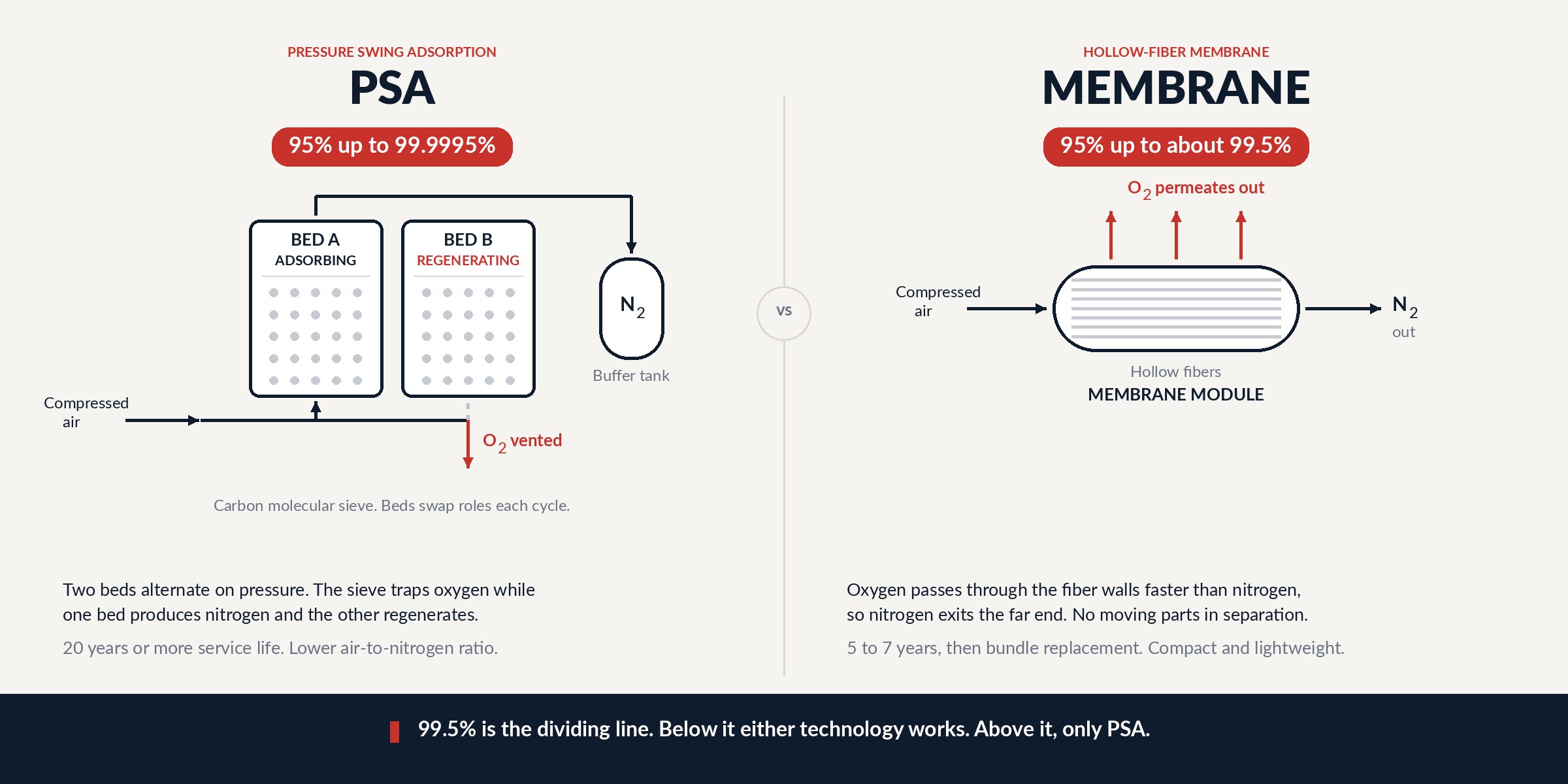
Side by side
PSA vs membrane nitrogen generators, compared spec by spec
| Factor | PSA | Membrane |
|---|---|---|
| Purity range | 95% up to 99.9995% | 95% up to about 99.5% |
| Service life | 20 years or more, sealed adsorbent beds | 5 to 7 years, then membrane bundle replacement |
| Separation method | Carbon molecular sieve, two beds swinging on pressure | Hollow-fiber membrane, passive permeation, no moving parts in separation |
| Air-to-nitrogen ratio | Lower, less compressed air per unit of nitrogen | Higher, and the gap widens as purity climbs |
| Footprint | Larger, sieve beds plus buffer tank | Compact and lightweight |
| Cost model | Higher up front, lower cost per CCF at volume | Lower up front, simpler controls, higher cost per CCF |
| Best fit | Electronics, laser cutting, heat treating, pharmaceutical, food and beverage | Fire suppression, tire inflation, marine and offshore inerting, mobile rigs, bulk blanketing |
Read the table this way: red marks the technology with the advantage on that row, not the better machine. There is no better machine. A membrane unit inerting a fuel tank at 95% and a PSA unit feeding a laser at 99.999% are both the right answer to their own question.
Frequently asked
PSA and membrane questions we get
What is the difference between PSA and membrane nitrogen generators?
Both separate nitrogen from ordinary compressed air, but by different physics. PSA pushes air through a carbon molecular sieve that traps oxygen, using two beds that alternate on pressure so one regenerates while the other produces. Membrane pushes air through bundles of hollow polymer fibers, and oxygen permeates through the fiber walls faster than nitrogen does, so nitrogen comes out the far end. The practical consequence is purity: PSA reaches 99.9995%, membrane reaches about 99.5%. PSA also runs 20 years or more against a membrane bundle's 5 to 7, and uses less compressed air per unit of nitrogen. Membrane is smaller, simpler, and cheaper to buy.
Which is better, PSA or membrane?
Neither is better in general, and the question usually answers itself once you name your purity. Above 99.5% nitrogen, PSA is the only option, so there is no comparison to make. Below 99.5% both technologies work and the decision turns on economics and space. Membrane wins on purchase price, footprint, weight, simplicity, and outlet pressure. PSA wins on service life, compressed air consumption, and cost per CCF at volume. A high-volume plant running 20 years will usually come out ahead on PSA even at purities membrane could have met.
How do prices compare for PSA vs membrane nitrogen generators?
Membrane costs less to buy and PSA costs less to run, so the comparison depends on how much nitrogen you use and how long you keep the system. Membrane has fewer components and simpler controls, which lowers the purchase price. PSA uses less compressed air per unit of nitrogen, and compressed air is the operating cost of any on-site generator, so the PSA gap compounds every hour the plant runs. Add the service life difference, 20 years or more versus 5 to 7, and high-volume users generally reach a lower total cost with PSA. Either way the typical payback against delivered nitrogen is 12 to 14 months. Purchase price alone is the wrong number to compare.
What purity can a membrane nitrogen generator reach?
About 99.5% is the practical ceiling for membrane. The technology can be pushed higher, but the air-to-nitrogen ratio climbs steeply as purity rises, so you burn progressively more compressed air for progressively less nitrogen. At some point the compressor cost of running membrane at high purity exceeds the cost of simply buying a PSA system. That crossover is why the two technologies split the market at roughly 99.5% rather than competing across the whole range.
Can a membrane generator be upgraded to PSA later?
Not as a conversion. They are different machines and the separation hardware is not interchangeable. If there is a real chance your purity requirement will rise above 99.5% within the life of the system, that belongs in the sizing conversation before you buy, not after. Tell us what the process might become and we will size for where you are heading rather than only where you are.
Which technology do most of your customers install?
PSA, because most of the work we do sits above the membrane purity ceiling. Electronics, laser cutting, heat treating, pharmaceutical and food and beverage packaging all commonly specify purities membrane cannot hold. Membrane is the right call for fire suppression, tire inflation, marine and offshore inerting, and mobile rigs, and we supply and size membrane systems for those. We are not tied to one technology, so the sizing exercise decides it rather than the catalog.
Keep reading
Go deeper on either technology
PSA
What is a PSA nitrogen generator?
The two-bed swing cycle, what carbon molecular sieve does, and where PSA fits best.
Membrane
What is a membrane nitrogen generator?
Inside the hollow-fiber bundle, how permeation separates the gas, and where membrane wins.
Cost
How much does a nitrogen generator cost?
What drives the number, and how on-site compares against delivered gas over time.
Sizing
Borrow a flow meter
Measure what your plant actually uses before either technology gets specified.
Next step
Tell us your purity and flow. We will tell you which technology fits.
We supply both PSA and membrane systems, so the sizing decides it rather than the catalog. Send your target purity, flow rate, and delivery pressure and we will size the system and quote it. If you do not know your actual consumption yet, borrow a flow meter and measure it first. We ship it to you free and you cover the return.