On-Site Nitrogen Generation
Nitrogen Blanketing
Nitrogen blanketing holds an inert layer of nitrogen in the vapor space above a stored liquid, displacing oxygen and moisture to stop oxidation, contamination, and flammable vapor buildup. Generating that nitrogen on site gives you a steady, low-cost supply for tank blanketing, purging, and sparging, with no delivery schedule to manage and no cylinders to swap.
Typical blanketing purity range
Gas cost vs delivered nitrogen
Supply on demand, no run-outs
Domestic build, ASME tanks standard
The Basics
What nitrogen blanketing is and how it works
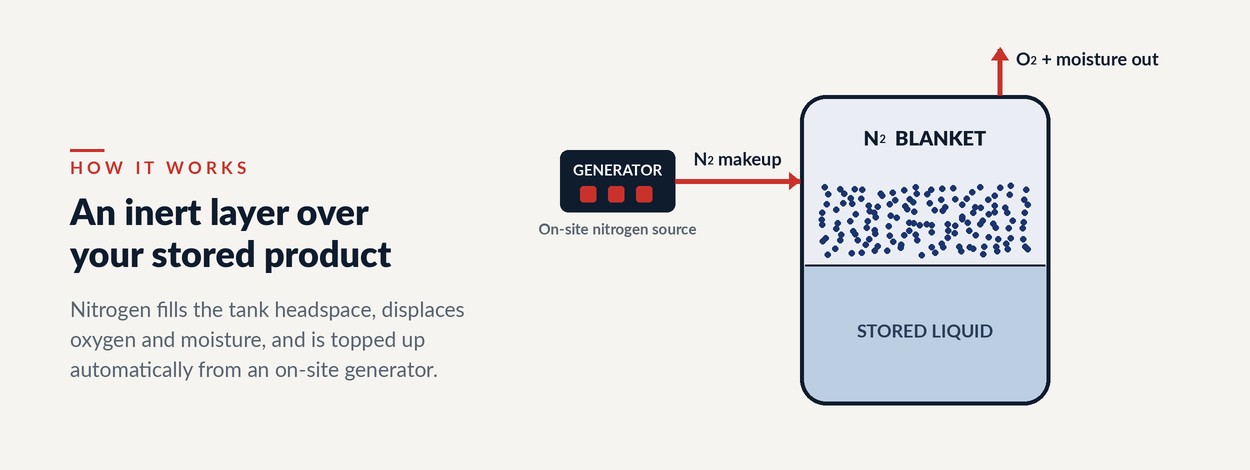
A nitrogen blanket is a cushion of nitrogen gas held in the headspace of a tank, vessel, or reactor, above the liquid it stores. Because nitrogen is inert and pushes oxygen and water vapor out of that space, the product underneath is protected from oxidation, moisture pickup, and the risk of a flammable oxygen-fuel mixture forming. As liquid is drawn down or temperature changes, more nitrogen flows in to keep the headspace covered and lightly pressurized, so air is never pulled back in.
Blanketing is one of three related ways nitrogen keeps oxygen away from a product. They are often used together on the same tank.
Blanketing
Cover the headspace
A steady nitrogen layer sits over the stored liquid and is topped up automatically as the level or temperature shifts. This is the everyday protection that keeps oxygen and moisture out during storage. Also called tank blanketing or padding.
Purging
Clear out the air first
Before filling or after maintenance, nitrogen purging sweeps the existing air or vapor out of a vessel or pipeline so the oxygen level drops to a safe point. Once the space is purged, a blanket holds it there.
Sparging
Strip dissolved oxygen
Nitrogen sparging bubbles gas up through the liquid itself to drive off dissolved oxygen and other gases. It is common in beverages and chemicals where oxygen in the liquid, not just the headspace, affects quality.
What A Nitrogen Blanket Is Used For
Where nitrogen blanketing is used
Anywhere a stored liquid reacts with oxygen, picks up moisture, or gives off flammable vapor, a nitrogen blanket protects it. These are the most common uses we supply nitrogen for.
Chemical and petrochemical storage
Solvents, resins, monomers, and other reactive chemicals are blanketed so oxygen and humidity do not degrade them or build a combustible atmosphere in the tank. This is also central to oil and gas storage and processing, where vapor spaces are kept inert.
Flammable and combustible liquids
Fuels, alcohols, and volatile organics give off vapor that can ignite when mixed with air. Holding the headspace below the oxygen level needed for combustion keeps the tank out of the flammable range during storage and transfer. The same principle covers cargo tank inerting on tankers.
Food, beverage, and edible oils
Oxygen turns oils rancid and dulls flavor and color. Blanketing and wine sparging and blanketing protect product in storage, while related food packaging with nitrogen carries that protection to the finished package.
Pharmaceutical and fine chemicals
Oxygen and moisture sensitive intermediates and active ingredients are blanketed in reactors and storage to hold purity and shelf life. The same inert headspace protects the product through filling and transfer steps.
Adhesives, coatings, and inks
Many adhesives and coatings cure or skin over when they meet air. A nitrogen blanket over the bulk container slows that reaction so the material stays usable and consistent batch to batch.
Process vessels and reactors
Reactors and mixing vessels are purged and then blanketed so reactions run under a controlled, oxygen-free atmosphere. Nitrogen also pads the vessel as it cools to prevent air from being drawn back in.
Why Generate It On Site
Blanketing is the ideal case for on-site nitrogen
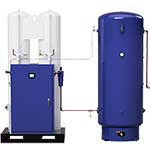
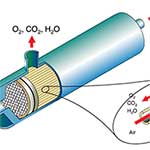
Blanketing demand is steady, runs at modest purity, and never stops, the exact profile where buying delivered gas is most wasteful. An on-site generator pulls nitrogen from compressed air right at the tank farm, so you pay for power instead of deliveries and never run a tank dry.
Lower operating cost
On-site generation produces nitrogen at up to 90% less than delivered cylinders or bulk liquid. Most blanketing customers recover the full investment in 12 to 14 months, and the system runs for 20 years or more.
Purity matched to the job
Most blanketing runs at 95% to 99.5% nitrogen, and over-specifying only adds cost. We dial the system to the purity your product and safety case need, and every generator includes a built-in oxygen analyzer so you can verify it.
Supply that never runs out
A blanket has to hold around the clock. On-site generation feeds a buffer tank continuously, so there are no delivery gaps, no rental cylinders to track, and no risk of an empty tank pulling air back into your headspace.
Sized to your real demand
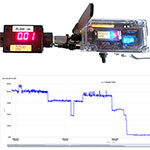
If you do not know your nitrogen usage yet, we send a flow meter at no cost with a cellular logger that streams your real demand to a web dashboard. The system is then sized to actual use, not an estimate.
Common Questions
Nitrogen blanketing FAQ
What is nitrogen blanketing?
Nitrogen blanketing is the practice of holding a layer of nitrogen gas in the headspace of a tank or vessel, above the liquid it stores. Because nitrogen is inert, it displaces oxygen and moisture from that space and keeps the product underneath protected. It is also called tank blanketing or padding, and it is one of the most common industrial uses of on-site nitrogen.
How does nitrogen blanketing work?
Nitrogen is fed into the vapor space above the liquid until oxygen is pushed down to a safe level, and a light positive pressure is maintained. As liquid is drawn off or the temperature drops, the headspace would otherwise pull in outside air, so more nitrogen flows in automatically to keep the blanket in place. The result is a stable, oxygen-free cushion over the product at all times.
What is a nitrogen blanket used for?
A nitrogen blanket protects stored liquids from oxidation, moisture, and the risk of a flammable vapor and air mixture. It is used on chemical and petrochemical storage, fuels and other flammable liquids, edible oils, wine and other beverages, pharmaceuticals, adhesives and coatings, and process reactors. Wherever a product reacts with oxygen or gives off combustible vapor, blanketing keeps the tank atmosphere inert.
Why is nitrogen blanketing required?
Blanketing is required when contact with air would spoil a product or create a hazard. Oxygen causes oxidation, rancidity, and color and flavor loss, moisture can ruin sensitive chemicals, and flammable vapors mixed with air can ignite. Holding an inert nitrogen layer removes the oxygen that drives all three problems, which protects product quality and reduces fire and explosion risk during storage and transfer.
When should you use nitrogen blanketing instead of purging or sparging?
Use blanketing for ongoing storage protection, when you need to keep oxygen out of the headspace day in and day out. Use purging to clear air out of a vessel or pipeline before filling or after maintenance, and use sparging to strip oxygen that is dissolved in the liquid itself. The three are complementary: a tank is often purged first, sparged if the liquid quality demands it, and then blanketed for the long term.
What nitrogen purity does blanketing need?
Most blanketing runs at 95% to 99.5% nitrogen, which is lower than purities used for soldering or heat treating, so it is well matched to on-site generation. The exact target depends on how oxygen sensitive your product is and on your safety requirements. We size the generator to the purity your application needs, and every system includes a built-in oxygen analyzer so you can confirm the blanket is holding spec.
Build On What You Know
Resources to spec your system
Protect Your Product
Size a nitrogen blanketing system
Tell us what you store, how many tanks you blanket, and the purity you need, and we will engineer the on-site nitrogen system and quote the complete package. If you do not know your nitrogen usage yet, we will send a flow meter at no cost to measure your real demand first. No obligation.