
Wineries & Wine Bottling
Nitrogen Generators for Wineries, Wine Sparging, and Bottling
On-site nitrogen for sparging, tank blanketing, barrel work, bottle purging, and inert transfer. 99.5% to 99.9% purity feeding membrane contactor sparging skids, monobloc bottling lines, variable-capacity tanks, and mobile bottling operations. One generator supplies the cellar, the bottling line, and the barrel room. Up to 90% lower gas cost than delivered nitrogen, with most wineries paying back in 12 to 14 months.
What we do
Wine production depends on a continuous supply of high-purity nitrogen to protect flavor, aroma, and color through fermentation, tank storage, barrel aging, sparging, and bottling. Gas Generation Solutions designs on-site nitrogen generators for boutique wineries, mid-size and large commercial wine producers, custom-crush facilities, and mobile bottling operations serving multi-location programs. Our systems produce nitrogen at purities from 95% up to 99.9995%, reducing gas costs by up to 90% compared to delivered nitrogen. A boutique winery can run on a small on-site nitrogen system. Gas Generation Solutions was incorporated in 1979 and has over 40 years of industry experience. Our USA-built systems ship across the United States, Mexico, and Canada. For broader modified atmosphere packaging context, see our MAP nitrogen page or the food grade cornerstone.
Systems in the field
PSA nitrogen at the cellar, the bottling line, and the sparging skid
Sparging supply
PSA nitrogen feeding a winery sparging skid
Continuous high-purity nitrogen for stripping dissolved oxygen out of wine before bottling and transfer.

Bottling line
Generator supplying a monobloc bottling line
Pre-fill bottle purge plus post-fill headspace flush before closure, sized to peak bottling line speed.

Plant install
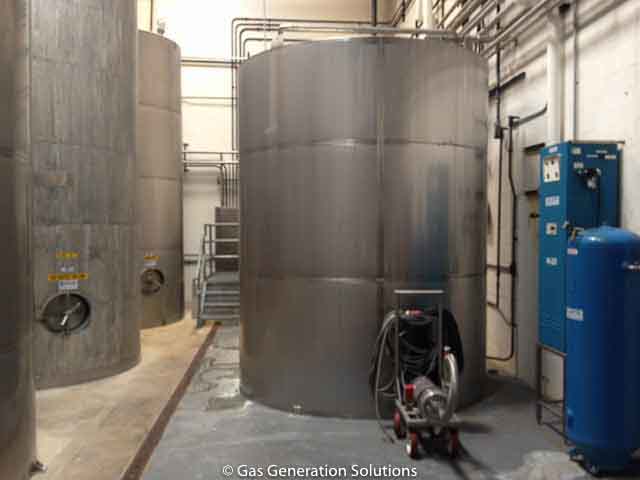
Whole-winery nitrogen system in production
One source feeding tank blanketing, barrel work, racking, and bottling across the cellar.
Applications
How nitrogen is used in winemaking
A correctly sized on-site generator supplies every nitrogen point of use in the winery from a single source: sparging skids, monobloc bottling lines, fermentation and storage tanks, barrel rooms, and inert racking and transfer between vessels.
Sparging
Nitrogen strips dissolved oxygen out of wine before bottling or transfer. Dissolved oxygen at bottling is the single largest driver of premature aging and bottle shock.
Tank blanketing & ullage purging
Variable-capacity tanks, stainless fermenters, and storage tanks use nitrogen to fill headspace and ullage, preventing surface oxidation during storage and aging. Nitrogen blanketing detail →
Barrel blanketing & cleaning
Inert barrel headspace after topping. Purge barrels during cleaning and sulfur dioxide application. Compatible with silicone bung fittings and barrel wash stations.
Bottle purging at the filler
Bottles are purged with nitrogen before fill to remove air from the container. Post-fill headspace is flushed with nitrogen before the closure is applied.
Inert racking & transfer
Nitrogen pressure pushes wine through lines during racking, filtration, and tank-to-tank transfer without introducing oxygen at any step.
Kegs & bag-in-box
Nitrogen or nitrogen-blend gas for keg fill, wine-on-tap dispense, and bag-in-box formats. Same generator, different connection, no separate supply.
One generator, whole-winery supply. A properly sized on-site system feeds every nitrogen demand in the winery from one source: sparging skids, bottling line, fermentation tanks, barrel room, and transfer lines. One generator replaces the complete delivered-nitrogen supply chain.
Sparging & dissolved oxygen
Three ways to strip dissolved oxygen out of wine. One supply that runs continuously.
Sparging methods
Membrane contactor, countercurrent column, or micro-bubble diffusion
Sparging is the controlled introduction of nitrogen into wine to strip dissolved oxygen out of solution. Three method families cover almost every cellar use case, with consistent high-purity nitrogen feeding all of them.
Hollow-fiber contactor
Wine flows through a hollow-fiber membrane module with nitrogen on the counter-current side. Controlled, low-shear, highly efficient. Typical choice for in-line bottling.
Countercurrent sparging column
Wine flows down a column while nitrogen flows up, contacting and stripping oxygen. Used at higher flow rates where membrane modules become impractical.
Micro-bubble diffusion
Nitrogen introduced through a fine-pore diffuser into tank wine. Simple and effective for tank-level dissolved oxygen reduction without an inline skid.
Dissolved oxygen targets
Wine arrives at bottling carrying 2 to 8 ppm DO. Sparging brings it down.
Wine absorbs oxygen during every pump-over, transfer, filtration step, and open-top operation. Effective sparging hits a measured target before the bottle closure goes on.
DO at bottling without sparging
Typical dissolved oxygen carried into the bottling line by a finished wine after normal cellar handling. Drives premature aging, browning, and bottle shock if left in solution.
Premium wine target
Standard target after nitrogen sparging for most premium commercial bottling programs. Holds wine quality through the cold chain and onto the shelf.
Ultra-premium & long-aging target
Tightest standard for ultra-premium reds, reserve programs, and wines with extended bottle aging on the label. Requires both sparging and bottle/headspace flushing in concert.
Purity & gas choice
Two purity tiers for winemaking. Nitrogen for the majority of work, argon where it earns its cost.
Nitrogen purity
99.5% for most winery work, 99.9% for premium and long-aging programs
Wineries run at standard food-grade nitrogen purities, measured as percent N₂ with the balance as residual oxygen in parts per million.
5,000 ppm O₂
Typical for most commercial wine bottling, tank blanketing, and routine barrel work. Covers the majority of winery nitrogen consumption.
1,000 ppm O₂
Premium programs, extended cellar aging, export formats, and reserve bottling where lower in-bottle dissolved oxygen targets are required.
Nitrogen vs Argon
Two inert gases. Pick the one that fits the vessel.
Both nitrogen and argon are inert and food-grade. The practical choice usually comes down to cost, application, and container geometry.
Use for: sparging, bottling, sealed tanks, transfer
Sparging skids, bottling line flush, sealed or gasketed tank blanketing, inert racking and transfer, and barrel purging. Significantly less expensive on-site, and the standard for high-volume continuous applications.
Use for: open-top vessels, partial fills
Open-top containers and partial-fill vessels where a heavier-than-air blanket is advantageous. Argon is about 1.4x the density of air and stays in place on an open surface better than nitrogen.
Equipment compatibility
Built for every major winery equipment category
Our nitrogen generators supply every piece of cellar and bottling equipment that runs on inert gas. Each piece has its own inlet pressure, flow, and purity requirement. We review the spec sheet, match the generator output, and confirm compatibility before quoting.
Sizing & ROI
Sized to measured demand, paid back in 12 to 14 months
Winery tiers
Nitrogen consumption by winery size
Small boutique winery
Under 10,000 cases per year. Sparging on a small bottling skid, intermittent tank blanketing and barrel work.
Mid-size winery
10,000 to 100,000 cases per year. Inline sparging at bottling, regular tank blanketing across multiple varietals, active barrel program.
Large commercial winery
100,000+ cases per year. High-speed bottling line, simultaneous cellar demand across many tanks and a large barrel inventory.
Mobile bottling operation
Per-stop demand for mobile bottling lines serving multiple wineries. Permanently installed generator at the home facility plus a high-pressure storage bank avoids the need to coordinate dewar deliveries at each remote site.
Our free flow meter rental with cellular data logger measures actual consumption across a full bottling campaign and routine cellar work. Measured data drives sizing instead of nameplate estimates.
Cost & payback
Up to 90% lower gas cost vs delivered nitrogen
12–14 mo
Typical payback
20+ yr
Service life
$10,000 to $150,000+ system price range across boutique to large commercial wineries.
Delivered nitrogen for a winery carries compounding costs: gas charges, cylinder or dewar rental, hazmat fees, delivery surcharges, dewar demurrage, and 2 to 8% per day boil-off from idle liquid tanks. Wineries with seasonal demand pay for storage during low-use periods and still face delivery shortfalls during peak campaigns. On-site generation eliminates all of them. Recurring cost is electricity for compressed air plus routine filter changes. Over a 20-year service life, cumulative savings on a mid-size winery commonly reach hundreds of thousands of dollars.
Food safety & supply consistency
Sparging-grade nitrogen, every shift, no supplier dependency
Nitrogen used in winemaking is food-grade inert gas, listed as Generally Recognized As Safe under FDA 21 CFR 184.1540. The same gas covers sparging, blanketing, transfer, and bottle headspace flush across the cellar.
- Dissolved oxygen targets: held below 0.5 ppm for premium and below 0.2 ppm for ultra-premium programs
- Tank surfaces: protected from oxidation through aging via continuous ullage purge
- Bottle headspace: flushed before closure for consistent in-bottle DO across the run
- Sealed sieve beds: no top-off; no sieve failure modes that interrupt the sparging skid
Maintenance
Three filter changes a year, no service contract required
Winery nitrogen generators require minimal routine maintenance. Cellar staff perform filter changes themselves. Annual filter cost is typically a few hundred dollars depending on system size.
- Every 3 months: water and dirt filter change
- Every 6 months: oil filter change, valve and safety device inspection
- Every 12 months: charcoal final filter change
- Sealed sieve beds: no top-off required under normal operation
Related pages
Food grade context, MAP science, and other F&B segments
The winery page is one part of a broader F&B cluster. Go up to the food grade cornerstone and MAP packaging science, or across to other F&B segments served by the same generator family.
F&B cornerstone
Food Grade Nitrogen Gas Generator
MAP sub-hub
Nitrogen Generator for Food Packaging and MAP
Cheese
60/40 · 70/30Shredded, sliced, block, grated, bulk.
Snack Food
100% N₂Chips, jerky, nuts, popcorn, trail mix.
Coffee
100% N₂Whole bean, ground, pods, RTD, cold brew.
Salad & Lettuce
EMAP balanceSpring mix, baby greens, salad kits.
Salad Condiments
100% N₂Dressings, kits, packets, single-serve pouches.
Pet Food
100% N₂Dry food, treats, birdseed.
Frequently asked
Questions about winery nitrogen generators
What nitrogen purity do wineries need?
Wineries run at 99.5% to 99.9% nitrogen purity (1,000 to 5,000 ppm oxygen). Most commercial bottling, tank blanketing, and routine barrel work runs at 99.5%. Premium programs, extended cellar aging, and export formats push to 99.9%. Wineries do not require purity higher than 99.9%. Our generators are capable of any purity from 95% up to 99.9995% for specialty applications.
What is nitrogen sparging and why does it matter?
Sparging is the controlled introduction of nitrogen to strip dissolved oxygen out of wine. A finished wine can carry 2 to 8 ppm dissolved oxygen at bottling, which drives premature aging and bottle shock. Sparging reduces dissolved oxygen to below 0.5 ppm for premium wines and below 0.2 ppm for ultra-premium wines. Effective sparging requires consistent, high-purity nitrogen supply, which is exactly what on-site generation provides.
Should I use nitrogen or argon for my winery?
Nitrogen is the standard for sparging, bottling, sealed tank blanketing, inert transfer, and barrel purging because it is significantly less expensive than argon when produced on-site. Argon is better for open-top containers and partial-fill vessels because it is heavier than air and forms a stable surface blanket. Most wineries use nitrogen for the majority of gas consumption and keep a small delivered-argon supply for open-vessel work.
Can one nitrogen generator feed sparging, bottling, and tank blanketing?
Yes. A single generator sized to total winery demand can supply the bottling line, sparging skids, fermentation and storage tanks, barrel blanketing, and inert transfer from one source. This is more cost-effective than running separate supplies at each demand point and simplifies expansion when production grows.
How much does a nitrogen generator for winery applications cost?
Systems for wineries typically range from approximately $10,000 for a small boutique operation to over $150,000 for large commercial wineries with high-speed bottling lines and active cellar programs. Price depends on total flow rate, required purity, delivery pressure, and any redundancy requirements. Regardless of system size, the average payback remains 12 to 14 months.
How much nitrogen does a winery use?
Consumption varies by production size and cellar activity. Small boutique wineries under 10,000 cases per year typically use 50 to 300 SCFH. Mid-size wineries (10,000 to 100,000 cases) use 300 to 1,500 SCFH. Large commercial wineries use 1,500 to 10,000 SCFH. Our free flow meter rental measures your actual consumption across a full bottling campaign and routine cellar work.
Is on-site nitrogen generation practical for small boutique wineries?
Yes. Compact systems starting at approximately $10,000 fit small-footprint boutique wineries and recover full investment in 12 to 14 months. Many boutique wineries currently use dewar-based delivered nitrogen, which carries high per-unit cost and delivery risk during harvest and bottling campaigns. On-site generation eliminates both problems.
How long does a winery nitrogen generator last?
Our systems are designed for 20 years or more of continuous service. Sealed sieve beds do not require replacement or top-off under normal operating conditions. Competing systems using flanged sieve beds may require sieve replacement every 8 to 10 years, which is a significant hidden cost over the life of the equipment. Call 760-505-1300 or contact us here for a same-day quotation.
Budgeting a system
Winery sparging and blanketing systems span Small to Medium tiers. For a full breakdown of nitrogen generator cost by application and scale, see our tier guide.
Size Your Winery System
Borrow a flow meter. Size the generator to your real bottling-campaign demand.
We rent a flow meter at no charge, sized for winery service. The meter installs inline between your current nitrogen supply and your sparging skid or bottling line, with a cellular data logger so you can view flow rate and pressure in real time on our dedicated server. No WiFi required at your facility. After a full bottling campaign and a stretch of routine cellar work, we size the generator and storage to your measured peak simultaneous demand, not a nameplate estimate. Most wineries recover their full system investment inside 14 months.
Already know your flow, purity, and pressure? Send them over with your bottling line and sparging-skid spec sheets and we will return a complete quotation the same day.