
On-Site Nitrogen for LC/MS, QTOF, and Analytical Lab Workflows
Laboratory Nitrogen Generator for Analytical Labs
A laboratory nitrogen generator sized to the actual flow and purity each instrument needs, not the highest spec on the page. LC/MS at 99% and QTOF at 95% to 99.998% are the bread-and-butter fits. GCMS at 50 mL/min usually runs better on a UHP cylinder, and we will say so on the call.
Lab purity range
LC/MS to multi-instrument lab flow band
Typical payback
Service life
Why On-Site Nitrogen for Analytical Labs
Right-sized to each instrument, not the highest spec on the sheet
A laboratory nitrogen generator earns its keep on the bread-and-butter instruments: LC/MS and QTOF. A typical LC/MS runs around 21 LPM (about 44 SCFH) at 99% nitrogen at 100 PSIG. A QTOF runs anywhere from 18 to 60 LPM depending on model and source, with drying gas at 95% and collision-cell gas at 99.998%. Both flows are squarely in the small-to-mid PSA generator range, both purity tiers are economical to produce on-site, and both displace a steady stream of cylinder or dewar deliveries that the lab is already paying for every month.
GCMS is the case where we will tell you to keep using cylinders. A GCMS runs about 50 mL/min per detector at 99.9995% UHP grade. A 300 cubic foot UHP cylinder drawn down to 100 PSIG holds enough nitrogen at that flow to last decades on a single bottle. Sizing a generator for that flow means paying capital for a duty cycle the system will spend almost entirely on standby. We will quote a generator for it if a customer asks, but the honest recommendation is a UHP cylinder for the GCMS and a generator for the LC/MS and the QTOF.
Why laboratory gas generators pay back at all. Most analytical labs reduce nitrogen costs by up to 90% compared to delivered cylinder or dewar gas. Payback runs 12 to 14 months on a typical multi-instrument lab. Systems are engineered to run for 20 years or more. A nitrogen generator for laboratory service ends the cycle of scheduling change-outs, losing analytical runs to a late delivery, and paying rental and demurrage on tanks. Compressed air goes in, lab-grade nitrogen comes out, on the lab's schedule. Many labs run on a small nitrogen generator sized to one or two instruments.
Liquid nitrogen generators for cryostorage and live cultures
Labs that need liquid nitrogen for cryopreservation, live culture storage, vapor-phase freezers, or sample-cooling work need a different machine than a gaseous PSA generator. On-site LN2 generators size to daily liter usage from the lab's delivery records.
See LN2 generators →How a PSA nitrogen generator works
Pressure swing adsorption uses a carbon molecular sieve to selectively adsorb oxygen from compressed air, leaving high-purity nitrogen at the outlet. The same technology that delivers 99% for LC/MS delivers 99.9995% for UHP detector work, with no consumables in the gas path.
Learn more about PSA →Sample Installations
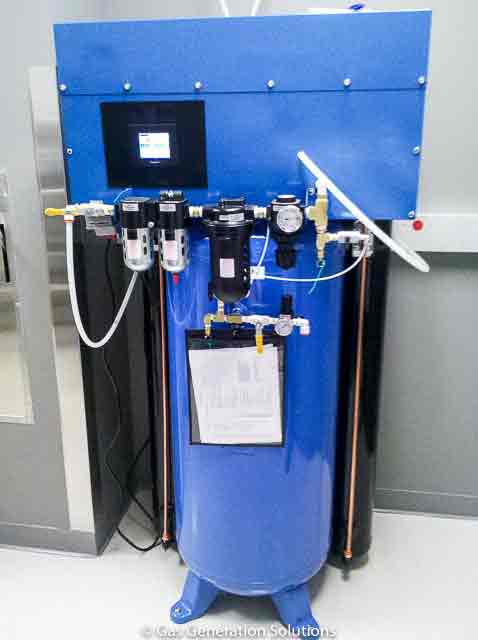
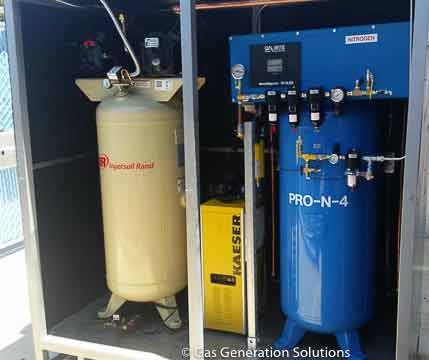
Lab nitrogen generator installations
Two on-site PSA nitrogen generator installations sized for analytical lab service. Both deliver lab-grade nitrogen at the instrument inlet on a continuous duty cycle.
What Clean Nitrogen Protects
Defects prevented by stable, in-spec lab nitrogen
The cost of a bad nitrogen day in an analytical lab is rarely the gas itself. It is the run that fails, the calibration that drifts, and the queue that backs up behind it. On-site nitrogen takes purity and supply continuity off the variability list.
Baseline drift and ghost peaks
Trace oxygen, moisture, or hydrocarbons in the support gas show up as elevated baseline noise, ghost peaks, and drifting retention times in the chromatogram. The instrument is fine; the gas is not.
Result: failed QC, repeated injections, lost analytical hours.
Detector noise and sensitivity loss
Mass spectrometers are most sensitive to gas-side contamination at low ion abundance. Even a brief excursion above the detector's purity spec degrades the signal-to-noise ratio on trace analytes the lab is being paid to detect.
Result: limit-of-detection slippage, customer reanalysis requests.
Collision-cell contamination
QTOF and triple-quad collision cells require nitrogen at 99.998% or better. Cell contamination from out-of-spec gas changes fragmentation efficiency and can require a vent, bake-out, or service call to recover.
Result: instrument downtime, service contract activity, lost runs.
Run interruption from cylinder change-out
A cylinder bank that empties mid-run kills the run. A late delivery cancels the next day's queue. Manual change-overs introduce air, water, and dust at the regulator. On-site PSA holds steady supply pressure on continuous duty.
Result: delayed reports, missed turnaround, lab schedule slip.
Purity by Use
Pick the lowest purity that meets the spec
Higher purity costs more compressed air per unit of nitrogen. The air-to-nitrogen ratio rises from about 2 SCFM of air per SCFM of nitrogen at 95% purity to about 6 SCFM at 99.9995%. The right number for the lab is the lowest purity each instrument family will accept, with the highest-purity tier reserved for the gas that actually needs it.
5% O2
QTOF drying gas, sample evaporation
Drying and nebulizer gas for QTOFs. Sample evaporators, blow-down stations. Lowest air consumption per SCFH of nitrogen.
1% O2
LC/MS curtain and source gas
Standard LC/MS curtain, drying, and nebulizer gas. The single largest tier of analytical lab nitrogen demand. Comfortable in any small or mid PSA cabinet.
20 ppm O2
QTOF and triple-quad collision cell
Collision cell gas for QTOF and triple quadrupole instruments. Low-flow, high-purity tier. Sized as a separate small high-purity feed alongside the main lab supply.
5 ppm O2
UHP / GCMS detector grade
UHP grade for GCMS detector support and other high-purity carrier-style applications. Highest air consumption per SCFH; rarely the right tier for a generator on a single GCMS.
PSA from compressed air
Pressure swing adsorption uses two carbon molecular sieve vessels. Compressed air enters under pressure; oxygen and water adsorb onto the sieve while nitrogen passes through. The vessels alternate so one is always producing while the other regenerates by venting to atmosphere.
No consumables in the gas path. The same generator, set up the same way, can run at 95% for drying gas one day and at 99.9% for routine analytical work the next.
Why not membrane for analytical labs
Hollow-fiber membrane generators top out around 99% to 99.5% purity at reasonable air consumption. They are excellent for tank blanketing and tire inflation. They are not the right tool for an LC/MS at 99.5% to 99.9% or a QTOF collision cell at 99.998%.
For analytical labs, PSA is the technology of record. The cost per SCFH of nitrogen is lower at lab purity tiers, and the headroom to step up to 99.998% or 99.9995% on the same machine is built in.
Sizing and Payback
From instrument inventory to right-sized cabinet
Lab sizing is straightforward when the instrument list is in front of you. Sum the per-instrument flows at each purity tier, add a buffer for sample prep and headspace work, and match to a generator that can hold spec at the highest tier any instrument needs. Three inputs drive the build, three drivers drive the payback, and a worked example below shows how a typical multi-instrument lab lands.
Sizing inputs
- 1. Instrument list with model numbers Every instrument that consumes nitrogen, with the OEM model number. QTOF flow swings 3x across model variants alone.
- 2. Per-instrument flow and purity Carrier, drying, source, and collision-cell flows broken out separately. The collision cell is low flow but high purity; the drying gas is high flow but low purity.
- 3. Sample prep and headspace allowance Blanket gas for sample tubes, evaporators, headspace samplers. Often missed on the first pass and worth 10 to 20 LPM in a working lab.
Payback drivers
- Cylinder and dewar spend, displaced Most analytical labs reduce nitrogen costs by up to 90% versus delivered cylinder or dewar gas. Removing rental, demurrage, and delivery line items often surprises the finance team more than the gas itself.
- Lost-run risk, removed An empty cylinder mid-run, a late delivery, or a cylinder change-over that introduces air all cost real lab time. On-site PSA holds steady supply pressure on continuous duty.
- Capital amortized over 20 years or more System service life is 20 years or more with routine filter changes. Cost per analytical run on year five through year fifteen is effectively the electricity bill on the compressor.
Worked example: typical multi-instrument lab
LC/MS
21 LPM @ 99%
QTOF (mid-range)
30 LPM @ 95%
Sample prep blanket
10 LPM @ 99%
Sized at 99%
~130 SCFH
Total demand is about 61 LPM, or roughly 130 SCFH when the system is set to hold 99% across the whole lab. That lands cleanly on a small-to-mid cabinet rated for about 130 SCFH at 99% on roughly 7 SCFM of compressed air at 100 to 119 PSIG inlet. The QTOF collision cell, if it needs 99.998% nitrogen, runs as a small high-purity feed sized separately.
Frequently Asked Questions
Lab nitrogen generator FAQ
Which mass-spec instruments are good fits for an on-site nitrogen generator?
LC/MS and QTOF are the bread-and-butter fits. An LC/MS pulls about 21 LPM of nitrogen at 99% purity at 100 PSIG. A QTOF pulls 18 to 60 LPM depending on model and source, with drying gas at 95% and collision cell gas at 99.998%. Both flow ranges sit comfortably in the small-to-mid PSA generator band, and both purity tiers are economical to produce on-site.
Is a GCMS a good candidate for a generator?
Usually no. A GCMS pulls roughly 50 mL/min per detector at 99.9995% UHP grade. A 300 cubic foot UHP cylinder at 2,200 PSIG drawn down to 100 PSIG holds enough gas at that flow to run for decades. Sizing a generator for a single GCMS means paying capital for a duty cycle that is almost entirely standby. The honest recommendation for a GCMS-only lab is a UHP cylinder; a generator pays back when there is also an LC/MS or a QTOF in the lab.
What nitrogen purity does an LC/MS need?
99% or better is the standard LC/MS curtain, drying, and nebulizer gas spec. Some site-prep documents call for 99.5%; some labs run a touch higher for sensitivity. A PSA generator running at 99% to 99.9% covers the LC/MS line in any small or mid cabinet, with the air-to-nitrogen ratio comfortably below 4 SCFM of compressed air per SCFM of nitrogen.
What nitrogen purity does a QTOF need?
A QTOF needs two purity tiers, sized separately. Drying gas and source gas run at 95% or better and account for most of the QTOF flow. The collision cell runs at 99.998%, but at much lower flow. The right design feeds the bulk drying load from a low-purity, high-flow leg of the system, and the collision cell from a small high-purity feed taken off the same generator or a smaller dedicated cabinet.
Can one generator feed multiple instruments?
Yes. Most analytical labs with two or more instruments run a single generator at the highest purity any instrument needs, with a buffer tank to hold steady supply pressure under simultaneous demand. The only common exception is when a lab has a dedicated GCMS that needs UHP grade and an LC/MS line that only needs 99%; running the generator at UHP for the LC/MS wastes air, so a small UHP cylinder for the GCMS plus a 99% generator for everything else is often the cleaner answer.
Do you supply LN2 generators for cryostorage and live cultures?
Yes, but liquid nitrogen comes from a different machine than the gaseous PSA generator on this page. On-site LN2 generators handle cryopreservation, vapor-phase storage, sample cooling, and live-culture work. Sizing is based on the lab's daily liquid-nitrogen usage from current dewar or bulk delivery records. See the dedicated LN2 page for the full lineup and sizing guide.
Do you supply hydrogen generators for chromatography carrier gas?
No. Gas Generation Solutions supplies on-site nitrogen and oxygen generators. Some chromatography users run hydrogen as a carrier gas in place of helium, but on-site hydrogen generation is a separate technology family. Labs needing carrier-gas hydrogen typically work with a dedicated hydrogen generator vendor; a nitrogen generator from us covers the support, drying, and source gases on the same instrument.
How long does payback take on a lab nitrogen generator?
Typical payback is 12 to 14 months for a multi-instrument analytical lab on delivered nitrogen. Most customers reduce nitrogen costs by up to 90% compared to cylinder or dewar gas once rental, demurrage, and delivery line items are included. Systems are engineered to run for 20 years or more, so the cost per analytical run on year five through year fifteen is essentially the electricity bill on the upstream compressor.
Send the instrument list and we will size it
Send a list of every instrument that uses nitrogen with model numbers, the per-instrument flow and purity from each site-prep document, and a note on whether the lab does sample prep or headspace work that pulls extra nitrogen. With that, we will recommend the right cabinet size, the right purity setting, and the right buffer tank for steady supply pressure.
Request a quote →On-site nitrogen for aerospace, pharmaceutical, food and beverage, electronics, and industrial manufacturing customers across the United States, Mexico, and Canada. Up to 90% lower nitrogen cost than delivered gas. Payback in 12 to 14 months. Service life of 20 years or more.